
The solo business model is booming. But most solo founders are still making the same avoidable mistakes. Here are the 11 lessons the best ones have already learned.
Discover 11 battle-tested lessons for building a stronger solo business in 2026. From validation to AI leverage, unit economics to distribution — what actually works for solopreneurs today.
Introduction: Building has never been easier. Knowing what to build has never mattered more.
Something significant has shifted in the economics of starting a business.
A decade ago, launching a product required capital, a team, months of development, and a significant tolerance for risk. Today, a solo founder with a laptop and a $300 monthly software stack can build, launch, and iterate faster than a five-person startup from 2015.
But here is the problem with that. When building gets easier, more people build. When more people build, the market fills faster. When the market fills faster, the advantage shifts away from whoever can build quickest and toward whoever understands the customer most deeply.
In 2026, the scarce resource is not the ability to build. It is knowing what to build, for whom, and in what order.
This article distills 11 lessons from a LinkedIn discussion that generated unusually strong signal from experienced solo founders and operators. The underlying principle behind all of them is the same: reduce risk first. Add complexity only when demand earns it.
The numbers behind the solo boom
- According to FutureWarns’ 2026 solo business analysis, 74% of solopreneurs now actively use AI in their business, and 64% say their business would not have grown without it. A complete AI solopreneur tech stack now costs $3,000 to $12,000 per year compared to $400,000 to $1,000,000 for a traditional team.
- According to LonelyEntrepreneur’s 2026 analysis, over 117,000 one-person businesses crossed $1 million in revenue with zero employees, and solo business applications are up 27% year on year.
- According to AutoFaceless, 77% of solopreneurs are profitable in their first year, with one in five earning between $100,000 and $300,000 annually, and a record 94% projecting business growth in 2026.
The solo economy is not a niche experiment. It is becoming the default structure for a growing share of new business creation.
The sequence that changes everything
Before the 11 lessons, one framework deserves its own moment. It emerged from the LinkedIn discussion, and it reframes everything that follows.
Problem, validation, simple offer, demand, distribution, monetization, leverage.
That sequence is not a list of things to do eventually. It is a capital-allocation and risk-reduction model. Each stage must produce evidence before the founder earns the right to invest in the next one. Skipping stages does not accelerate growth. It accelerates the discovery of failure, usually at considerable cost.
Most solo founders violate this sequence in the same place: they jump from problem to build, skipping validation entirely. In 2026, that mistake is more forgivable because building is cheap. It is also more common because of exactly the same reason.
11 lessons for building a stronger solo business in 2026
1. Validate before building
Talk to at least 10 potential customers before investing heavily in a product. Not a survey. An actual conversation, recorded and reviewed. The goal is not to confirm your idea. It is to discover whether the problem is real, frequent, and painful enough for someone to pay to have it solved. Customer evidence should precede significant product investment, every time.
2. Get the sequence right
Problem, validation, simple offer, demand, distribution, monetization, leverage. This is the order. Not all at once. Not in parallel. Each stage earns the right to invest in the next. A solo business that tries to build distribution before validating demand is spending time it cannot recover.
3. Focus. Say no more often
In a solo business, the scarce resource is founder attention, not ideas. The ideas will keep coming. Attention is finite and non-renewable. Every new initiative competes with every existing one for the same limited hours. Build a stop list alongside your to-do list. Learn to distinguish signal from noise. The businesses that compound are the ones that do fewer things for longer.
4. Use AI for leverage, not as a substitute for judgment
AI adoption among solopreneurs has reached 74% in 2026. But the most important distinction is what AI is being used for. Automating context, repetition, and operations is leverage. Using AI to make decisions about what to build, who to sell to, or what the market wants is delegation of the one thing a founder cannot afford to outsource.
As building becomes cheaper, the advantage shifts toward understanding the customer and the problem. AI expands what you can produce. It does not tell you what is worth producing.
5. Make the offer specific
A clear outcome plus proof plus price beats a broad description of capabilities every time. Specific offers convert because they make the decision easy. The buyer can immediately assess whether the outcome matches their situation. Vague offers require the buyer to do extra work to figure out whether they qualify, and most will not bother.
Sell the transition, not the service. Not “copywriting” but “a landing page that converts cold traffic to email subscribers.” Not “consulting” but “a 90-day plan that gets your first 10 paying customers.”
As Will McTighe put it in the discussion: “Validating demand early can save founders months of building something nobody needs.“ A simple offer tested with real customer feedback gives more clarity than months of preparation ever will.
6. Build systems that make you progressively less essential
A solo business that depends entirely on the founder’s daily involvement is not a business. It is a job with extra steps. The goal is to build systems, processes, and reusable intellectual property that deliver value without requiring the founder to be present for every interaction.
Think in repeatable processes: product delivery, sales, marketing, customer communication, inbound lead handling. Each one that gets systematized frees attention for higher-value work.
7. Run small experiments before building big things
A checklist, a consultation, a prototype, a manual service, or a simple email course can test demand before a full product is built. The experiment does not need to be the finished product. It needs to answer one question: will people pay for this outcome?
If the answer is no at the experiment stage, the cost of that discovery is low. If the answer is no after six months of building, the cost is your six months.
8. Build distribution before you need it
A great product without a way to reach customers is not a business. It is an inventory problem. Distribution is a core part of marketing strategy, not separate from it. In the classic marketing mix, it is the Place in the 4Ps: the deliberate choice of which channels, platforms, and ecosystems carry your product to the right customer at the right moment.
For solo founders, distribution usually means one of: a personal brand built through consistent content, a network that generates referrals, an SEO presence that captures search demand, or a marketplace that provides built-in traffic. Concrete examples include Amazon for physical or digital products, the App Store or Google Play for software, Etsy for creative goods, LinkedIn for B2B services, and Upwork or Fiverr for freelance work. Each of these platforms hands you an existing audience in exchange for a share of the transaction. Understanding that tradeoff is part of the distribution decision.
The best time to build distribution is before you have something to sell. The second best time is now.
9. Diversify your dependencies
Dependence on a single client, product, channel, or platform is fragile in direct proportion to how much it contributes to total revenue. The founder who earns 80% of revenue from one client is one relationship away from a cash flow crisis.
After establishing what works, use the Pareto principle deliberately: identify the 20% of customers, products, or channels generating 80% of value, then build toward replicating and expanding that segment rather than servicing everything equally.

10. Build relationships. Solo does not mean isolated
The loneliness of running a solo business is real and underestimated. More practically, relationships provide what organizational scale provides in larger companies: second opinions, market intelligence, referrals, accountability, and the occasional collaboration that neither party could achieve alone.
Connect with other founders at a similar stage. Attend industry events. Join communities built around your market or method. The relationships that compound most are the ones built before you need something from them.
11. Apply unit economics from day one
This is the lesson most conspicuously absent from the typical solopreneur conversation, and it is arguably the most important one.
A validated problem is not automatically a good business. To assess whether a solo business is worth building, you need to understand the full equation:
Pain x willingness to pay x reachable customers x margin x repeatability x retention, divided by founder dependency.
A problem can be real and validated but still produce a terrible solo business because acquisition is too expensive, customers require excessive support, revenue is project-based and does not repeat, or delivery cannot be separated from the founder’s direct involvement.
Learn the metrics that matter: Customer Acquisition Cost (CAC), Customer Lifetime Value (CLTV), gross margin, monthly recurring revenue (MRR), churn rate, and cash flow. Understand what a customer is worth. Know what it costs to acquire one. Know when spending one euro reliably returns more than one euro. This is not complexity. It is the foundation that every other lesson builds on.
The solo business validation gate
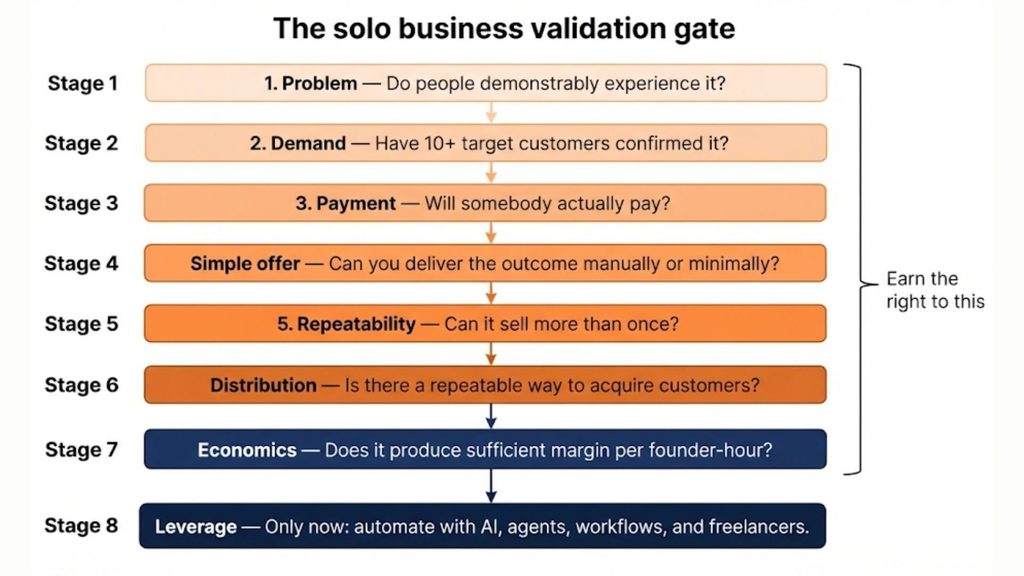
The ordering of the validation gate matters as much as the gate itself. AI, automation, and infrastructure belong at the bottom, not the top. The most common mistake is inverting the gate: building leverage before establishing what is worth leveraging.
Stop adding infrastructure until demand earns the next layer.
The insight the LinkedIn feed mostly missed
The discussion generated strong agreement around validation, sequence, and focus. What it almost entirely skipped was unit economics.
A validated problem is necessary but not sufficient. You still need to assess whether the business is worth building even if demand exists. The formula is not comfortable, but it is honest:
Pain x willingness to pay x reachable customers x margin x repeatability x retention, divided by founder dependency.
Each variable in that formula is worth interrogating before investing seriously. A high score on the first three with a low score on margin and repeatability is still a difficult business. A high score across all six with a high founder dependency score is a job, not a business.
Quote:
“Problem, validation, simple offer, demand, distribution, monetization, leverage.”
— Asif Hossain
Final thoughts: Add complexity only when demand earns it
The solo business model in 2026 is genuinely exciting. The tools available, the reduction in startup costs, the AI leverage, the global distribution platforms, the conditions for building a profitable one-person business have never been better.
But better conditions do not guarantee better outcomes. The founders who will win are not the ones who build fastest. They are the ones who validate earliest, systematize most deliberately, and add complexity only after demand has earned it.
Start with the problem. Talk to ten people. Get one person to pay. Then build.
Your next step:
If you are building a solo business and want to make sure the foundations are in place before you invest further, the Business Plan Template from excellentbusinessplans.com gives you a structured framework to define your customer, validate your offer, and map your financial assumptions in one place. And if you are in the early stages and need a practical launch checklist, the Startup Checklist Template walks you through every critical step before you commit serious time or money.
Frequently asked questions (FAQ)
1. What is a solopreneur?
A solopreneur is a business owner who builds and runs their business independently, without full-time employees. They typically leverage software, AI tools, freelancers, and systems to scale output beyond what a single person could achieve manually. In 2026, there are approximately 29.8 million solopreneurs in the US alone.
2. What is the biggest mistake solo founders make in 2026?
Building before validating. With AI making production cheaper and faster, the temptation to build first and find customers later is stronger than ever. The problem is that cheaper building does not change the economics of demand. A product nobody wants is still a product nobody wants, regardless of how quickly or cheaply it was built.
3. How does AI fit into a solo business strategy?
AI is most valuable as leverage: automating repetitive tasks, generating first drafts, handling customer queries, and running operations that do not require human judgment. It is not a substitute for understanding the customer, validating the problem, or deciding what is worth building. Use AI after establishing what creates value, not before.
4. What is the right sequence for building a solo business?
Problem, validation, simple offer, demand, distribution, monetization, leverage. Each stage must produce evidence before investing in the next. Skipping stages, especially validation, is the most reliable way to spend significant time and money discovering that the market does not care.
5. What are unit economics and why do they matter for solo businesses?
Unit economics describe the financial performance of a single unit of your business: one customer, one transaction, one subscription. The key metrics are Customer Acquisition Cost (CAC), Customer Lifetime Value (CLTV), gross margin, and churn rate. Understanding these tells you whether the business is worth scaling. A validated problem with poor unit economics is still a poor business.
6. How do solo founders build distribution without a marketing team?
The most sustainable solo distribution channels are personal brand content that attracts inbound interest, SEO that captures search demand, referral networks built through relationships, and marketplace or platform presence that provides built-in traffic. The key is to pick one and build it consistently before spreading across several.
References
- AutoFaceless Blog. (2026). Solopreneur Statistics 2026: 29.8 Million Solo Businesses, $1.7 Trillion Revenue and AI-Driven Growth. https://autofaceless.ai/blog/solopreneur-statistics-2026
- FutureWarns. (2026). One-Person Businesses Using AI: 2026. https://futurewarns.com/one-person-businesses-using-ai-2026/
- LonelyEntrepreneur. (2026). The Million-Dollar Solo: Why the One-Person Business Just Became the Most Ambitious Bet in America. https://lonelyentrepreneur.com/million-dollar-one-person-business/
- Solo Business Hub. (2026). Solopreneur Statistics 2026: Market Size and AI Impact. https://www.solobusinesshub.com/solo-business-statistics/
- Futurist Speaker. (2026). The Rise of the One-Person Company. https://futuristspeaker.com/business-trends/the-rise-of-the-one-person-company/
- Grey Journal. (2026). Beginner’s Guide to Building a One-Person Business in 2026. https://greyjournal.net/hustle/grow/beginners-guide-to-building-a-one-person-business-in-2025/