

That consistently brings in new customers
Most small businesses rely on word of mouth to attract new customers. A sales lead pipeline replaces both with a system that works even when you are not in the room.
Learn how to build a sales lead pipeline step by step. A practical guide for small business owners on generating, qualifying, nurturing, and converting leads into loyal customers.
Introduction
Ask most small business owners where their next customer is coming from and the honest answer is usually the same. Someone will refer them. A past client will come back. Something will turn up.
That is not a sales strategy. That is hope. And hope is not a reliable revenue model.
The businesses that grow consistently are not the ones that get lucky with referrals. They are the ones who have built a system for finding the right people, starting the right conversations, and moving those people steadily toward a decision. That system is called a sales lead pipeline, and it is one of the most valuable things a small business owner can build.
A pipeline does not replace relationship-based selling. It structures it. It gives you visibility into every potential customer at every stage of their journey so you always know who to contact, what to say, and what to do next.
This guide walks you through exactly how to build one from scratch, stage by stage, so your business never has to rely on hope again.
Business Facts
- According to industry research from Verified Metrics, 67% of sales are lost because sales reps failed to properly qualify their leads before pursuing them. At the same time, 61% of salespeople say lead qualification is their single biggest challenge. Building a pipeline with a clear qualification stage eliminates both problems before they cost you revenue.
- A Harvard study confirmed that, in 2024, HubSpot data found that responding to a new lead within five minutes makes you 21 times more likely to qualify that lead compared to waiting just 30 minutes. Speed of response is one of the highest-leverage actions in any sales pipeline.
- According to research compiled from First Page Sage, HubSpot, and Ruler Analytics, the average B2B sales funnel converts just 2.3% of website visitors into leads, and most funnels lose over 90% of those leads before they ever reach the opportunity stage. A structured pipeline is what prevents that loss from happening silently.
Why It Matters: What Happens When You Have No Pipeline
When a small business has no structured pipeline, three things happen consistently.
First, revenue becomes unpredictable. Some months are strong because a few good referrals came in. Other months are quiet for no clear reason. Without a pipeline, there is no early warning system for a slow month ahead. By the time you notice the problem, it is already too late to fix it quickly.
Second, the best leads go cold. A potential customer expresses interest and then nothing happens for two weeks because the business owner was busy. By the time they follow up, the lead has moved on to a competitor who responded faster and followed up more consistently.
Third, growth becomes reactive rather than intentional. The business grows when circumstances are favorable and stalls when they are not. There is no lever to pull when revenue needs to increase because there is no system generating new opportunities on demand.
A structured sales pipeline fixes all three problems. It gives you predictability, speed, and control over the single most important number in your business: how many new customers are coming in.
What Is a Sales Lead Pipeline?
A sales lead pipeline is a visual, structured system that tracks every potential customer from the moment they first become aware of your business to the moment they make a purchase and beyond.
It is not a contact list. A contact list tells you who exists. A pipeline tells you where each person is in their journey toward becoming your customer, what they need next, and what action you should take to move them forward.
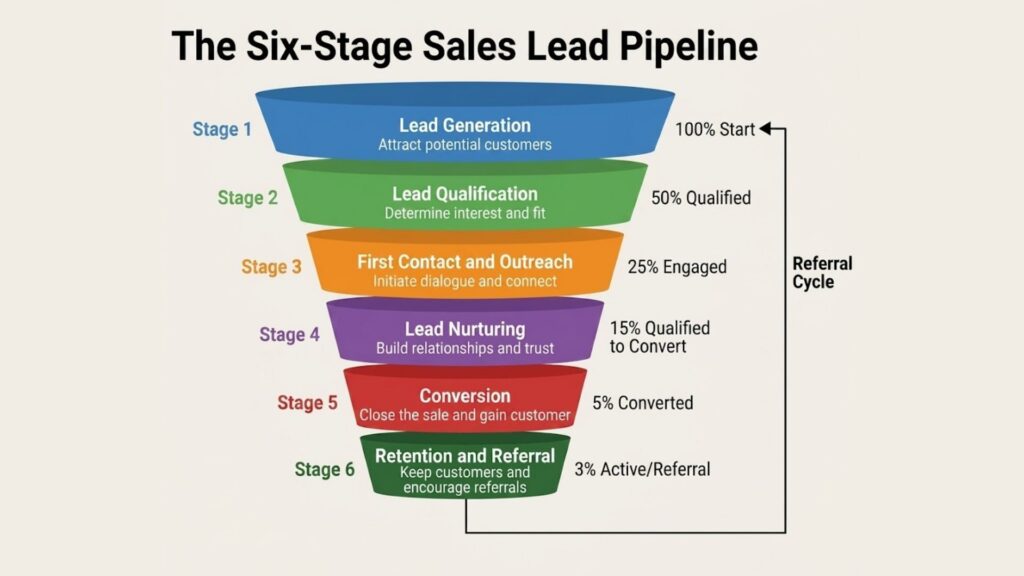
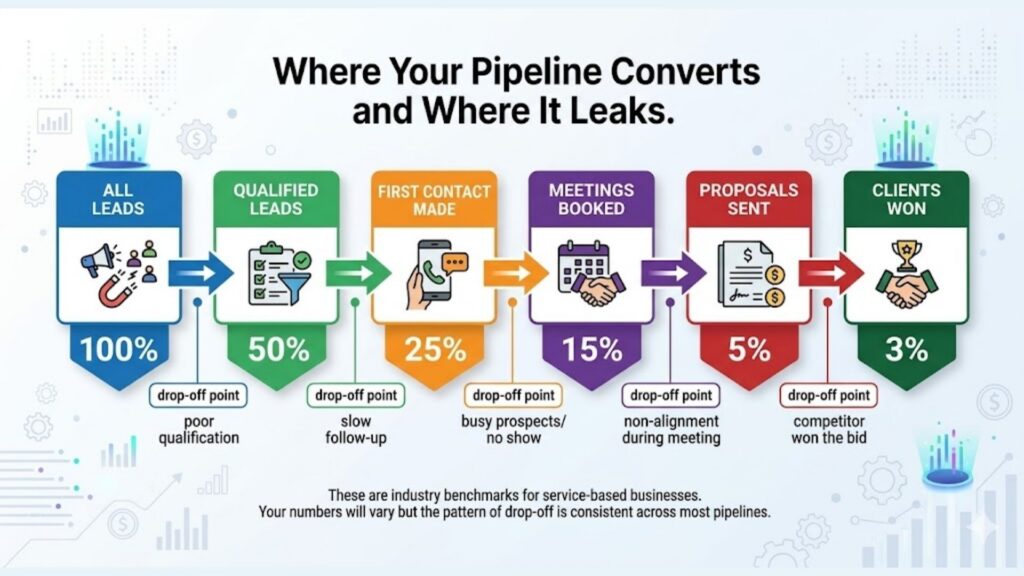
Think of it as a series of stages. At the top, you have the widest part where the largest number of potential customers enter. As they move through each stage, some drop out, and others progress. At the bottom, you have the narrowest part where leads become paying customers. The goal is not to force everyone through. The goal is to move the right people through efficiently and to understand exactly where and why others leave.
A healthy pipeline has leads at every stage simultaneously. That is what creates consistent, predictable revenue rather than the feast and famine cycle that most small businesses experience.
Stage 1: Lead Generation: Finding the Right People
Lead generation is the process of identifying and attracting people who have a genuine potential interest in what your business offers. It is the top of your pipeline and the engine that keeps everything else moving.
The most common mistake at this stage is prioritizing volume over quality. Filling your pipeline with the wrong people wastes time at every subsequent stage and produces a low conversion rate that has nothing to do with the quality of your product or service.
Before generating a single lead, define your ideal customer precisely. Use the Customer Persona Template to capture not just their demographic profile but their full situation and jobs to be done. What problem are they experiencing right now that your business solves? What have they already tried? What does a successful outcome look like for them? The more specifically you can answer these questions, the more targeted and efficient your lead generation becomes.
The most effective lead generation channels for small businesses:
Content marketing attracts leads who are actively searching for answers to the problems your business solves. A well-written blog post, a practical guide, or a useful video that ranks on Google can bring in qualified leads consistently without ongoing advertising spend.
Referrals remain the highest-converting lead source for most small businesses. A referred lead arrives with built-in trust that takes months of marketing to replicate organically. Building a deliberate referral system, asking satisfied customers for introductions, creates a self-reinforcing pipeline that costs almost nothing to run.
Social media and LinkedIn outreach, when targeted correctly, allow you to start conversations with potential customers who match your ideal profile before they have actively started searching for a solution. This outbound approach works best when the message is specific, relevant, and genuinely useful rather than generic and promotional.
Networking and events put you in front of potential customers in a context where trust is built faster. For service-based businesses in particular, in-person and virtual networking remains one of the most cost-effective lead generation methods available.
Email marketing to an existing list of subscribers, past customers, and warm contacts is one of the most underutilized lead generation tools in small businesses. People who have already raised their hand by subscribing to your list are warmer than any cold lead you will ever generate through advertising.
Stage 2: Lead Qualification: Separating the Right Leads From the Wrong Ones
Lead qualification is the process of assessing whether a new lead is genuinely a good fit for your business before investing significant time and energy in pursuing them. It is the stage that most small businesses skip and the reason most sales pipelines leak.
As the research shows, 67% of lost sales can be traced back to leads that were never properly qualified in the first place. Qualification is not about being selective for its own sake. It is about protecting your most valuable resource, your time, and directing it toward the opportunities most likely to convert.
A simple qualification framework for small businesses covers four questions. Does this person or business have the problem your product or service solves? Do they have the budget or willingness to pay for a solution? Do they have the authority to make a purchasing decision, or are they an influencer? And is the timing right, meaning are they actively looking for a solution now, or is this a future consideration?
Leads that score well on all four questions move forward in your pipeline as high-priority opportunities. Leads that score poorly on one or two questions move to a nurturing track where you stay in contact until their situation changes. Leads that score poorly across all four are removed from active pursuit, freeing up your time for better opportunities.
Stage 3: First Contact and Outreach: Starting the Right Conversation
The first contact with a qualified lead sets the tone for everything that follows. It is not a sales pitch. It is an opening of a conversation that is genuinely about the lead’s situation, not about your product. When that conversation leads to a new client, download the Client Intake Checklist from Excellent Business Plans gives you a complete framework to capture every critical detail before work begins.
The single most important factor at this stage is speed. Responding to an inbound lead within five minutes makes you 21 times more likely to qualify that lead than waiting 30 minutes. For most small businesses, this means building a simple system that alerts you the moment a new lead comes in, whether through a contact form, an email inquiry, or a social media message, so you can respond immediately.
Always research the lead before reaching out. A specific, relevant message will always outperform a generic template.
And if you are wondering whether a follow-up after no reply feels pushy, it rarely does. Most non-responses are not rejections. They are busy people. A polite, direct second message is almost always welcome.
The goal of first contact is not to close a sale. It is to open a conversation and earn the right to the next step, whether that is a discovery call, a meeting, or simply a reply.
Stage 4: Lead Nurturing: Building Trust Over Time
Most leads are not ready to buy the first time they hear from you. Research consistently shows that the majority of B2B purchases involve multiple touchpoints over weeks or months before a decision is made. Lead nurturing is the process of staying in contact with qualified leads during that period in a way that builds trust, demonstrates value, and keeps your business top of mind.
Effective nurturing is not following up to ask if they are ready to buy yet. That is the fastest way to irritate a potential customer. Effective nurturing is delivering consistent value. Useful content, relevant industry insights, case studies, or event invitations that deliver genuine value at every touchpoint.
The key is consistency over time. One strong email followed by three weeks of silence is not a nurturing system. A consistent, structured cadence of relevant touchpoints every one to two weeks is.
For small businesses without a dedicated sales team, a simple email sequence built once and automated through a basic CRM or email marketing tool does the work of staying in contact without requiring daily manual effort.
As your pipeline grows, a few simple tools make the process significantly easier to manage. Lead scoring, available in most basic CRM platforms, assigns a value to each lead based on their engagement level so you always know who deserves your attention first. Automated pipeline reminders ensure no lead goes uncontacted beyond your set follow-up window. Deal velocity tracking shows you how quickly leads are moving through each stage so you can spot slowdowns before they affect your revenue. None of these requires expensive enterprise software. HubSpot’s free tier, Pipedrive, and Zoho CRM. all offer these features at a price point accessible to any small business.
Stage 5: Conversion: Turning Leads Into Customers
Conversion is the stage where a nurtured, qualified lead makes the decision to buy. By this point, if the previous stages have been executed well, the conversion should feel like the natural next step rather than a hard close.
The most common conversion blockers at this stage are not price or product quality. They are uncertainty and friction. The lead is not yet fully confident that your solution is the right fit. Or the process of actually buying is complicated, slow, or unclear.
Address uncertainty by making your offer as specific and concrete as possible. What exactly does the customer get? What does the process look like from their perspective? What results can they realistically expect? What happens if it does not work out? Answering these questions clearly removes the hesitation that stops qualified leads from taking the final step.
Reduce friction by making it as easy as possible to say yes. A clear, simple proposal. A straightforward contract. An obvious next step. A fast response time. Every additional complication between a lead deciding to buy and actually completing the purchase is an opportunity for doubt to creep in. And if a lead goes quiet after showing strong interest, follow up directly. Most silences are not rejections. They are busy people.

Stage 6: Retention and Referral: How Happy Customers Become Your Strongest Sales Asset
The most underused stage of any sales pipeline is the one that comes after the sale. A customer who has had a genuinely positive experience with your business is not just a source of repeat revenue. They are one of the most powerful lead generation tools you have.
A deliberate retention and referral system turns your existing customers into advocates who bring new leads into the top of your pipeline. Ask satisfied customers for referrals at the moment of highest satisfaction, which is typically immediately after they have experienced the first strong result from working with you. Make it easy for them to refer by giving them specific, simple language to describe what you do and who you help.
Build a simple check-in process for existing customers. A brief call or email at 30, 90, and 180 days after purchase not only identifies and resolves any issues before they become problems but also uncovers new opportunities to serve the same customer again.
The best sales pipelines are circular, not linear. The customer who enters at Stage 6 becomes the referral that starts a new lead at Stage 1, creating a self-sustaining system that grows stronger the more customers pass through it.
What a Working Pipeline Looks Like in Practice
Here is a simple example of how all six stages work together for a real small business.
Imagine a freelance accountant targeting self-employed consultants in her city. Here is how her pipeline works month to month.
Lead Generation: She publishes one LinkedIn article per week, answering common tax questions her ideal clients ask. She also attends one local business networking event per month. Together, these two channels bring in roughly 15 to 20 new leads per month.
Qualification: She applies a simple four-question checklist to every new lead. Are they self-employed? Do they have an annual revenue above $50,000? Are they the ones making financial decisions? Are they currently unhappy with their existing accountant or have none at all? Leads that answer yes to all four move forward. Others go into a low-touch nurturing list.
First Contact: Every qualified lead gets a personalized LinkedIn message or email within the same day they are identified. The message references something specific about their situation and asks one focused question rather than pitching her services immediately.
Nurturing: Leads who are not ready to book a call receive a fortnightly email with one practical tax tip relevant to consultants. No selling. Just consistent, useful value that keeps her top of mind.
Conversion: When a lead expresses interest in working together, she sends a one-page proposal within 24 hours outlining exactly what she does, what it costs, and what the onboarding process looks like. She follows up twice if she does not hear back.
Retention and Referral: Three months after each new client starts, she sends a brief check-in message asking how things are going and whether they know anyone else who might benefit from her services. Roughly one in three clients refer at least one new lead within their first year.
The result: from 15 to 20 monthly leads, she qualifies roughly eight, converts two to three into paying clients, and generates one additional referral lead per month. That is a consistent, predictable $3,000 to $5,000 in new monthly revenue from a pipeline she built once and maintains in under two hours per week.
How to Measure Your Pipeline Health
A pipeline you cannot measure is a pipeline you cannot improve. These five metrics tell you everything you need to know about the health of your lead pipeline:
Number of active leads: Is your lead generation working? A declining number here needs attention before anything else.
Conversion rate at each stage: Where exactly are leads dropping out? A low rate from qualification to outreach means your criteria need tightening. A low rate from nurturing to conversion means your offer or follow-up needs work.
Average time in pipeline: How long does a lead take to move from first contact to customer? Longer-than-expected cycle times usually indicate a nurturing or follow-up problem.
Pipeline value: What is the total potential revenue across all active stages? Multiplied by your average conversion rate, this gives you a realistic revenue forecast for the weeks ahead.
Win rate: What percentage of qualified leads convert into customers? Improving this by even five percentage points delivers a significant revenue impact without generating a single new lead.
If your pipeline metrics are consistently falling short and your team is stretched too thin to manage lead generation and follow-up effectively, it may be time to bring in dedicated sales support. Read our guide on How to Hire a Remote Sales Rep to Accelerate Startup Growth and find out how to build the sales capacity your pipeline needs.
Comparison Table
| Pipeline Health Indicator | Weak Pipeline | Strong Pipeline | Example Numbers to Target |
| Lead Volume | Irregular and unpredictable | Consistent flow at every stage | 20 to 50 new leads per month, depending on industry |
| Lead Quality | Mixed, many unqualified | Screened and qualified before pursuing | 40% to 60% of leads pass qualification |
| Response Time | Hours or days | Within 5 minutes for inbound leads | Under 5 minutes for inbound, same day for outbound |
| Follow-up Consistency | Sporadic and reactive | Structured cadence every 1 to 2 weeks | Minimum 6 touchpoints per qualified lead |
| Conversion Rate | Below 10% of qualified leads | 20% to 30% of well-qualified leads in service businesses | 1 in 4 to 1 in 5 qualified leads convert |
| Revenue Predictability | Feast or famine cycle | Consistent and forecastable | 3-month rolling forecast within 15% accuracy |
| Referral System | Absent or accidental | Deliberate and systematic | 1 referral per 3 satisfied clients per quarter |
Quote
“Sales are contingent upon the attitude of the salesman, not the attitude of the prospect.”
– W. Clement Stone, (Businessman and Philanthropist)
Final Thoughts
A sales lead pipeline is not a luxury for large businesses with dedicated sales teams. It is the foundation of any small business that wants to grow consistently, predictably, and without relying on luck or circumstance.
You do not need expensive software or a complex system to get started. You need a clear definition of your ideal customer, a consistent process for finding and qualifying them, and the discipline to follow up with genuine value at every stage.
The businesses that build and maintain a healthy pipeline do not just get more customers. They get better customers, serve them more effectively, and grow in a way that is sustainable because it is systematic.
Start small. Pick one lead generation channel. Build a simple qualification checklist. Set up a basic follow-up schedule. Measure your conversion rate. Improve one stage at a time.
A pipeline works best when it sits inside a broader business growth strategy. Knowing who your ideal customer is, how you create value for them, and how your finances support your growth ambitions gives your pipeline the strategic context it needs to deliver consistent results.
Ready to build that foundation? Download the Business Plan Template from Excellent Business Plans and put the complete strategic framework in place around your pipeline today.
Next Steps: Start Building Your Pipeline This Week
You do not need to build everything at once. Start here:
- Write a one-paragraph description of your ideal customer, including their problem, budget, and decision-making authority
- Download the Customer Persona Template and build your ideal customer profile before your pipeline goes live
- Create a simple four-question qualification checklist and apply it to every new lead before investing significant time
- Set up a response system that alerts you to new inbound leads so you can reply within five minutes
- Build a simple six-touch nurturing sequence that delivers genuine value at each contact point
- Ask your three most satisfied current customers for one specific referral this week
A pipeline is not built in a day. It is built one consistent action at a time.
FAQs
1. Do I need a CRM to build a sales pipeline? No. A simple spreadsheet tracking leads, their stage, and last contact date is enough to start. As volume grows, tools like HubSpot’s free tier, Pipedrive, or Zoho CRM make management easier. But the system always matters more than the software.
2. How many leads do I need in my pipeline at any one time? It depends on your conversion rate and revenue target. If you close 20% of qualified leads and need ten new customers per month, you need at least 50 active leads. Work backward from your revenue goal to find your number.
3. How long does it take to build a healthy pipeline? Most small businesses see consistent lead flow within three to six months. The first month focuses on defining your ideal customer and establishing channels. Months two and three are for qualifying and nurturing. By months four to six, conversions should start flowing regularly.
4. What is the difference between a sales pipeline and a sales funnel? A sales funnel describes the customer journey from the buyer’s perspective. A sales pipeline tracks the same journey from the seller’s perspective through specific stages. Both are useful, but the pipeline is what you actively manage every day.
5. How do I stop leads from going cold in my pipeline? Set a specific follow-up date for every lead and stick to it. Never let a lead go more than two weeks without a touchpoint. When you follow up, always lead with value, not just a check-in asking if they are ready to buy.
6. Should I focus more on generating new leads or converting existing ones? For most small businesses, improving the conversion of existing leads is faster and cheaper than generating new ones. Audit your pipeline first. Where are leads dropping out? Are follow-ups consistent? Fixing a leaky pipeline always produces better returns than filling it with more water.
References
- Verified Metrics: Sales Pipeline Metrics You Should Track: https://verifiedmetrics.com/blog/sales-pipeline-metrics-you-should-track-to-improve-your-sales-conversion-rates
- Harvard Study via HubSpot 2024: Speed to Lead Research: https://blog.hubspot.com/sales/the-short-life-of-online-sales-leads
- SERPSculpt: B2B Sales Conversion Rate by Industry 2025: https://serpsculpt.com/reports/b2b-sales-conversion-rate-by-industry/
- First Page Sage: Sales Funnel Conversion Rate Benchmarks 2026: https://firstpagesage.com/seo-blog/sales-funnel-conversion-rate-benchmarks-2025-report/
- Ruler Analytics: Average Conversion Rate by Industry 2025: https://www.ruleranalytics.com/blog/insight/conversion-rate-by-industry/
- Salesforce: What Is a Sales Conversion Rate and How Is It Measured: https://www.salesforce.com/sales/analytics/sales-conversion-rate/