



A new Dutch study suggests the biggest barrier to AI for small businesses is not skill. It is keeping up with how fast the technology changes.
Learn what a Dutch study found about small business owners and AI: why using AI feels easy, but keeping up with it does not, and what can help.
The more AI is used, the less certain it feels
A Dutch bachelor thesis found a result that sounds backwards. Among 59 small business leaders in the province of Zuid-Holland, those who used AI more often found it easier to understand and use. They also felt less sure about where the technology was heading.
The study, written by Martijn Penning at Erasmus University College in 2026, points to a simple idea. For these leaders, being ready for AI is less about knowing how to use it. It is more about knowing what to follow, what to ignore, and what matters for the business while AI keeps changing.
What is AI readiness?
AI readiness describes how prepared a person or a business is to understand, judge and use AI. In large companies, readiness is shared across IT, innovation and management teams. In a small business, there is usually no such team. The owner makes the decisions, so the owner’s readiness is effectively the firm’s readiness.
What the data says about small firms and AI
- According to the CBS AI-monitor 2024, 59.2% of Dutch firms with 500 or more employees used AI technology in 2024, compared with only 17.8% of firms with 10 to 19 employees.
- Eurostat reports that 19.95% of EU enterprises with 10 or more employees used AI in 2025, up from 13.5% in 2024. Among small enterprises, the share was 17%.
- Of Dutch firms that considered AI in 2024 and decided against it, 75% cited a lack of experience as the main reason, according to a CBS summary.
- A 2026 survey of more than 1,700 Dutch SME owners and managers found that about seven in ten now use AI, up from 6% in 2024. Yet half say they are unsure how to use it well, according to the Exact MKB Barometer 2026. Because this survey counts any use of AI tools, its figures are not directly comparable with the CBS and Eurostat numbers.
Together, these numbers show a pattern. More small firms are starting to use AI, yet many still feel unsure how to make it work for them. The thesis looks at why.
Why the owner’s confidence matters
Small firms rarely have a specialist who tracks new technology. The thesis notes, drawing on earlier research, that small business innovation depends strongly on the owner’s ability to spot opportunities, make decisions, and turn plans into action. That owner is also running sales, staff, and finances.
This means every AI decision lands on one person. If that person feels unsure, the whole business waits.
A small example
Picture a café owner trying to decide whether an AI tool is worth the switch. She already uses AI daily to draft supplier emails and social posts, so the tool itself doesn’t feel hard. What stops her is a different question: will this still be the right tool in six months, or will something better replace it before she’s even learned this one properly? That’s the gap this study points to; it’s not a skills gap, it’s a “what’s worth following” gap.
Three things the study measured
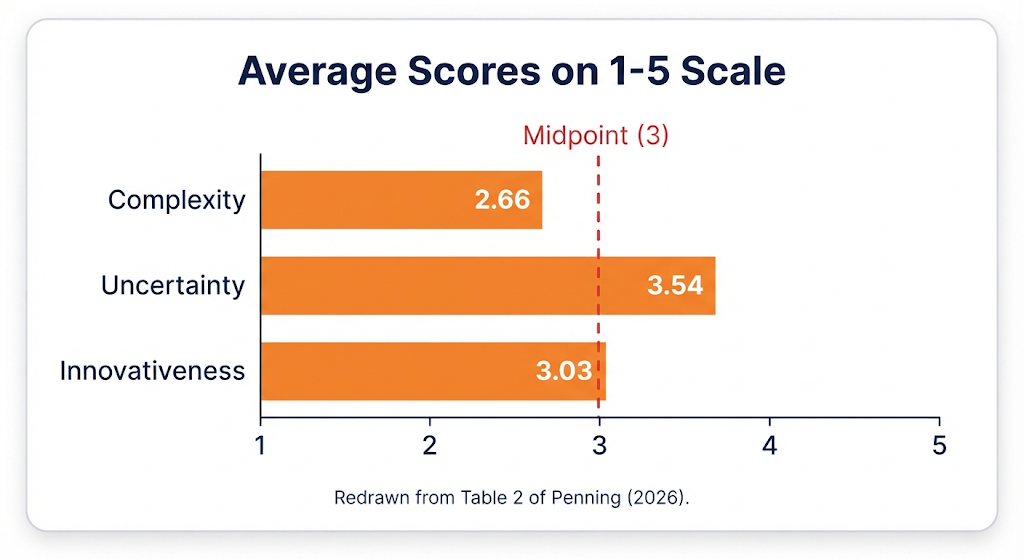
The study used established research scales, adapted to refer to AI. Each idea was rated from 1 to 5, where 3 is the neutral midpoint.
- Complexity: how hard AI feels to understand and use. Researchers call this techno-complexity.
- Uncertainty: how stressful it feels that AI keeps changing and needs constant relearning. Researchers call this techno-uncertainty.
- Personal innovativeness: how willing someone is to try new technology early and work it out independently.
The first two come from technostress research, which studies the strain people feel from technology.
What the leaders reported
Almost all respondents were owners or co-owners (96.6%), and 83.1% led firms with 1 to 9 employees. AI use was fairly common. Around 39% used AI daily or almost daily, while 11.9% never used it.
The results were clear:
- Complexity was low. The average score was 2.66, and only 28.8% of leaders scored above the midpoint.
- Uncertainty was high. The average score was 3.54, and 74.6% scored above the midpoint.
- Innovativeness sat in the middle. The average was 3.03, which describes leaders who are neither resistant to AI nor eager early adopters.
Within the same person, 48 of the 59 leaders scored higher on uncertainty than on complexity. In short, AI did not feel too hard to use. It felt too fast to follow.
Feeling confident using AI and feeling unsure about where it’s going turned out to be two separate things; one didn’t predict the other. A leader can feel comfortable with AI tools and still feel unsure about what comes next.
The paradox: more familiarity, more uncertainty
Leaders who used AI more often reported lower complexity but higher uncertainty. The same pattern appeared for leaders who rated their own understanding of AI higher. More innovative leaders also reported more uncertainty, and this held even after taking AI use into account.
The thesis offers possible explanations, not proof. Leaders who follow AI closely may simply see more of how quickly it moves. Uncertainty may also reflect awareness rather than stress alone, because frequent users meet more new tools and more strategic questions.
Why the pace creates pressure
The thesis links this uncertainty to the Red Queen effect from organisational research, as detailed in the foundational study by William P. Barnett and Morten T. Hansen, “The Red Queen in Organizational Evolution” (Strategic Management Journal, 1996). The idea is that organisations must keep moving just to stay in the same place. Standing still means falling behind. On top of that, researchers describe fear of missing out, which can push decision makers to adopt tools simply because competitors have.
Does explaining AI help?
The study also tested a 4.5-minute video that explained generative AI in simple terms. Ten leaders watched it and eight did not. No clear difference appeared in either score, but the groups were far too small to draw conclusions. The result fits a wider message from the study: information alone may not be enough to reduce uncertainty.
A note on what the study can and cannot say
- Small and self-selected sample. Leaders were recruited by cold email, and only a small share responded, which is normal for this kind of outreach but worth keeping in mind. All were in Zuid-Holland.
- More AI-familiar than average. Many respondents already used AI often, so the results may understate the difficulty felt by owners with little experience. This fits the CBS finding that lack of experience holds many firms back.
- Patterns, not causes. The study shows links between scores, not what causes them.
- A starting point. This is a bachelor’s thesis, so its findings are a first picture rather than a final answer.
What small business owners can do about AI uncertainty
The thesis concludes that support should do more than explain tools. It should help owners judge which developments matter for their own business. The suggestions below are practical ways to apply that idea. They are not findings from the study.
- Pick a few trusted sources. Follow two or three reliable sources and review them at a set time each month, instead of trying to follow everything.
- Tie every tool to a goal. Ask whether a new tool helps with a specific business goal, such as saving time on invoices or answering customers faster. If not, it can wait.
- Start with one small task. Summarising a long email or drafting a first version of a message are simple places to begin. Review the results before doing more.
- Treat uncertainty as normal. In this study, more experienced users reported more uncertainty, not less. Feeling unsure isn’t a sign you’re behind.
The results at a glance
| What was measured | What it means | Average score (1 to 5) | Share above midpoint | What it means for owners |
| Techno-complexity | AI feels hard to understand or use | 2.66 | 28.8% | Most leaders did not find AI too difficult |
| Techno-uncertainty | AI changes too fast to keep up with | 3.54 | 74.6% | Most leaders found the pace hard to follow |
| Personal innovativeness | Willingness to try new technology early | 3.03 | 44.1% | Leaders were neither resistant nor eager |
Source: Penning (2026), Table 2. Scores ranged from 1 to 5, with a midpoint of 3.
Expert quote: Lewis Carroll, author of Through the Looking-Glass
“It takes all the running you can do, to keep in the same place.”
The Red Queen says this to Alice in Carroll’s 1871 novel. Researchers later used it to describe organisations that must keep adapting just to hold their position, which is exactly the pressure many owners feel with AI.
Final thoughts
For the leaders in this study, AI is not mainly too hard to use. The harder question is how to stay oriented while it keeps changing. Using AI more made it easier to understand but did not make its direction clearer.
The practical lesson is to focus less on learning every tool and more on deciding what matters for the business. A clear goal, a few trusted sources, and one small first step can turn a fast-moving technology into a manageable one.
Next steps:
- Write down one business goal AI could help with this month
- Choose two or three trusted sources and set a monthly review time
- Test one AI tool on one small task and review the result
A clear plan makes every technology decision easier. Download our business plan template to map out your goals, priorities, and next steps in one place.
Frequently asked questions
What is AI readiness for a small business?
It describes how prepared a business, and especially its owner, is to understand, judge, and use AI. In small firms, the owner’s confidence largely decides the firm’s readiness.
What is techno-uncertainty?
Techno-uncertainty is the stress caused by technology that keeps changing and needs constant relearning. In this study, it was the strongest feeling among small business leaders.
Why do small businesses use AI less than large companies?
Small firms usually have fewer specialists, less time, and fewer resources. According to CBS, lack of experience was the main reason firms gave for deciding against AI.
Do small business owners need technical skills to use AI?
Not necessarily. In this study, most leaders did not find AI too complex to understand or use. Their main concern was keeping up with how quickly it changes.
How can a small business keep up with AI without wasting time?
Follow a few trusted sources, review them at a set time, and test only tools that support a clear business goal. Starting with one small task keeps the effort manageable.
Is AI use among Dutch small businesses growing?
Yes. A 2026 Exact survey found that about seven in ten Dutch SMEs now use AI, up from 6% in 2024, although half are unsure how to use it well.
References
- Penning, M. (2026). AI Readiness among SME Leaders in the Netherlands: Techno-Complexity, Techno-Uncertainty, and Personal Innovativeness. Bachelor thesis, Erasmus University College.
- Centraal Bureau voor de Statistiek. (2025). AI-Monitor 2024. https://www.cbs.nl/nl-nl/longread/aanvullende-statistische-diensten/2025/ai-monitor-2024?onepage=true
- Eurostat. (2025). Use of artificial intelligence in enterprises. https://ec.europa.eu/eurostat/statistics-explained/index.php/Use_of_artificial_intelligence_in_enterprises
- Exact. (2026). MKB Barometer 2026. https://files.exact.com/static/web/pdf/mkb-barometer/2026/Rapport-MKB-Barometer-2026-NL.pdf
- Ragu-Nathan, T. S., Tarafdar, M., Ragu-Nathan, B. S., & Tu, Q. (2008). The consequences of technostress for end users in organizations: Conceptual development and empirical validation. Information Systems Research, 19(4), 417-433. https://doi.org/10.1287/isre.1070.0165
- Tarafdar, M., Tu, Q., Ragu-Nathan, B. S., & Ragu-Nathan, T. S. (2007). The impact of technostress on role stress and productivity. Journal of Management Information Systems, 24(1), 301-328. https://doi.org/10.2753/MIS0742-1222240109
- Barnett, W. P., & Hansen, M. T. (1996). The Red Queen in organizational evolution. Strategic Management Journal, 17(S1), 139-157. https://doi.org/10.1002/smj.4250171010
- Naheed, S., Pinto, R., & Pirola, F. (2025). A preliminary multidimensional AI readiness assessment model for SMEs. Procedia Computer Science, 253, 774-783. https://doi.org/10.1016/j.procs.2025.01.139
- Carroll, L. (1871). Through the Looking-Glass, and What Alice Found There, Chapter 2. Project Gutenberg. https://www.gutenberg.org/files/12/12-h/12-h.htm


