
Funders don’t read a plan to be inspired. They score it. Here is how to write one that scores well.
Learn how to write a business plan for a grant application, from matching funder goals to building a budget, with a simple checklist to avoid rejection.
Introduction: A grant plan is a test, not a pitch
A strong idea needs funding to become real. A grant or innovation subsidy can look like the perfect answer, because the money comes from a funder rather than an investor.
But the terms are not always what they seem. Some grants are free money. Others come as government loans that must be repaid, sometimes with interest. In the Netherlands, for example, the Netherlands Enterprise Agency (RVO) lists both subsidies and loans for innovation in its overview of financing options (in Dutch), including the Innovation Credit, a loan for risky product development. It is important to know which type is on offer before applying.
A grant business plan is also not the same as a normal business plan. A bank or investor wants to know how a business will make a profit. A grant reviewer wants to know whether the project fits the funder’s goals, delivers real impact, and can actually be done.
This guide is for founders, small business owners, freelancers, and NGO owners. NGOs (non-governmental organizations) often run largely on grants, so a strong grant plan can decide whether the organization can operate at all. Donor fundraising is another route for NGOs, but it is outside the scope of this guide. The guide explains what reviewers look for, how to build the plan step by step, and why so many applications fail. Horizon Europe, the EU’s large research and innovation program, serves as the main example because its scoring rules are public.
Business facts: why grants are hard to win
- According to the European Commission’s interim evaluation of Horizon Europe, 16.4% of eligible proposals were funded between 2021 and January 2025, up from 12% in the previous program, Horizon 2020.
- The same evaluation found that experts rated 54.6% of proposals as high quality, yet only 30.1% of those could be funded with the available budget. A good plan is not always enough. A great one has to win.
- The European Innovation Council received 1,211 full applications for its October 2024 EIC Accelerator round, and 71 companies were selected. That is about 6%, based on those two figures.
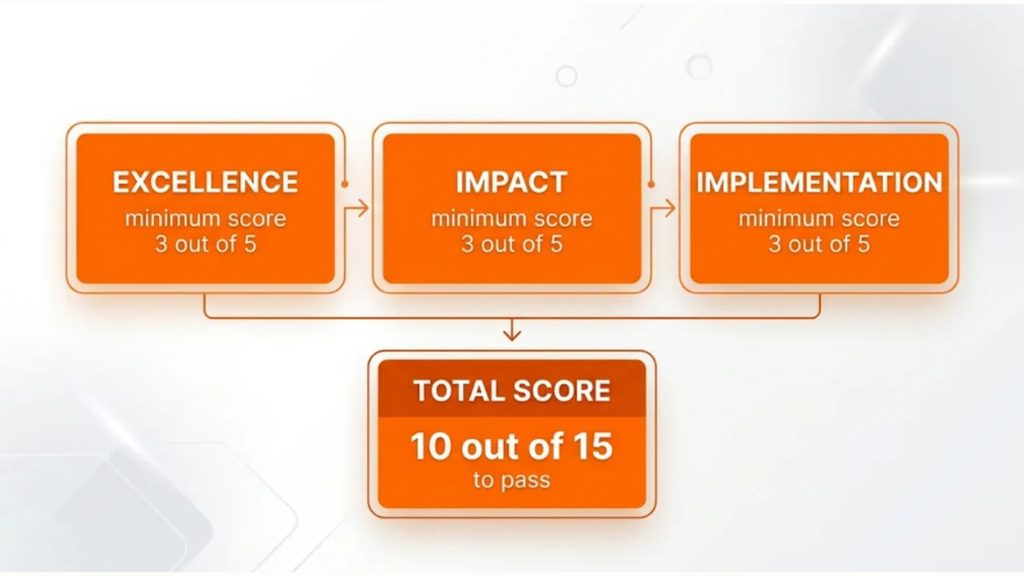
- Horizon Europe reviewers score each criterion from 0 to 5. According to the EU evaluation form, a proposal needs at least 3 on each criterion and 10 points overall. Some calls set different thresholds.
Rules and odds differ by funder and country. These EU figures show how competitive large public programs are, and the steps below work for most funders.
Why it matters: the real problem with most grant plans
Many applicants copy a normal business plan into a grant form. That is the first mistake.
Reviewers read many applications and follow a score sheet. According to the EU evaluation form, applications are evaluated as submitted, not on their potential if changes were made. If a plan does not answer the funder’s questions in the funder’s order, it loses points, even when the business is good.
Here is the pain point: a great idea can still be rejected because the plan was written for the wrong reader. The fix is simple: write for the scorer.
How to write a business plan for a grant application: 5 steps
Step 1: Start with the funder, not the idea
Read the call or program guide before writing a word. Find the funder’s goals, the eligible costs, and the scoring criteria. Then match the project to them.
Northern Ireland’s government business advice site lists work that is not relevant to the funder as the first of several common reasons for rejection. If a project does not fit, no amount of good writing will save it. Choose the right grant first.
Step 2: Describe the problem and the innovation
Explain the problem in plain words. Who has it? How big is it? What is the solution, and what makes it new or better?
Back every claim with a fact or source. The same Northern Ireland guidance lists statements without supporting facts as a common reason for rejection.
Step 3: Set measurable outcomes
This is where many plans fall short. “We will help small farms” is a wish. “We will cut water use by 20% on 50 farms within 18 months” is an outcome.
Good outcomes are specific, have a number, and have a deadline. They show the funder exactly what its money will change.
Step 4: Build a realistic project plan
Break the work into phases. For each phase, list the activities, who does them, and when they finish. Add milestones so the reviewer can see progress.
Keep it honest. A plan with realistic timing and clear roles scores better than one that promises everything in six months.
Step 5: Justify every cost in the budget
Reviewers don’t just check the total. They check the logic. Link each cost to an activity, show how it was calculated, and include only costs the funder allows.
Reviewers also check whether the resources match the planned work. In Horizon Europe, this is part of the implementation score, according to the EU evaluation form. If a number is rounded or estimated, give the reason.

Why business grant applications get rejected
Northern Ireland’s government business advice site lists the most common reasons. They include:
- The work is not relevant to the body awarding the grant.
- The plan of action is unclear or the research plan is unfocused.
- Claims are not backed up with facts.
- The impact on the wider community or industry is not explained well.
- The applicant cannot prove matched funds, or the need for the grant has not been proven.
Notice the pattern. Most of these are not about a bad idea. They are about unclear writing and missing proof, and both can be fixed.
A quick example (illustrative, not a real company)
Imagine a small team that makes software to cut food waste in restaurants. Their first draft says, “Our tool will reduce waste and help the planet.” It scores badly: no numbers, no timeline, no proof.
In the second draft, the team adds a pilot with 10 restaurants, a target of 15% less waste in 12 months, a three-phase work plan, and a budget that links each cost to one activity. Same idea, but now a reviewer can score it.
Normal business plan vs Grant business plan
| Normal business plan | Grant business plan | |
| Main reader | Investor or bank | Reviewer scoring against set criteria |
| Main goal | Profit and growth | Fit with funder goals and measurable impact |
| Structure | Free choice | Follows the funder’s template and criteria |
| Budget | Financial forecast | Itemized costs, each linked to an activity |
| Proof of success | Revenue and margins | Measurable outcomes with numbers and dates |
Expert quote:
“Plans are worthless, but planning is everything.”
Dwight D. Eisenhower, 34th president of the United States
Eisenhower said this in a 1957 speech, crediting an old Army saying. For a grant application, the point is the same: the thinking behind the plan matters more than the document.
Where to find grants
The right funder depends on the type of organization, the country, and the project. These five are a starting point, and each one publishes who can apply.
- EU Funding & Tenders (European Union). According to the European Commission’s page on funding opportunities for NGOs, NGOs can apply for programs such as Horizon Europe and for development and humanitarian aid funding, and the LIFE program accepts proposals from any public or private legal entity registered in the EU. Start-ups and SMEs can also apply through the European Innovation Council, mentioned above.
- Netherlands Enterprise Agency, RVO (Netherlands). RVO lists subsidies, loans, guarantees, and tax relief for innovative entrepreneurs, from early-stage loans to subsidies for SME collaboration. The page is in Dutch.
- Innovate UK (United Kingdom). According to nibusinessinfo.co.uk, Innovate UK provides government funding to UK businesses and research organizations, mainly through grant competitions, and also offers loans. Open competitions are listed on its Innovation Funding Service.
- Grants.gov (United States). Grants.gov is the central site for finding and applying for US federal grants. Most opportunities there are for organizations, and each one lists who is eligible, which can include nonprofits and small businesses.
- fundsforNGOs (worldwide). fundsforNGOs is an online platform that shares funding opportunities and donor information for NGOs, enterprises, and start-ups around the world.
Funding rules differ by country, so it also helps to check the national innovation or enterprise agency where the organization is based.
Who can help with applications?
Writing a grant application takes time, and many applicants get help. Specialist consultancies find suitable programs, write or review the application, and sometimes support the reporting after the grant is awarded.
One example is PNO Innovation, formerly PNO Consultants, a European innovation and funding consultancy. According to its company history, it started in 1982 as the first grants consultancy in the Netherlands and is now represented in 10 European countries. Its public funding services include EU funding, national funding, tax incentives, and grant compliance support.
Fees differ by agency. Some work on a success fee, meaning they take a share of the grant if it is awarded, so it is worth checking the terms before signing.
A grant is not a business model
A grant can start a project, but it cannot replace a business model. This matters most for NGOs and other organizations that depend on grants.
- The runway can be short. Grant money often covers a fixed period. If it is not renewed, the budget can disappear within a year or two.
- Cash can be thin. In a 2025 survey of 2,206 US nonprofits, the Nonprofit Finance Fund found that 52% had three months or less of cash on hand, and 18% had one month or less.
- Funders can steer the mission. An organization that depends on one funder may slowly adjust its work to that funder’s priorities instead of its own.
- Payment can lag behind spending. Costs may need to be covered before grant money arrives, so cash flow needs planning.
A sound economic model reduces these risks. Plan how the project or organization will earn or raise money after the grant ends, and treat grants as one source among several. A clear financial plan makes this much easier.
Final thoughts
A winning grant plan is clear, measurable, and written for the reviewer. Pick the right grant, prove every claim, set numbers that can be reached, and explain every cost. Just as important, a grant is funding for a project, not a business model, so plan how the work continues after the money ends.
Your next steps:
- [ ] Read the funder’s guide and scoring criteria.
- [ ] Shortlist 3 funders from the list above and check who can apply.
- [ ] Write 3 measurable outcomes with numbers and deadlines.
- [ ] Link every budget line to a project activity.
- [ ] Plan how the project will be funded after the grant ends.
- [ ] Ask someone outside the team to read the plan and score it.
Ready to put the plan on paper? Download our Business Plan Template and our Financial Plan Template to build a clear structure and a budget that holds up.
Frequently Asked Questions (FAQ)
What is the difference between a grant proposal and a business plan?
A business plan shows how a whole company will grow and make money. A grant proposal focuses on one funded project and shows how it matches the funder’s goals. Many funders ask for parts of both.
Does a grant have to be paid back?
It depends on the program. Some grants are free money. Others are government loans that must be repaid, sometimes with interest. Always check the terms before applying.
What do grant reviewers look for in a business plan?
They look for fit with the funder’s goals, a clear problem and solution, a realistic plan, a justified budget, and measurable impact. In Horizon Europe, these appear as Excellence, Impact, and Implementation.
How do I show the impact of my business in a grant application?
Use numbers. Say who benefits, by how much, and by when. Add proof from pilots, customers, or trusted data. Connect the outcome to what the funder wants to achieve.
What are common reasons grant applications get rejected?
Poor fit with the funder, unclear plans, claims without proof, weak explanation of impact, and no evidence of need or matched funds.
Can an NGO rely on grants alone?
Rarely for long. Grants often end or change, so planning other income, such as earned revenue or donor fundraising, helps an organization keep working after a grant ends.
Can a consultant help with a grant application?
Yes. Grant consultancies, such as PNO Innovation, help find programs and prepare applications. Fees vary, and some charge a share of the grant if it is awarded, so check the terms first.
Can I ask for feedback if my application is rejected?
Yes, in most cases. Government advice suggests asking for feedback, because it can help structure future applications better. Resubmission rules differ by program, so check each funder’s rules.
References
- European Commission. (2025). Interim Evaluation of the Horizon Europe Framework Programme (2021-2024), SWD(2025) 110. https://research-and-innovation.ec.europa.eu/document/download/a3aa9b90-15c0-4ea7-b25e-9f4e29cfa740_en
- European Innovation Council. (2024). EIC Accelerator October cut-off: record number of proposals submitted. https://eic.ec.europa.eu/news/eic-accelerator-october-cut-record-number-proposals-submitted-eics-launch-under-horizon-europe-2024-10-10_en
- European Innovation Council. (2025). EIC Accelerator: 71 companies selected in the most competitive funding round so far. https://eic.ec.europa.eu/news/eic-accelerator-71-companies-selected-most-competitive-funding-round-so-far-2025-02-17_en
- European Commission. (2025). Horizon Europe Evaluation Form, Version 4.0 (scoring thresholds). Hosted by Europe’s Rail Joint Undertaking. https://rail-research.europa.eu/wp-content/uploads/2025/10/Tpl_Evaluation-Form-CSA.pdf
- nibusinessinfo.co.uk (Northern Ireland government). Why a grant application might be turned down. https://nibusinessinfo.co.uk/content/why-grant-application-might-be-turned-down
- Quote Investigator. Plans Are Worthless, But Planning Is Everything. https://quoteinvestigator.com/2017/11/18/planning/