On a cold day in Islamabad, a young entrepreneur printed a stack of pamphlets and walked into a residential neighborhood in Sector F-11. He knocked on the first door. No. The second door. No. By the time he reached the twenty-sixth door, he had heard twenty-six versions of the same answer.
He kept going anyway.
By the end of the campaign, StreamWorks had generated six-figure revenue from its Winter School. Not because the market was easy. Because Norose refused to let rejection be the final word.
This is the story of StreamWorks: an EdTech startup built on passion, persistence, and the quiet belief that Pakistani children deserve a different kind of education.
Company Snapshot
| 🏠 Industry | Education Technology (EdTech) |
| 🚀 Founded | 1 Year Ago |
| 📈 Business Phase | Early-Stage Startup |
| 👥 Team Size | 3 Core Members + 10 Interns |
| 📍 Revenue Model | Workshop fees + STEM Kit sales (subscription model planned) |
| 🌍 Location | Islamabad, Pakistan |
| 🌐 Website | Under Development |
| 📧 Contact | streamworks.mail@gmail.com |
Abstract
Norose is the COO of StreamWorks, an EdTech startup based in Islamabad, Pakistan. This is Norose’s second startup; his first failed, and he credits that failure as one of his most important lessons. StreamWorks was founded after a Final Year Project on STEM education led to a successful pitch at an incubation center, where Norose’s university supervisor, Dr. Neelam, became his co-founder and partner.
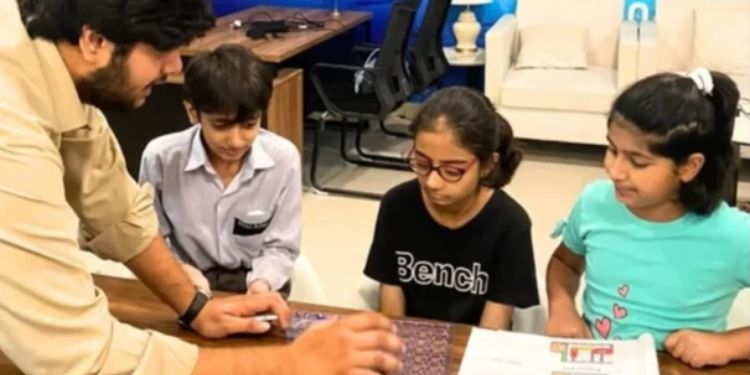
StreamWorks operates on a hybrid model: it produces and sells STEM educational kits (hardware/product) and delivers skill-based workshops, including monthly workshops, summer schools, and winter schools (services).
The company also collaborates with schools and NGOs. With a current revenue of approximately 800 USD per month and a 2026 target of 1 million PKR, StreamWorks is at a critical inflection point: transitioning from a service-heavy, intern-dependent model to a product-driven, recurring revenue business.
Vision
Make STEM education accessible, engaging, and practical for Pakistani children by shifting the market away from a redundant traditional education system and toward skills-based learning that prepares them for the real world.
Business Challenge
As StreamWorks grows, its founder must answer several critical questions:
- How does StreamWorks change the mindset of Pakistani parents who are resistant to skill-based education outside the traditional system?
- How does it transition from intern-dependent operations to a stable, full-time team without the recurring revenue to fund it?
- How does it move from a service-heavy model to a product-led business that scales without requiring proportionally more human resources?
- How does it compete against established players like LearnObots, which has been operating for 14 years, as a company with only one year of history?
- How does it balance investor interest and NDA constraints while continuing to build momentum independently?
Value Proposition
✔ Hybrid EdTech model combining physical STEM kits and live workshops
✔ Skill-based learning designed for children outside the traditional school system
✔ Collaborations with schools and NGOs for institutional reach
✔ Hands-on, practical education rooted in Science, Technology, Robotics, Engineering, Arts, and Maths
✔ Founded and led by practitioners from within the STEM education field
Situation
StreamWorks was born at the intersection of academic passion and entrepreneurial ambition. Norose’s Final Year Project on STEM education caught the attention of his supervisor, Dr. Neelam, who invited him to pitch the concept to an incubation center. They were selected. StreamWorks was founded.
The company operates on a lean structure: two contract-based team members who earn on commission, ten interns who are trained and managed on a rolling basis, and Norose himself functioning as both CEO and COO. Revenue currently sits at approximately 800 USD per month, generated through workshop fees from monthly workshops, summer schools, and winter schools. A STEM kit product is in the final stages of launch, intended to create recurring revenue that reduces the company’s dependence on live workshop delivery.
StreamWorks has already attracted the interest of international investors who are active in the STEM education space, with discussions ongoing under NDA. A Business Model Canvas has been prepared and shared with interested parties.
Analysis
StreamWorks has correctly identified a real and growing problem: Pakistan’s education system is not preparing children for a skills-based economy, and the gap between what schools teach and what the job market requires is widening. The STREAM framework, Science, Technology, Robotics, Engineering, Arts, and Maths, gives the company a clear, credible positioning in a space that international investors are already taking seriously.
As Norose explains: “You enter the market, make mistakes, learn, and jump to the next thing. That is how I nurtured myself as a leader.”
The company’s biggest strength is its founder. Norose is analytically rigorous about costs and contracts, genuinely passionate about education, and willing to do the unglamorous work, including knocking on twenty-six doors and hearing twenty-six rejections — to generate results. The challenge is that these qualities currently exist only in one person, and the business model depends on them in ways that will not scale.
The pending product launch is the most important strategic event in StreamWorks’ near-term future. If the STEM kit generates the recurring revenue Norose is projecting, it unlocks the ability to hire full-time staff, reduce intern dependency, and move the business from a founder-powered service model to a systems-driven product company.
Difficulties to Overcome
The Pakistani market mindset is the primary barrier. The biggest structural challenge StreamWorks faces is not competition, it is culture. Pakistani parents are deeply invested in the traditional education system, and convincing them to allocate time and money to skill-based workshops outside that system requires not just marketing but genuine behavior change. This is a slow, persistent process that cannot be solved by a single campaign.
The business runs on interns, not employees. StreamWorks cannot afford full-time salaries at its current revenue level, so it depends on a rotating team of student interns. Interns cannot always be available, cannot be pushed too hard without risking their departure, and require constant training. This creates a fragile operational backbone that limits growth and quality consistency.
Service-based revenue is difficult to scale. Workshops require people to deliver them. Every new workshop means more coordination, more human resources, and more operational complexity. Without the product revenue stream in place, StreamWorks cannot grow its income without proportionally growing its workload, a ceiling that the STEM kit launch is designed to break.
Competing against established players with limited resources. LearnObots has been in the market for 14 years. StreamWorks has been operating for one. Competing on brand recognition or marketing budget is not realistic at this stage. The competitive strategy must be built on agility, niche positioning, and relationship-driven growth rather than scale.
Issues
Three root issues sit beneath these difficulties:
Founder-dependency across every function. Norose runs finances, operations, team management, sales, and strategic planning simultaneously. This is common for a one-year-old startup, but it creates a ceiling that cannot be raised until at least some of these functions are delegated or systematized.
Revenue model not yet diversified. The business currently generates income only from workshops. The STEM kit, the product most likely to create recurring, scalable revenue, is not yet launched. Until it is, the business remains entirely dependent on live delivery, which is the most resource-intensive form of revenue generation.
Operational systems built for a startup, not for growth. WhatsApp, informal intern management, and commission-based contracts are appropriate for the earliest stage of a startup. But as the business approaches its 1 million PKR revenue target and begins attracting investors, the gap between operational maturity and investor expectations will become visible and costly.
Biggest Constraint
StreamWorks is caught in a classic early-stage EdTech trap: it needs recurring product revenue to hire full-time staff, but it needs full-time staff to build the operational capacity to scale product revenue.
The STEM kit launch is not just a product milestone. It is the key that unlocks almost every other constraint the business faces. Without it, the company will continue to cycle through interns, limit its workshop scale, and be unable to build the team stability required to attract serious investment.
Until the product is live, generating real recurring revenue, and proving its market fit, StreamWorks remains a high-potential, high-friction service business led by an exceptional founder who is personally compensating for every gap the business has yet to fill.
Frameworks That Might Help
Lean Startup (Eric Ries): StreamWorks has already been applying lean principles instinctively — testing workshops with real students, gathering market feedback, and iterating. Applying this framework more formally to the STEM kit launch, with a clear hypothesis, a defined test, and measurable success criteria, would reduce the risk of launching a product that doesn’t generate the recurring revenue it’s intended to.
Crossing the Chasm (Geoffrey Moore): StreamWorks is trying to shift Pakistani parents from a traditional education mindset to a skills-based one. This is exactly the “chasm” Moore describes: the gap between early adopters (progressive parents who are already open to alternative education) and the early majority (mainstream parents who need social proof and trusted references). Focusing first on one specific, winnable segment rather than the whole market would dramatically improve conversion.
Business Model Canvas (Osterwalder): StreamWorks already uses a BMC for investor conversations. Using it more actively as an internal operational tool, especially to map the transition from a service-led to a product-led revenue model, would help the team make clearer decisions about resource allocation and prioritization.
EOS by Gino Wickman (Traction): With a team of interns and a founder managing every business function simultaneously, StreamWorks needs a simple operating system. EOS’s 90-day priorities (Rocks), clear role documentation, and weekly check-in rhythm would give the company structure without bureaucracy, and would help Norose begin delegating with confidence.
Products That Might Help
Business Plan Template: StreamWorks has a Business Model Canvas prepared for investors, but not a full business plan. As investor conversations mature, the need for a more comprehensive, formal plan, covering financial projections, market analysis, and operational roadmap, will become critical. This template provides that structure.
Marketing Plan Template: StreamWorks currently relies on pamphlets, door-to-door outreach, and word of mouth to fill its workshops. A documented marketing plan would systematize these efforts and add digital channels, SEO, social media, and email, that can reach parents at scale without proportionally increasing effort.
Website Template: With StreamWorks’ website still under development, first impressions currently depend entirely on personal contact and referrals. A professional website is not just a digital presence; for an EdTech company targeting schools, NGOs, and international investors, it is a credibility signal. A clean, well-structured website template would accelerate the launch and give StreamWorks a professional front door that works around the clock.
Actions for the Coming Period
- Launch the STEM kit product and track its revenue generation against the recurring income model assumption
- Execute the 2026 workshop calendar, targeting at least 1 million PKR in total annual revenue
- Build school contracts into a reliable recurring revenue stream alongside the product launch
- Implement a basic CRM to manage school partnerships, parent enquiries, and follow-ups beyond WhatsApp
- Begin documenting core operational processes to reduce dependency on Norose for day-to-day decisions
- Define 3 to 5 KPIs to track monthly: workshop enrollment rate, repeat enrollment, STEM kit units sold, revenue per intern hour, and conversion rate from enquiry to registration
In Their Own Words
“You cannot do a startup just for money. You need something greater, like passion.”, Norose, on what drives StreamWorks
“I knocked on about 26 to 30 doors. All of them said no. But we kept going, and eventually we generated six-figure revenue for that Winter School.”, Norose, on persistence and market development
“If you are not willing to face rejection and grind through the boring parts, don’t do it. Your dopamine won’t like the startup culture.”, Norose, advice to aspiring entrepreneurs
“Once our product is out in the market, it will produce recurring business, allowing us to hire full-time staff.”, Norose, on the strategic importance of the STEM kit launch
5 Key Learnings from StreamWorks
1. Your first startup is your most expensive teacher. Norose’s first startup failed. He started it for the wrong reason, money, and it taught him that passion, not profit, is the only foundation that survives the difficult early months of building a business. Key Takeaway: A failed startup is not a failure. It is the most practical business education money can buy.
2. Rejection is data, not defeat. Twenty-six doors. Twenty-six no’s. One six-figure Winter School. Norose’s door-to-door campaign is one of the most honest examples of what early-stage marketing actually looks like beneath the polished surface of startup culture. Key Takeaway: The willingness to hear no repeatedly is one of the most underrated entrepreneurial skills.
3. Passion is necessary but not sufficient, the math must work too. Norose is both a passionate educator and a rigorous financial thinker. Before hiring contract staff, he ran the numbers. Before setting revenue targets, he built a calendar. Passion drives the vision; calculation protects the business. Key Takeaway: Great founders carry both a mission and a spreadsheet.
4. The product is the unlock. StreamWorks’ entire next phase, hiring full-time staff, reducing intern dependency, scaling revenue, is contingent on one event: the successful launch of the STEM kit. In a service business, the product is often what makes scale possible. Key Takeaway: If you are running a service business that can’t scale, find the product hiding inside it.
5. Listen to the market even when it says things you don’t want to hear. The Pakistani market has pushed back consistently on skill-based education outside the traditional system. Norose didn’t ignore that feedback or fight it head-on. He adapted: building school collaborations, creating NGO partnerships, and finding the channels through which parents are already willing to engage. Key Takeaway: Market resistance is not a wall. It is a signal pointing you toward a better entry angle.
SWOT Analysis
| Strengths | Passionate and analytically rigorous founder, incubation center backing, hybrid product and service model, active investor interest, strong competitor research |
| Weaknesses | Intern-dependent operations, no live website, limited marketing systems, service-heavy revenue model not yet diversified, founder managing all functions simultaneously |
| Opportunities | Growing international investment in STEM education, school contract pipeline, STEM kit launch for recurring revenue, government and HEC focus on STEM in Pakistan |
| Threats | Established competitors with years of brand equity (LearnObots, 14 years), traditional education system resistance, high intern turnover risk, economic volatility in Pakistan affecting discretionary education spend |
Overall Business Health Score: 5.2 / 10
Executive Capability Dashboard
| Capability | Score |
| 🌱 Grow | 6.0 / 10 |
| ⚙️ Operate | 5.0 / 10 |
| 🛡 Sustain | 4.5 / 10 |
Business Health Scorecard
| Category | Score | Status |
| Product / Service | 7.5 / 10 | 🟢 Strong |
| Strategy | 6.5 / 10 | 🟡 Developing |
| Marketing | 4.5 / 10 | 🔴 Critical |
| Operations | 5.0 / 10 | 🟠 Needs Attention |
| Financial Readiness | 5.5 / 10 | 🟠 Needs Attention |
| People and Organization | 4.0 / 10 | 🔴 Critical |
| Overall | 5.2 / 10 | 🟡 Developing |
StreamWorks scores well on product-market fit, founder credibility, and strategic direction. The score is held back by heavy intern dependency, the absence of a live website and formal marketing systems, and a revenue model not yet diversified beyond live workshops. The pending STEM kit launch is the single most important variable in this score; a successful launch and recurring revenue would meaningfully lift Operations, Financial Readiness, and People scores within 12 months.
(What is a Business Health Score? Find out here)
Strengths
- Clear and defensible niche in Pakistan’s growing STEM education market
- Founder with prior startup experience, incubation backing, and analytical discipline
- Hybrid business model combining product revenue and service revenue
- Active international investor interest in the STEM space
- Proven ability to generate results through persistence and creative market development
StreamWorks has already done something remarkable: it has turned two co-founders, ten interns, and a stack of pamphlets into a company that international investors are watching. Its next challenge is turning that momentum into a business that scales beyond what one determined founder can personally carry.
This interview and its accompanying content were created and reviewed with the explicit consent of StreamWorks and its COO. Published in August 2026. Author: Moeez Hassan.