
From Formula 1 pit stops to hospital wards, how the smartest businesses learn from rivals, and from industries that have nothing to do with their own.
Learn how competitive benchmarking helps businesses improve faster by studying rivals, and even unrelated industries, for ideas that create a real edge.
What is competitive benchmarking?
Competitive benchmarking means comparing a business’s performance, processes, or offerings against other businesses, direct rivals or otherwise, to find where there’s room to improve or stand apart. It’s one of the simplest, most underused tools available to any business owner.
When a hospital learned from a race car
In the early 2000s, doctors at Great Ormond Street Hospital in London faced a serious problem. Every time a child left heart surgery and moved into intensive care, the handover between teams was chaotic. Too many people spoke at once, and no one was clearly in charge during those first critical minutes. In a process that fragile, a small mistake made in a rush can put a patient at real risk.
Two of the hospital’s doctors were watching a Formula 1 race one weekend and noticed something. A pit crew changed all four tires, refueled the car, and sent it back onto the track in under seven seconds, with no confusion and no wasted movement. So the hospital reached out to Ferrari directly.
The team travelled to Ferrari’s headquarters in Maranello, Italy, to study the pit crew’s process: who stands where, who speaks first, and how every movement is rehearsed until it becomes automatic. They brought those lessons home and rebuilt their patient handover procedure around them.
According to an ASQ Case Study by Sower, Duffy, and Kohers, the redesigned process led to a 67% drop in critical handover errors. Hospitals in other countries later adopted the same approach.
The lesson applies well beyond healthcare. The hospital didn’t invent new technology or run a research study. It looked outside its own field and borrowed a process that already worked elsewhere. That’s competitive benchmarking in its clearest form, and it’s a tool most businesses rarely use to its full potential.
What the numbers say
Benchmarking isn’t a new idea. Benchmarking began as a formal business practice with Xerox in the late 1970s, in direct response to being outperformed by competitors on cost. For more on the tools and methods behind this kind of analysis, see VantaInsights’ guide on competitive benchmarking. Rather than guessing what had gone wrong, Xerox compared its own processes to its rivals’ step by step, and used what it learned to close the gap.
A few figures worth knowing:
- Formal benchmarking as a business practice started with Xerox in the late 1970s.
- According to an ASQ Case Study by Sower, Duffy, and Kohers, the Great Ormond Street Hospital case is one of the most cited examples of cross-industry benchmarking, producing a 67% reduction in critical handover errors.
- According to the official Blue Ocean Strategy website, early 2000s research found that more than 1,600 wineries in the US market had nearly identical value curves, competing on the same factors with little real differentiation. StrategyU’s guide explains how to map this out for any business.
- According to Learn Biomimicry’s roundup of business examples, Velcro was invented after an engineer noticed how burs stuck to his dog’s fur, and Japan’s Shinkansen bullet train redesigned its nose after studying a kingfisher’s beak, solving a tunnel-noise problem traditional engineering couldn’t fix.
The pattern is consistent: businesses that look beyond their immediate rivals tend to find opportunities that others, focused only on the same few competitors, miss entirely.
Why most businesses only look at the obvious competition
Most business owners study whoever is most visible: the shop down the street, or whichever competitor ranks above them on Google. That’s a reasonable starting point, but it’s also usually where the search stops.
When an entire industry watches the same handful of players, businesses in that industry tend to converge. Pricing looks similar. Service looks similar. Even marketing language starts to sound alike. This is close to what happened across the US wine industry, where dozens of wineries followed the same playbook until few of them stood out.
Finding a real edge means widening the view, and understanding that competition isn’t just one thing.
Three levels of competition and where the real opportunity hides
Direct competition. Businesses offering the same product or service to the same customers. This is a useful baseline, but a limited one, since it’s the level every competitor is already watching.
Generic competition. Businesses solving the same underlying customer need in a different way. A coffee shop’s generic competition isn’t limited to other coffee shops or energy drinks. It also includes other places people go for the same underlying reasons, such as a hotel lobby used as a meeting space or an office used as a quiet place to work.
Fringe or unrelated industries. Fields with nothing obviously in common, but that have already solved a problem shaped like the one at hand, such as a hospital learning from a race team. This level is rarely studied, which is exactly why it’s worth the effort.
Most of the practical value comes from levels one and three: a clear baseline from direct competitors, and breakthrough ideas from somewhere unexpected.
How to benchmark a competitor, step by step
Step 1: Build a real competitor list.
Separate direct competitors, generic competitors, and, where possible, one or two fringe industries facing a similar core challenge, such as speed, trust, or consistency.
Step 2: Identify where competitors do better.
Review their website, reviews, and social media, and, where the organization can find it, how their customer service handles a complaint. The goal is an honest list of where a competitor clearly outperforms, without getting defensive about it. That defeats the whole point.
Step 3: Map a simple value curve.
A value curve, from the Blue Ocean Strategy framework developed by W. Chan Kim and Renée Mauborgne, is a chart used to compare how a business and its competitors perform across the same set of factors. List the 5 to 7 factors an industry competes on, such as price, speed, quality, personal service, and convenience, and plot how each competitor scores on them. For a closer look at how this works, see what is Blue Ocean strategy?
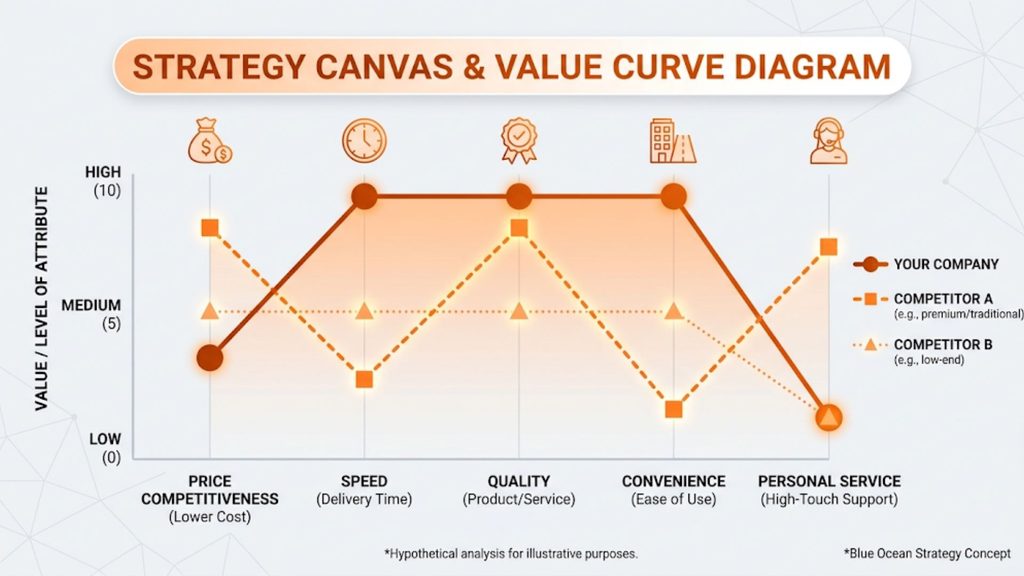
If a business’s line looks nearly identical to its competitors’, that’s a warning sign of a crowded, undifferentiated space. The goal is to find one or two factors to clearly raise above the rest, and one or two to intentionally lower. In some cases, the strongest Blue Ocean differentiator comes from adding something entirely new that no competitor currently offers, such as a hospital that adds an on-site coffee bar for visiting families.
Step 4: Define the differentiator.
Once the value curve shows where a business genuinely stands apart, that’s the foundation of a real Unique Selling Proposition (USP), the specific reason a customer chooses one business over another. It doesn’t need to be dramatic. It can be as simple as faster response times, a more personal process, or a guarantee no one else in the market offers.

Step 5: Look beyond the industry entirely.
This step is the one most businesses skip, and it’s what turns the hospital example into a repeatable strategy rather than an interesting story. The key question is which industries, unrelated on the surface, face a challenge that resembles this one. A restaurant struggling with slow table turnover might learn more from studying an airport check-in process than from another restaurant. A repair shop dealing with cost-anxious customers might learn more from how dentists build trust upfront than from a competing repair shop.
| Approach | What’s being compared | Best for | Example |
| Direct benchmarking | Same product/service, same market | Setting a baseline, checking pricing | Comparing a bakery to the one across town |
| Generic benchmarking | Different product, same customer need | Spotting substitute threats | A coffee shop studying energy drink brands |
| Fringe/cross-industry benchmarking | Unrelated industry, similar core challenge | Breakthrough process ideas | A hospital learning handover speed from an F1 pit crew |
Expert quote:
“The only way to beat the competition is to stop trying to beat the competition.”
W. Chan Kim
Co-creator of the Blue Ocean Strategy framework
This is from Kim’s 2005 California Management Review article on Blue Ocean Strategy, and it captures the core idea well. The value of benchmarking lies not in the research itself, but in what a business does with it afterward.
Final thoughts
Learning from competitors isn’t about copying what everyone else already does, since that only makes a business blend in further. Real advantage comes from studying direct rivals honestly, understanding the wider competition for customer attention, and staying curious enough to look at industries with nothing obviously in common on the surface.
The fastest-growing businesses are rarely the most original ones. They’re the ones willing to learn from good ideas wherever they appear, and apply them with discipline.
Next steps:
- [ ] List direct, generic, and one fringe-industry competitor
- [ ] Map a simple value curve across the top 5 competing factors
- [ ] Identify one process, from any industry, to adapt this month
Ready to put a competitive advantage into an actual plan? Download the business plan template to map out positioning, differentiators, and next steps in one place. Or start mapping the framework for your organization here.
Frequently asked questions
What is competitive benchmarking in simple terms?
It means comparing a business’s performance, processes, or offerings against other businesses, direct rivals or otherwise, to identify where to improve or stand apart.
What’s the difference between direct and generic competition?
Direct competitors offer the same product or service. Generic competitors solve the same underlying problem in a different way, such as a gym competing generically with home workout apps, not just other gyms.
Why would a business study a completely unrelated industry?
Because unrelated industries often solve similar underlying problems, such as speed, trust, or consistency, in ways a given industry has never tried. The Great Ormond Street Hospital case is one of the best-documented examples of this working in practice.
What is a value curve, and does it require special software?
A value curve is a chart comparing how a business and its competitors perform on the factors customers care about most, such as price, speed, or service. It can be sketched on paper or in a basic spreadsheet, no special tools required.
How does a business find its Unique Selling Proposition?
By mapping a value curve first. Wherever a business’s line clearly rises above competitors’ on a factor customers genuinely care about, that’s the foundation of a USP.
What is Porter’s Five Forces, and how does it relate to competitive benchmarking?
Porter’s Five Forces is a framework for analyzing the competitive intensity of an industry, looking at rivals, new entrants, suppliers, buyers, and substitute products. It complements benchmarking by mapping the wider competitive landscape a business operates in.
What is market share, and why does it matter in competition?
Market share is the percentage of total sales in a market that a business controls. In highly competitive industries, businesses often compete directly for market share, since markets tend to consolidate around one or two dominant players over time.
How does substitution relate to generic competition?
Substitution happens when customers meet the same need with a completely different category of product, such as choosing to redecorate a room instead of buying new furniture. It’s a core part of generic competition, since it shows where demand can shift outside an industry entirely.
References
- Sower, V. E., Duffy, J. A., & Kohers, G. Great Ormond Street Hospital for Children: Ferrari’s Formula One Handovers and Handovers from Surgery to Intensive Care. ASQ Case Study. https://asq.org/quality-resources/articles/case-studies/great-ormond-street-hospital-for-children-ferraris-formula-one-handovers-and-handovers-from-surgery-to-intensive-care?id=fbc699af11d04980ade06f409a5d6f98
- Kim, W. C., & Mauborgne, R. (2005). Blue Ocean Strategy. Harvard Business Review Press. https://www.blueoceanstrategy.com/
- StrategyU. Blue Ocean Strategy: How to Use the Strategy Canvas to Find Uncontested Markets. https://strategyu.co/blue-ocean-strategy/
- Learn Biomimicry. Ten of Our Best Biomimicry Examples in Business. https://www.learnbiomimicry.com/blog/biomimicry-business-examples
- Talkspirit. Putting Biomimicry to Work in the Workplace: 10 Examples. https://www.talkspirit.com/en/blog/biomimicry-in-the-workplace-examples
- VantaInsights. Competitive Benchmarking: Tools, Methods & Data Sources. https://vantainsights.com/insights/competitive-benchmarking