
Most businesses focus on getting customers. The smart ones focus on keeping them. Here is how a customer journey map shows you exactly where you are losing people and what to do about it.
Learn how to build a customer journey map for your small business. Discover the 5 stages, common pain points, and practical steps to turn one-time buyers into loyal repeat customers.
Introduction: You are probably losing customers at the same point every time
Here is a question most small business owners cannot answer: where exactly do customers drop off before buying from you?
Not a rough guess. The actual point. Is it your website? Your pricing page? After a first purchase when they never hear from you again?
Most businesses do not know. And not knowing is costly.
A customer journey map helps address that. It gives you a clearer picture of every step a customer takes from first hearing about you to becoming a loyal repeat buyer, showing you where friction builds up and where people quietly walk away.
This guide explains what a customer journey map is, how to build one, and how to use it to remove the friction that is costing you repeat customers.
The numbers that make this hard to ignore
- According to Mediaplus research, businesses with strong customer journey mapping see 54% higher ROI on average. Companies that maximize satisfaction across customer journeys can increase revenue by 15% and lower service costs by 20%.
- According to Hanover Research, 76% of companies say journey mapping data has increased the ROI of their business investments and helped them become significantly more customer-centric.
- According to Aberdeen Group research cited by Adobe, organizations that focus on customer journey management achieve over 50% greater return on marketing investments and more than 2.5 times greater revenue from customer referrals compared to those that do not.
The core insight behind these numbers: your product gets customers in the door. Your customer experience determines whether they stay.
Why most small businesses skip this and pay for it later
Customer journey mapping has a reputation for being a corporate exercise. Big companies, big budgets, dedicated CX teams with wall-sized diagrams. That reputation puts most small business owners off, and it is undeserved.
Small businesses need journey mapping more than large ones. In a large company, hundreds of data points eventually reveal where customers drop off. In a small business, blind spots are costlier and harder to detect. One stage in the journey where customers consistently experience friction can account for a significant portion of lost revenue without anyone noticing.
Most small businesses are so focused on acquiring new customers that they never examine what happens after the first interaction. Acquisition gets all the attention. Retention gets none. And yet retaining an existing customer costs five to seven times less than acquiring a new one.
A customer journey map shifts the focus from top-of-funnel activity to the full arc of the customer relationship.
What Is a Customer Journey Map?
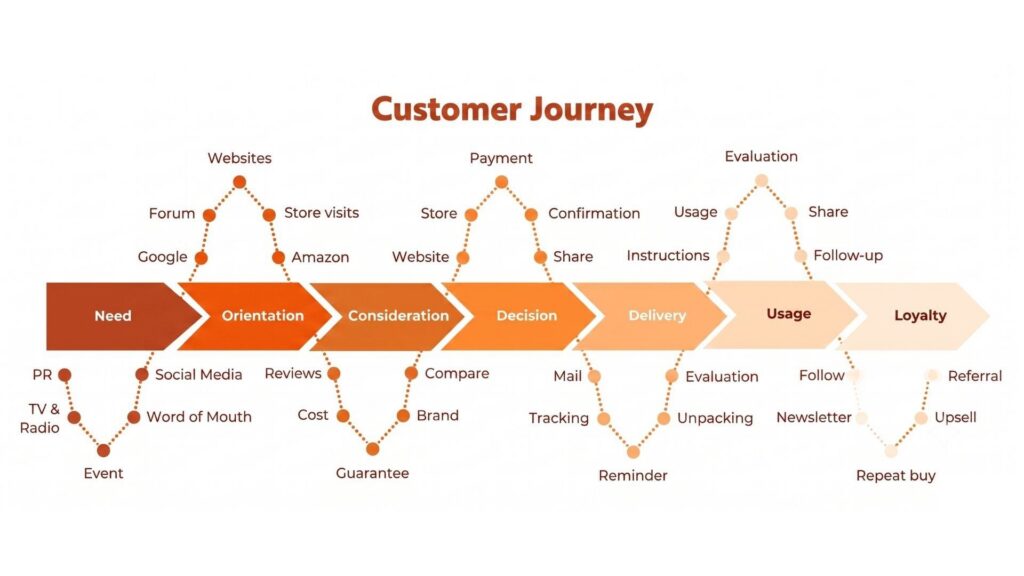
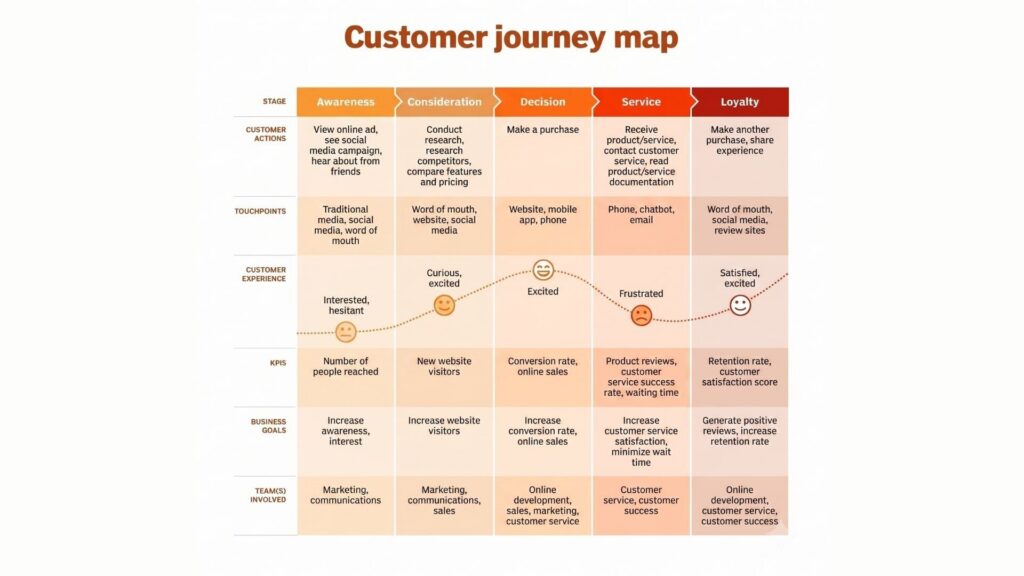
A customer journey map is a visual representation of every step a customer takes when interacting with your business, from first becoming aware of you through the decision to buy, through using your product, and all the way to whether they come back and refer others.
It is not a flowchart of your internal processes. It is a map of the customer’s experience told from their perspective, documenting what they are doing, thinking, and feeling at each stage.
The goal is not to create a perfect map. The goal is to identify the friction points: the specific moments in the journey where the experience becomes difficult, unclear, or disappointing. These friction points, sometimes called moments of truth in marketing, are where customers decide whether to continue or walk away. Identifying and improving them is the core purpose of journey mapping.
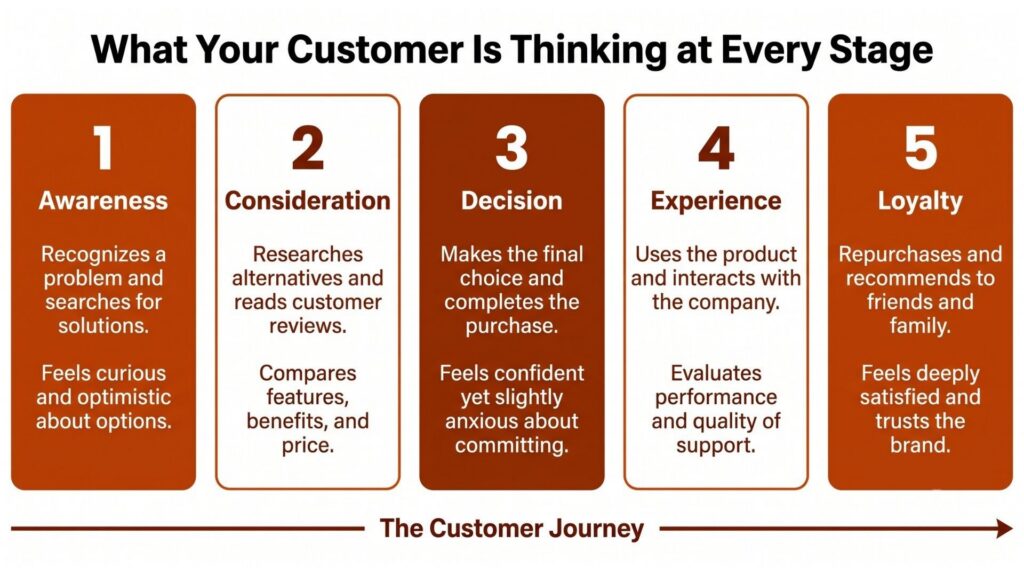
The 5 Stages Every Customer Journey Goes Through
Stage 1: Awareness, they discover you
A potential customer first becomes aware your business exists through a search, referral, social post, or ad. They are not thinking about buying yet. The key question: can people who need what you offer actually find you, and does the first impression communicate your value clearly?
Stage 2: Consideration, they compare options
The customer evaluates: reading your website, checking reviews, comparing you to competitors. Trust is everything here. They are asking: is this business credible? Do they understand my problem? Have others had a good experience? Your reviews, testimonials, and the clarity of your messaging determine whether they move forward or look elsewhere.
Stage 3: Decision, they choose to buy
The customer is ready to commit, but friction still loses people here. A confusing checkout, unclear pricing, or an unanswered question about what happens next can cause abandonment even when the customer was ready to buy.
Stage 4: Experience, they use your product or service
The most important stage and the most underinvested in. Does the reality match the expectation the customer had when they bought?
This is where the concept of moments of truth becomes critical. A moment of truth is any interaction that disproportionately shapes how a customer feels about your business. Consider the unboxing experience: the moment a customer opens a product for the first time. Amazon and Philips both invest heavily in this moment because they know it sets the emotional tone for the entire relationship. Is the packaging done well? Does everything work immediately? Is the setup process smooth or frustrating?
For service businesses, the equivalent might be the first delivery of work, the onboarding call, or the first invoice. Whatever it is, identifying your moments of truth and making them excellent is one of the highest-value improvements you can make.
Disappointments at this stage rarely produce complaints. They produce silence and a customer who quietly never returns.
Stage 5: Loyalty, they return and refer
A loyal customer buys again, spends more, costs less to serve, and refers others. This does not happen automatically. Specific loyalty touchpoints need to be designed and delivered: account creation, update emails, repeat check-ins, renewal reminders, and exclusive offers for returning customers. Most small businesses treat a completed purchase as the finish line. The best ones treat it as the starting line.
How to build your Customer Journey Map in 5 steps
Step 1: Define your Customer Persona
Start with one specific customer type, your best customer, the one you would clone if you could. Define their goals, frustrations, the language they use to describe their problem, and what they have tried before finding you. The more specific this is, the more useful the map. If you have not done this before, the Customer Persona Template from excellentbusinessplans.com gives you a ready-made structure to build a precise customer profile before you start mapping.
Step 2: List every touchpoint
A touchpoint is any moment of interaction between customer and business. List every one across all five stages: your website, social profiles, reviews, emails, phone calls, invoices, packaging, follow-up messages. Most businesses list far more than expected. Each is an opportunity to improve the experience or a risk of losing someone.
Step 3: Map the Customer’s Experience at each touchpoint
For each touchpoint, document three things: what the customer is trying to accomplish, how they are likely feeling, and what the experience currently looks like from their perspective. Map what it actually is, not what you hope it is. Many businesses discover a significant gap between these two things.
Step 4: Identify the Friction Points
Look for moments where the experience falls short of what the customer needs. Where is the process confusing? Where does communication drop off? Where do customers repeatedly ask the same question, signaling that information was not clear enough earlier? These friction points are your priority targets.
If you are data-driven, you can score each touchpoint on a simple 1 to 10 satisfaction scale. Mapping these scores visually gives you an emotion curve across the journey, showing clearly which touchpoints are performing well and which are creating frustration.
Step 5: Prioritize, involve your team, and fix
You will find more friction points than you can fix at once. Rank by impact: which are causing the most drop-off or dissatisfaction?
Before finalizing your map, share it with your team. Ask your service staff whether it reflects what they hear from customers daily. Check with your sales team whether the consideration stage is accurate. Ideally, share it with two or three actual customers and ask them to walk through it. Real input from real people is what turns a map from an internal assumption into a useful diagnostic tool.
Then fix one pain point at a time, starting with the highest impact.
Common Friction Points at each stage and how to fix them
| Stage | Key Touchpoints | Common Friction Point | Practical Fix |
| Awareness | Website, social media, Google search | Hard to find or unclear first impression | Improve SEO, claim Google Business Profile, post consistently |
| Consideration | Reviews, pricing page, testimonials | Weak or missing social proof | Actively request reviews, add testimonials and case studies |
| Decision | Checkout, contact form, pricing | Confusing process or unclear next steps | Simplify checkout, add clear CTA and FAQ section |
| Experience | Onboarding, delivery, first use | Reality does not match expectation | Align marketing promises with actual delivery, improve moments of truth |
| Loyalty | Follow-up emails, check-ins, renewals | No communication after purchase | Build email sequence: day 7 check-in, day 30 value add, renewal reminder |
What this looks like in practice
This kind of pattern plays out regularly for small businesses that go through a journey mapping exercise for the first time.
Consider a fitness studio where trial clients were converting poorly to memberships. The owner assumed price was the issue and was considering discounting. Before changing anything, she mapped the full customer journey.
What she found was revealing. The awareness stage was strong. The consideration stage had a problem: no testimonials on the website and an unclear pricing structure. The decision stage had friction: the trial booking process required three separate steps. The experience stage showed new clients felt unsupported in their first two weeks with no communication after the initial session.
Four targeted fixes followed. Testimonials added to the website. Booking form reduced to one step. A welcome message sent the day before each trial. A check-in call introduced at the two-week mark for new members.
None of these were expensive. None required a bigger marketing budget. They were all friction point improvements that the journey map made visible. The price was never the issue. The experience at four specific moments was.
This is what journey mapping does. It does not give you a bigger funnel. It shows you where your existing funnel is leaking.
Tools to build your Customer Journey Map
You do not need expensive software to get started. Here are the most practical options at different levels:
For getting started: Sticky notes on a wall organized by stage are still one of the most effective methods. Low cost, highly visual, and easy to rearrange as you learn more.
For digital mapping: Miro is one of the most widely used tools for customer journey mapping and works well for teams collaborating remotely. Lucidchart and Canva also offer accessible journey map templates.
For more advanced mapping: Smaply and UXPressia are purpose-built for journey mapping with emotion curves, touchpoint scoring, and persona integration built in.
For research and validation: Online focus groups are one of the most effective methods for building an accurate map. Gather a small group of existing customers, walk them through the journey stages, and ask them to describe their experience at each point. The feedback from a single two-hour session can surface more genuine insight than weeks of internal discussion.
Whatever tool you use, the quality of the map depends on real customer input, not internal assumption.
“A map is a tool to get you to where you want to go. Focus on your goals first, then address one area at a time and create action plans to execute. This is about progress, not perfection.” — Jeannie Walters, Certified Customer Experience Expert
Final thoughts: From assumption to a clearer picture of your customer
Customer journey mapping moves your understanding of the customer experience from assumption toward something more documented and actionable. It is not a perfect picture, you still need real data points and customer input to validate what you find. But it gives you a far clearer starting point than guesswork alone.
For a small business where every customer counts, one fixed friction point in the right stage of the journey can have a larger impact on revenue than a significant increase in marketing spend.
Start with one persona. Map one journey. Score your touchpoints honestly. Fix one friction point at a time.
Your next step …
The fastest way to start is with a structured template rather than a blank page. The Customer Journey Checklist from excellentbusinessplans.com gives you a ready-made framework to map every touchpoint across all five stages, so you can identify your friction points and start improving them today. And before you map the journey, make sure you know exactly who you are mapping it for. The Customer Persona Template helps you build a precise profile of your ideal customer so that every improvement you make is targeted at the people who matter most to your business.
Frequently Asked Questions (FAQ)
1. What is a customer journey map? A customer journey map is a visual representation of every step a customer takes when interacting with your business, from first becoming aware of your brand to becoming a loyal repeat buyer. It documents what customers are doing, thinking, and feeling at each stage, helping you identify where friction builds up and where experience can be improved.
2. Do small businesses really need customer journey mapping? Yes, especially small businesses. Without a journey map, small business owners make decisions about marketing, sales, and service based on internal assumptions rather than customer reality. A journey map reveals the specific friction points where customers are being lost or disappointed, enabling targeted improvements that deliver measurable results.
3. How long does it take to build a customer journey map? A basic map for one customer persona can be completed in a few hours using a structured template. In large organizations, journey mapping projects can run for three to five months given the complexity and number of stakeholders involved. For a small business, start simple: map the five core stages, identify your three biggest friction points, and refine over time as you gather real customer feedback.
4. What are moments of truth in customer journey mapping? Moments of truth are the three to five interactions that disproportionately determine whether a customer stays or leaves. The unboxing experience when a product arrives, the first onboarding call, the first invoice, or the first time a customer needs support, these moments carry more emotional weight than routine interactions and deserve extra attention in your journey map.
5. How do I know which friction points to fix first? Prioritize by impact. Focus on the stages where customers are dropping off most frequently or expressing the most dissatisfaction. A friction point preventing conversion at the Decision stage almost always deserves attention before one affecting the Loyalty stage, because it is blocking revenue from being generated at all.
6. What tools can I use to build a customer journey map? For small businesses, Miro is one of the most practical digital tools. Canva and Lucidchart offer accessible templates. For more advanced mapping with emotion curves and touchpoint scoring, Smaply and UXPressia are purpose-built options. However, the tool matters less than the input: a map built from real customer conversations is worth far more than a polished map built on internal assumptions.
References
- Mediaplus. (2026). Customer Journey Map: Templates & Guide 2025. https://mediaplus.com.sg/customer-journey-map/
- Hanover Research. (2026). Everything You Need to Know About Customer Journey Mapping. https://www.hanoverresearch.com/insights-blog/corporate/customer-journey-mapping/
- Breakthrough3x. (2025). Creating a Customer Journey Map for Digital Marketing Success https://breakthrough3x.com/resources/creating-a-customer-journey-map-for-digital-marketing-success/
- Salesforce. (2024). State of the Connected Customer, 8th Edition. https://www.salesforce.com/ap/products/resources/state-of-connected-customer/
- 9CV9 Blog. (2026). Top 104 Customer Journey Mapping Tools Statistics, Data & Trends in 2026. https://blog.9cv9.com/top-104-customer-journey-mapping-tools-statistics-data-trends-in-2026/
- Covisian. (2025). Customer Journey Analytics: Data-Driven Strategies to Optimize CX & Boost ROI. https://covisian.com/tech-post/customer-journey-analytics-data-driven-insights/
- CMSWire. (2025). The Complete Guide to Customer Journey Mapping in 2025. https://www.cmswire.com/customer-experience/customer-journey-mapping-a-how-to-guide/