
Being good at your job does not make you a good leader. Here is a 10-question test to find out where you stand and how to check it with your team.
Take this simple leadership self-test. Rate yourself on 10 research-based behaviours, ask your team to do the same, and see what to improve first.
Introduction: Great at the job, new at leading others
Many people become leaders because they were great at their work. The best salesperson becomes sales manager. The best developer becomes team lead. Then they discover that leading people is a different skill.
This guide is for founders, small business owners, and managers who want an honest answer to one question: do I have what it takes to lead? You will learn what good leadership looks like, take a 10-statement test, and learn how to check your score by asking your team. It is a self-check built on published research, not a formal psychological test. Think of it as a mirror, not a verdict.
Business facts: Why leadership matters
- According to Gallup research by Jim Harter and Amy Adkins, managers account for at least 70% of the variance in employee engagement scores. A Gallup study of 7,272 U.S. adults also found that one in two had left a job at some point to get away from their manager.
- Gallup’s analysis Why Great Managers Are So Rare estimates that about one in 10 people has the talent to manage well, and that companies fail to choose the right candidate for a manager role 82% of the time. Managers asked why they were hired often cited success in a previous role or their tenure.
- In 10 investigations with nearly 5,000 participants, organizational psychologist Tasha Eurich found that most people believe they are self-aware, while her team estimates that only 10 to 15% of the people studied truly were, according to her Harvard Business Review article. The figure is an estimate, but it shows why outside feedback matters.
- Google’s Project Oxygen analyzed more than 10,000 data points from performance reviews and feedback surveys. It found that teams with highly effective managers were more likely to achieve better results, be happier, and have lower turnover.
What is a good leader?
There is no single formula, but two large studies give us useful standards.
Google’s Project Oxygen studied what its best managers do. It identified 10 key behaviours, including being a good coach, empowering the team without micromanaging, and being a strong decision-maker. These describe what works at Google, so adapt them to your own business.
The CEO Genome Project is a 10-year study by a leadership consulting firm. It drew on more than 17,000 assessments of senior executives, including 2,000 CEOs. It found four behaviours that set successful CEOs apart: deciding with speed and conviction, engaging stakeholders, adapting proactively, and delivering reliably.
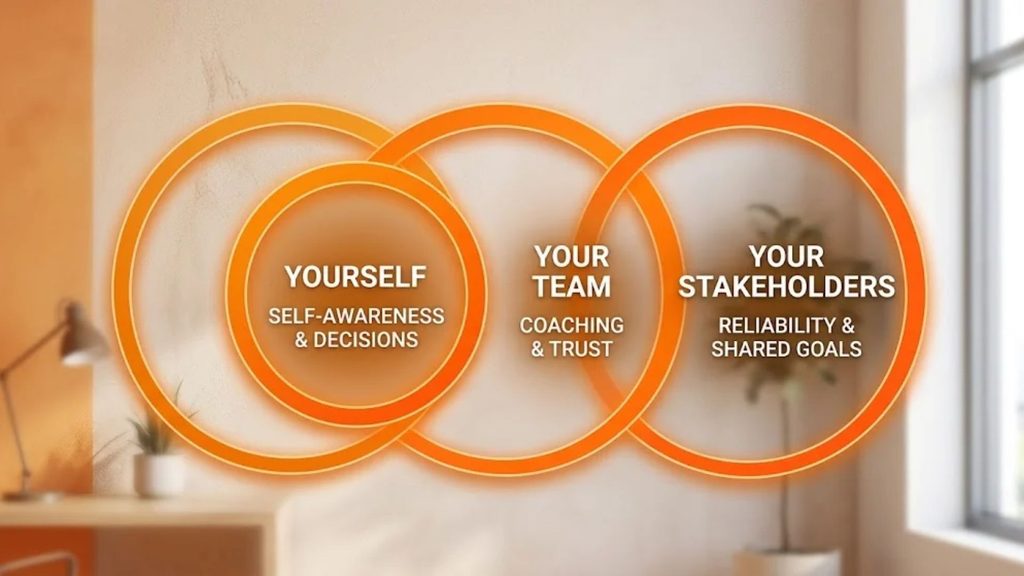
Put together, a good leader manages three things well: themselves, their team, and their stakeholders.
The 10-statement leadership test
Rate each statement from 1 (rarely true) to 5 (almost always true). Be honest. Nobody sees this but you.
Managing yourself
- I know my strengths and blind spots, and I ask for honest feedback.
- I make decisions with speed and confidence, even with incomplete information.
- I adapt quickly when plans change, and I treat mistakes as lessons.
Managing your team
- I coach my people instead of solving every problem for them.
- I trust my team and do not micromanage.
- I share a clear direction, and I listen as much as I talk.
- I care about my team’s well-being and make everyone feel included.
Managing your stakeholders
- I know what my customers, partners, and investors care about most.
- I deliver on my commitments reliably.
- I work well with other teams and partners.
Add up your score (10 to 50) and check the first table below.
Now ask your team
Your own score is only half the picture. Remember the self-awareness gap: you may rate yourself differently from how others see you.
- Pick 3-5 people who work with you. Include at least one person who will be honest with you.
- Ask them to rate you on the same 10 statements, anonymously if possible. A shared online form works well.
- Add up each person’s score and take the average.
- Subtract the team’s average from your own score. This is your gap (see the second table below).
- Also look at each statement. A difference of 3 points or more on a single statement is a strong signal.
- Pick one or two behaviours to work on, tell your team, and check again in three months.
Google uses a similar approach: managers receive feedback through a regular survey that Google has published openly on its re:Work site. You do not need a big system. A simple form and an open mind are enough.

When the situation changes, your style may need to change
Your score is a snapshot. Leadership that works today may not work tomorrow. You may get a new manager, or the company may move from startup to a larger organisation, or from fast growth to more structure. Your first leadership style may then stop working.
A classic tool for this is the Blake and Mouton Managerial Grid. It plots two dimensions: concern for people (team members’ needs and development) and concern for production (goals, efficiency, and results). Each runs from 1 (low) to 9 (high), and the grid describes styles such as Team Management (9,9), which combines great concern for both. Some sources point out that there is no single best style, and the most effective one can vary with the situation.
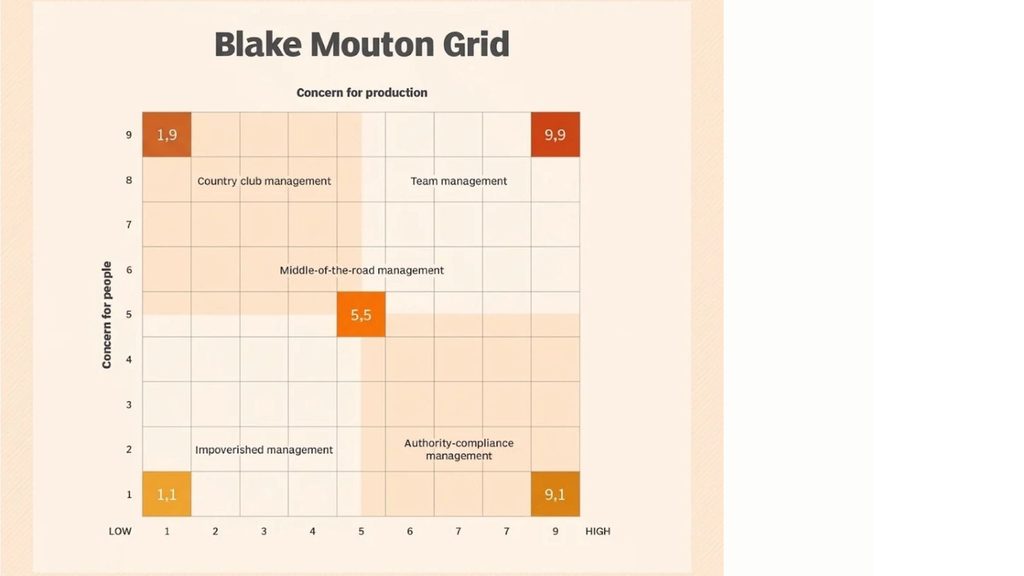
A practical way to use it: ask yourself, “Right now, am I leaning too much on people or on results?” A fast-growing startup may need more drive. A larger team may need more structure and care. Check in with your team when things change.
What to look out for
- You rate yourself high; your team rates you low. This is the blind-spot gap and the most important signal.
- You avoid decisions. Waiting for perfect information costs time and trust.
- You fix every problem yourself. Your team stops thinking for themselves.
- You only listen to the loudest voice. Quiet team members and stakeholders get ignored.
- You keep the same style when the situation has changed.
- You promise more than you deliver. Reliability builds trust faster than big plans.
A quick example (illustrative, not a real company)
Sam runs a 12-person design agency. She scores herself 41 out of 50. Then she asks four team members to rate her. Their average is 33, so her gap is 8 points, which is serious. The biggest difference is on statement 5: she rates herself 5; they rate her 2. She often rewrites her team’s work “to save time.”
Sam works on one behaviour. For one month, she lets her team send work without her review and holds a 15-minute coaching chat each week. Three months later, her team rates her 4 on that statement, and she gets two hours of her week back.
What your score means
Your own score
| Your score | What it means | Your next step |
| 10-24 | Early stage | Start with one area. Ask for feedback and find a mentor. |
| 25-34 | Developing | Pick your two lowest statements to improve. |
| 35-44 | Solid | Check your team’s view for blind spots. |
| 45-50 | Strong | Verify with your team and stay open to feedback. |
Your gap with the team (your total minus the team’s average)
| Gap | What it means | Your next step |
| 0-3 points | Aligned | Keep going and re-check in six months. |
| 4-7 points | Noticeable difference | Look at the statements with the biggest gaps and ask why. |
| 8+ points | Serious blind spot | Talk openly with your team and agree on one change. |
“The only definition of a leader is someone who has followers.”
Peter Drucker, management author and consultant
Drucker wrote this in his foreword to The Leader of the Future (1996). It explains why a leadership self-test needs the team’s view, not only the leader’s own.
Final Thoughts
Good leadership is learnable, but it starts with an honest look in the mirror. Test yourself, ask your team, and work on one thing at a time. If you run a small company, you are both a leader and a manager, which means setting direction and organising the work. The CEO Genome researchers found that roughly half of the strong leaders stood out in more than one of the four key behaviours, compared with only 5% of weak ones, so you do not need to be perfect. You need to keep improving.
Your next steps:
- [ ] Complete the 10-statement test today.
- [ ] Ask 3-5 people to rate you and calculate your gap.
- [ ] Pick one behaviour to improve this month.
Wondering if you have the mindset to start or grow a business? Take our entrepreneur test. Ready to turn your leadership into a clear plan? Download our Business Plan Template to set your goals and map out your next steps.
Frequently Asked Questions (FAQ)
Can leadership be learned?
Yes, in large part. Gallup notes that natural talent matters, but every manager can learn to engage a team somewhat. Feedback and practice make the difference.
What is the difference between a manager and a leader?
A manager organises work and people. A leader also gives direction and builds trust. Most small business owners need to do both.
Does my leadership style need to change over time?
Often, yes. When your company grows, your team changes, or you get a new manager, check whether your style still fits. Models like the Blake and Mouton grid can help.
What if my team rates me lower than I rate myself?
Stay calm and curious. A gap is useful information, not a failure. Thank your team, pick one behaviour to improve, and check again.
How often should I ask my team for feedback?
Every three to six months is a good rhythm. Share what you learned and what you will change, so people see that feedback leads to action.
References
- Harter, J., & Adkins, A. (2015). Employees Want a Lot More From Their Managers. Gallup. https://www.gallup.com/workplace/236570/employees-lot-managers.aspx
- Beck, R. J., & Harter, J. (2014). Why Great Managers Are So Rare. Gallup. https://www.gallup.com/workplace/231593/why-great-managers-rare.aspx
- Google re:Work. (2025). Following the data: The research behind great managers. https://rework.withgoogle.com/intl/en/guides/following-the-data-the-research-behind-great-managers
- Eurich, T. (2018). What Self-Awareness Really Is (and How to Cultivate It). Harvard Business Review. https://hbr.org/2018/01/what-self-awareness-really-is-and-how-to-cultivate-it
- Botelho, E. L., Powell, K. R., Kincaid, S., & Wang, D. (2017). What Sets Successful CEOs Apart. Harvard Business Review, May-June 2017. https://hbr.org/2017/05/what-sets-successful-ceos-apart
- Drucker, P. F. (1996). Foreword. In F. Hesselbein, M. Goldsmith, & R. Beckhard (Eds.), The Leader of the Future. Jossey-Bass. https://www.druckerforum.org/newsletter/2020/special/01.html