



Most founders believe they have built a business. Many have actually built a job with their name on the door. Here is how to tell the difference and what to do about it.
Could your business survive 30 days without you? Take the founder independence test, uncover the hidden dangers of keyman risk, and learn how to build a business that runs without you.
Introduction
Imagine you get on a plane tomorrow morning. A family emergency takes you abroad. There is no wifi. No phone signal. No way to check in, answer questions, approve decisions, or put out fires for thirty days.
Now ask yourself honestly: what happens to your business?
For some founders, the honest answer is reassuring. The team knows what to do. The systems handle what the team cannot. Revenue keeps coming in. Customers keep getting served. The business runs.
For most founders, the honest answer is uncomfortable. Without them, things start slipping within days. Decisions stall. Clients get frustrated. Team members look at each other, waiting for someone to say what comes next. Revenue wobbles. By week three, the whole thing is visibly struggling.
That gap between those two answers is one of the most important indicators of business health that most founders never measure.
It is not a reflection of how hard you work. It is a reflection of how well you have built. And it matters far more than most people realize, not just for the rare emergency, but for every holiday you want to take, every illness you cannot prevent, every stage of growth that requires you to step back and lead rather than execute.
This article gives you the honest test, the diagnostic framework, and the practical roadmap to answer the question every founder needs to face: is your business actually capable of running without you?
Business Facts
- According to a Small Business Pulse Survey by The Alternative Board, 84% of small business owners are working over 40 hours per week. Despite these long hours, the average business owner reports having only 1.5 hours of uninterrupted, highly productive time each day. When the owner is the business, that 1.5 hours is often the only thing standing between operations running smoothly and everything grinding to a halt.
- According to Gallup’s research on entrepreneurial well-being, 45% of entrepreneurs report being stressed on any given day, often citing the inability to disconnect from their work. The single biggest challenge isn’t just cash flow or competition; it is always being on the job. That stress is the sound of a business that cannot run without its owner.
- According to Verified Metrics on key person risk, small businesses and startups where the founder plays a pivotal role in all aspects of the business are particularly vulnerable to key person risk. The loss of just one key person can disrupt operations, lead to customer or partner loss, and result in the loss of specialized expertise that gives the company its competitive advantage. In most small businesses, that key person is the founder.
The Hidden Cost of an Owner-Dependent Business
Most founders treat owner dependency as a temporary condition. They tell themselves they will fix it when things slow down, when they can afford to hire, when the next phase of growth gives them the breathing room to step back. That moment rarely arrives on its own.
In the meantime, the cost of owner dependency compounds quietly in four ways.
It caps your growth. A business that requires the founder in every critical decision cannot scale beyond what one person can manage. Every new customer, every new hire, every new market opportunity increases the founder’s load rather than distributing it. Growth becomes a burden rather than a reward.
It destroys your leverage. The founder who cannot leave is not a business owner. They are the most expensive and most exhausted employee in the company. Every hour spent on tasks that a system or a team member could handle is an hour not spent on strategy, relationships, and the high-level decisions that only the founder can make.
It creates invisible fragility. A business that depends on one person is one illness, one emergency, one burnout episode away from serious disruption. That is not a theoretical risk. It is a structural vulnerability that affects the business’s value, its ability to attract investment, and its long-term survival.
It prevents you from enjoying what you built. The founder who cannot take a real holiday, who checks emails on Christmas morning, who cancels family plans because something urgent came up, has not built a business that serves their life. They have built a prison that happens to pay them.
What Does Owner-Dependent Actually Mean?
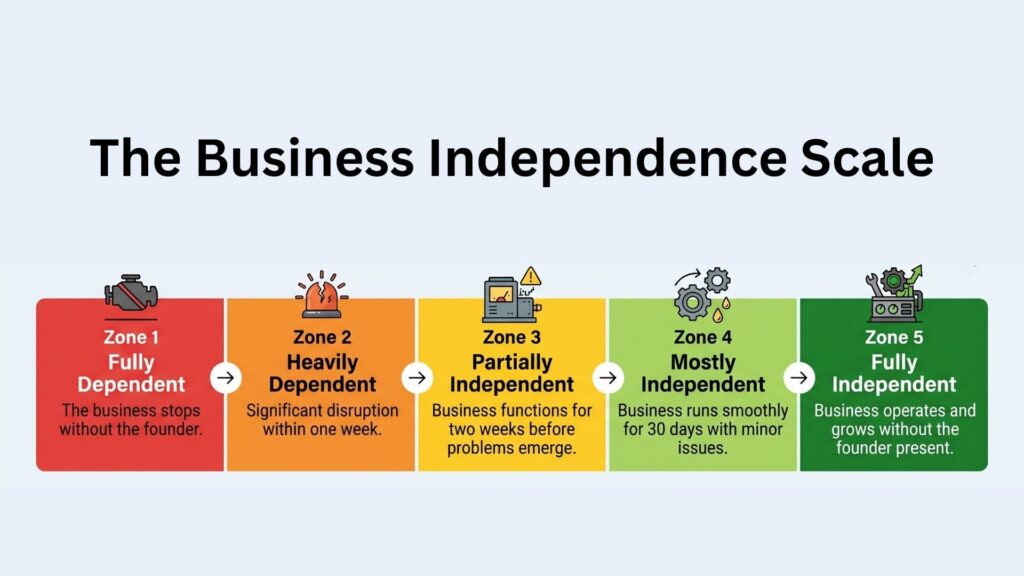
An owner-dependent business is one where the removal of the founder from daily operations would cause a measurable deterioration in performance within 30 days or less.
It is not about whether the founder is involved in the business. Founders should be involved. It is about whether the business can function, serve customers, generate revenue, and make reasonable decisions without the founder being present for every step.
The distinction is between a founder who chooses to be involved because their involvement adds strategic value and a founder who must be involved because the business has no functioning alternative.
The first is leadership. The second is dependency. And only one of them builds a business worth owning.
The 5 Signs Your Business Cannot Run Without You
Sign 1: You are the only person who knows how things work
If the answer to most operational questions is “ask the owner,” your business has a knowledge dependency problem. Critical processes, customer relationships, supplier contacts, system logins, and institutional knowledge live inside your head rather than inside documented systems that anyone on the team can access and follow.
This is the most common and most dangerous form of owner dependency because it is invisible until something goes wrong.
Sign 2: Decisions wait for you
If your team regularly pauses work, delays responses to customers, or holds off on moving forward until they can reach you, your business has a decision-making dependency. The team either lacks the authority to make reasonable decisions or lacks the framework to know what the right decision looks like.
Either way, the business can only move as fast as you are available to respond. That speed limit is invisible until you are unavailable for more than a day or two.
Sign 3: Your key client relationships are personal relationships
If your most important clients primarily relate to you rather than to your business, removing you from the relationship creates risk. Clients who chose you personally rather than your company are clients who may follow you if you leave, or churn if you become less available.
This is a particularly significant risk in service businesses, consulting practices, and agencies where the founder’s personality and reputation are central to the client relationship.
Sign 4: Revenue depends on your direct involvement
If the majority of new business comes from your personal network, your personal sales activity, or your direct involvement in the sales process, your revenue pipeline has a single point of failure. The moment you step back, the pipeline slows. The moment you step away entirely, it stops.
Sign 5: You feel guilty or anxious when you are not working
This is the most personal sign and often the most revealing. If taking a day off generates genuine anxiety about what might go wrong, if you find yourself checking messages during evenings and weekends not because you enjoy it but because you do not trust the business to handle things without you, the dependency is already affecting your quality of life as well as your business’s resilience.
The 30-Day Business Independence Test
Answer each question honestly with yes or no. Count your yes answers at the end.
☐ My team knows exactly what to do each day without me directing them
☐ Every key business process is documented and accessible to the relevant team members
☐ My business generates leads and enquiries through systems that do not require my personal involvement
☐ My team can handle customer questions, complaints, and escalations without contacting me for most situations
☐ My financial position is visible to at least one other person who can manage cash flow in my absence
☐ My key client relationships are managed at a company level, not solely through my personal contact
☐ My team knows who makes decisions and at what level when I am not available
☐ My business systems, passwords, and operational tools are accessible to the right people without me
☐ My business could onboard a new client without my direct involvement in the process ☐ I have taken at least five consecutive working days completely off in the last 12 months without significant problems arising
Your Score:
8 to 10 yes: Your business has strong independence. You have built genuine systems and a capable team. Focus on deepening the remaining gaps and preparing for the next stage of growth.
5 to 7 yes: Your business has partial independence. It can handle short absences but would struggle significantly over 30 days. You have a clear list of systems to build.
3 to 4 yes: Your business is heavily owner-dependent. A 30-day absence would cause real disruption. This is the most common score for founders at the 3 to 10 employee stage, and it is entirely fixable with deliberate effort over 90 days.
0 to 2 yes: Your business cannot currently run without you. This is not a judgment. It is a starting point. Every business starts here. The question is how deliberately and how quickly you build beyond it.
The 4 Systems Every Business Needs to Run Without the Owner
Building a business that can operate independently does not require a large team or expensive technology. It requires four fundamental systems working together.
System 1: Operations and Delivery
This is the system that answers the question: how does the work actually get done?
An operational system means that every key delivery process is documented, every team member knows their role within it, and every common problem has a known response protocol. It means that when a client asks a question, when a supplier misses a delivery, or when a project runs over schedule, the team knows what to do without asking the founder.
Start here. Document the three processes you personally handle most often. Write them as step-by-step checklists that a capable new hire could follow from their first week. This single action removes more owner dependency than almost anything else a founder can do.
System 2: Sales and Lead Generation
This is the system that answers the question: how does a new business find us when the founder is not personally selling?
A sales system means that your pipeline is not dependent on your personal network or your direct outreach. It means content, referrals, partnerships, or paid channels are generating enquiries through documented and repeatable processes. It means there is a clear sales process that a team member can execute, not just a founder who is good at closing.
This is often the last system founders build because it feels like the most personal. But a business where only the founder can sell is a business with a fundamental growth ceiling.
System 3: Financial Management
This is the system that answers the question: Does someone other than the founder understand the financial position of the business at all times?
A financial system means that cash flow is visible and tracked, invoices go out and get chased without the founder’s involvement, payroll is understood and manageable, and at least one other person can answer the question “are we financially healthy right now?” with confidence.
Many founders are the only person who truly understands their business’s financial position. That is a critical vulnerability that can turn a manageable challenge into a crisis during any period of founder absence.
System 4: People and Communication
This is the system that answers the question: does the team know how to communicate, decide, and escalate without the founder in the room?
A people and communication system means there is a clear meeting rhythm, a defined escalation path for decisions above a certain level of impact, and a shared understanding of what the business is trying to achieve in the current period. It means the team does not need the founder to tell them what matters today because the framework already does.
This is often the simplest system to describe and the hardest to actually build because it requires the founder to genuinely trust the team with real authority rather than nominal authority.

How to Reduce Owner Dependency in 90 Days
Building genuine business independence does not happen overnight, but it is not as complicated as most founders assume. Here is a practical 90-day framework.
Days 1 to 30: Document what only you know
Spend one hour each day writing down the processes, protocols, and decisions that currently live only in your head. Start with the tasks you repeat most frequently. Write them as simple checklists or step-by-step guides. If you need a solid framework to get started, check out our guide on how to write an SOP that scales your business. Store them somewhere the team can access. This alone will begin transferring critical knowledge out of your head and into the business.
Days 31 to 60: Delegate with a system, not just a task
Choose one complete function that you currently own personally and delegate it fully to a team member or a new hire. Not just the tasks, but the decision-making authority within that function. Brief them, support them, and then step back. Resist the urge to jump back in. The discomfort of stepping back is the exact feeling of a business becoming less dependent on you.
Days 61 to 90: Test the system deliberately
Take five consecutive working days completely offline. No email. No messages. No check-ins. Tell your team in advance. Brief them on how to handle common situations. Then actually disappear. When you return, review what happened. What was handled well? What created problems? What system is still missing? The problems that emerge during your five days offline are your priority list for the next 90-day cycle.
Comparison Table
| Business Factor | Owner Dependent Business | Owner Independent Business |
| Operations | Processes exist in the founder’s head | Documented, accessible, and team-executable |
| Decision-making | Waits for the founder’s availability | Clear authority levels and escalation paths |
| Sales pipeline | Driven by the founder’s personal network | Systematic and runs without founder involvement |
| Client relationships | Personal to the founder | Managed at the company level |
| Financial visibility | Only the founder truly understands it | Tracked and visible to key team members |
| Team behavior when the founder is away | Hesitation, delays, and escalations spike | Confident, self-directed execution |
| Founder experience | Always on, guilty when offline | Present by choice, not by necessity |
| Business value | Low, heavily discounted for key person risk | Higher, reflects genuine operational independence |
Quote
“The purpose of your life is not to serve your business. The primary purpose of your business is to serve your life.”
Michael E. Gerber, author of The E-Myth Revisited
Final Thoughts
The 30-day question is not really about 30 days. It is about what kind of business you are building and what kind of life that business is capable of giving you.
A business that cannot run without you is not a bad business. It is an unfinished one. Every business starts owner-dependent. The founders who build genuine independence are not the ones who work the hardest. They are the ones who work most deliberately on the business itself rather than endlessly in it.
The goal is not to remove yourself from your business. It is to make your presence a strategic choice rather than an operational necessity. To show up because your involvement creates value, not because the machine stops without you.
Start with the test. Count your yes answers honestly. Look at the gaps. Pick one system to build this month. Then build the next one.
Thirty days of independence do not happen in thirty days. It happens in the decisions you make today about how your business is allowed to function without you.
Ready to build the strategic foundation your business needs to operate independently? Download the Business Plan Template from Excellent Business Plans and give your business the structure that makes independence possible.
Next Steps: Start Building Your Business Independence This Week
You do not need to rebuild everything at once. Start here:
- Take the 30-Day Business Independence Test above and score yourself honestly
- Identify the single biggest knowledge gap that only exists in your head and write it down as a one-page process document this week
- Choose one task you personally handle every week and fully delegate it to a team member by the end of this month
- Schedule five consecutive working days offline in the next 90 days and commit to them as a genuine independence test
- Share your test score with one trusted team member or advisor and ask them what they think the biggest gap is
- Review your score again in 90 days and measure the improvement
Building a business that can run without you is one of the most valuable things you will ever do as a founder. Not just for the business but for yourself.
FAQs
1. Does building a business that runs without me mean I become less important? The opposite is true. When your business can run without your daily involvement, you become free to focus on the decisions, relationships, and opportunities that only you can pursue. The founder who is trapped in daily operations is the least strategically effective version of themselves. Removing yourself from the machine does not diminish your role. It elevates it.
2. How long does it realistically take to build a business that can run for 30 days without the owner? For most small businesses with two to ten employees, building genuine 30-day independence typically takes six to twelve months of deliberate, consistent effort. The first 90 days of documentation and delegation create the foundation. The following months deepen and test the systems. There are no shortcuts, but the progress is cumulative, and each system you build makes the next one easier.
3. What if I am a solo founder with no employees yet? The 30-day independence test is still relevant, but it looks different for a solo business. For a solopreneur, independence means having systems that handle lead generation, client communication, and administration even when you are not actively working. It means retainer income rather than purely project income. It means documented processes so that when you do hire your first person, the knowledge transfer is immediate rather than taking months.
4. Is owner dependency a sign that I am doing something wrong? No. Owner dependency at the early stages of a business is completely normal and often appropriate. The founder’s personal involvement is frequently what creates the quality and trust that builds the business in the first place. The problem is not dependency in the early stages. The problem is failing to deliberately reduce it as the business grows and the founder’s time becomes more valuable applied to strategy than operations.
5. What is the difference between being involved in my business and being dependent on my presence? Involvement means your contribution creates disproportionate value. Strategy, relationships, key hires, major decisions. These are high-leverage activities where founder involvement is genuinely additive. Dependency means the business cannot function at a basic operational level without you answering routine questions, making daily decisions, and handling tasks that a documented system or a capable team member could handle instead. The first is leadership. The second is a structural problem.
6. How does owner dependency affect the value of my business if I ever want to sell it? Significantly and negatively. Buyers and investors apply what is called a key person discount to businesses heavily dependent on the founder. A business that demonstrably runs without the founder is worth more, is easier to sell, and attracts a higher multiple than one where the value walks out the door with the owner. Building independence is not just a quality of life improvement. It is a direct financial investment in the value of what you are building.
References
- The Alternative Board via SCORE: Small Business Owners Work Long Hours But Get Little Done: https://www.thealternativeboard.com/pulse-survey-business-leaders-productivity
- Salesforce: Small Business Owners Lose 1.5 Hours Daily to Wasted Time 2024: https://www.salesforce.com/news/stories/small-business-productivity-trends-2024/
- Verified Metrics: Key Man Risk, The Person Who Can Make or Break Your Business: https://verifiedmetrics.com/blog/key-man-risk
- Gerber, Michael E. The E-Myth Revisited: Why Most Small Businesses Don’t Work and What to Do About It: https://www.amazon.com/E-Myth-Revisited-Small-Businesses-About/dp/0887307280
- Patriot Software: How Many Hours Do Business Owners Work: https://www.patriotsoftware.com/blog/accounting/how-many-hours-do-business-owners-work/
- McKinsey Institute for Economic Mobility: The Great Ownership Transfer 2026: https://www.mckinsey.com/institute-for-economic-mobility/our-insights/the-great-ownership-transfer-a-new-era-of-business-stewardship


