
Most business owners set goals. Far fewer set the right goals at the right time horizon. Here is how to build a three-tier goal framework that keeps your business moving in the right direction every quarter.
Learn the difference between short-term, mid-term, and long-term goals in a business plan. Discover how to set all three, connect them with quarterly KPIs, and build a system that actually delivers results.
Introduction: The goal that never becomes a plan
Most small business owners have goals. They want to grow revenue, expand into new markets, build a stronger team, and create a business that runs without them in the middle of everything.
The problem is not ambition. It is structure.
A goal without a time horizon is a wish. A long-term vision without short-term milestones is a dream with no path. And a quarterly plan disconnected from a three-year strategy is just busy work dressed up as progress.
The businesses that consistently move forward are not the ones with the biggest ambitions. They are the ones that have learned to organize their goals across three distinct time horizons, connect them to each other, and review progress regularly enough to stay on course.
This article shows you how to do exactly that.
The numbers behind the goal-setting gap
- According to Dr. Gail Matthews’ research at Dominican University, cited by Zippia, people who write down their goals are 42% more likely to achieve them compared to those who do not. Yet only 3% of the population sets goals at all, and only 1% writes them down.
- According to Blanchard, companies that review and set performance goals quarterly generate 31% more returns compared to those who review goals only annually. Frequency of review matters as much as quality of goal setting.
- According to Tability’s goal-setting analysis, the most common planning mistake is setting quarterly goals without long-term goals to anchor them to. A short-term goal that cannot be traced back to a long-term objective is likely consuming time and resources without building anything durable.
The data points to the same conclusion: setting goals is not enough. Writing them down, connecting them across time horizons, and reviewing them regularly is what separates the businesses that grow from those that stay stuck at the same level year after year.
Why most business goals stay on paper
There are three reasons goals fail to become results.
The first is that long-term goals are set without short-term steps. A business that decides it wants to double revenue in five years but has no plan for what that means this quarter has a vision, not a strategy.
The second is that short-term goals are set without long-term anchors. Teams race through quarterly priorities that feel urgent but do not compound. Short-term goals set without long-term anchors produce activity without lasting progress.
The third is that goals are reviewed too infrequently. Annual reviews are too far apart to course-correct in time. A business that checks its goals once a year discovers problems that have been compounding for months.
The solution is a structured three-tier goal framework with quarterly reviews built in as the engine that keeps everything moving.
The three time horizons every business plan needs
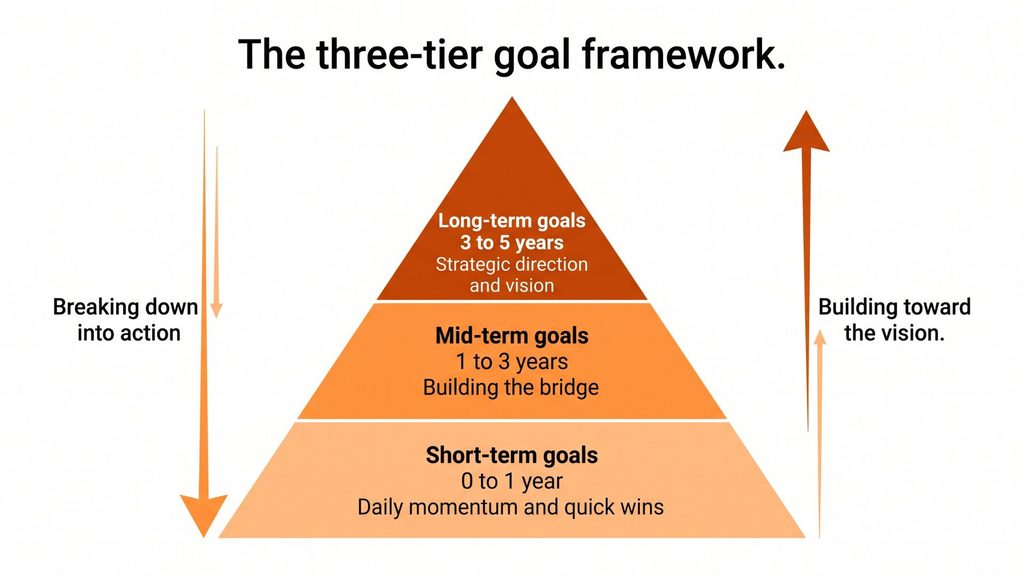
| Time Horizon | Timeframe | Focus | Review Cadence |
| Short-term goals | 0 to 1 year | Daily momentum, quick wins, operational KPIs | Monthly and quarterly |
| Mid-term goals | 1 to 3 years | Growth milestones, capability building, market expansion | Quarterly and annually |
| Long-term goals | 3 to 5 years | Strategic direction, vision, competitive positioning | Annually |
Each tier depends on the others. Long-term goals set the direction. Mid-term goals build the capabilities needed to get there. Short-term goals create the daily and quarterly momentum that makes progress visible and measurable.
SMART goal setting uses two directions at once. Backcasting starts at the top: define the 3- to 5 year vision first, then reason backwards to identify what must be true in years 1 to 3, and then what must happen in the next 0 to 1 year to stay on track. This is the top-down approach. Forecasting works the other way: start from where the business actually is today, extrapolate what is realistically achievable quarter by quarter, and use that data to sense-check whether the long-term vision is grounded in reality. The best business plans use both. Backcasting sets the ambition. Forecasting stress-tests it.
Long-term goals (3 to 5 years): Setting the direction
Long-term goals are the strategic foundation of the business plan. They describe where the business is headed and why, not what it will do next month.
These goals are broad by design. They cover revenue growth, market positioning, brand recognition, product development, team development, and operational resilience. They do not change frequently, and they should not. Long-term goals are the stable reference point that all shorter-term decisions are measured against.
Common long-term goals in a business plan:
- Achieve a net profit margin of 15% by year 5
- Expand into two new geographical markets within 4 years
- Become a recognized brand in the top 3 of the industry within 5 years
- Build an organization that operates without daily founder involvement within 3 to 5 years
- Achieve carbon-neutral operations by 2030
How to set them well:
Long-term goals should be ambitious but grounded in market reality. Use your SWOT analysis, competitive positioning, and financial projections from the business plan to make sure they are stretching but achievable. Set three to five long-term goals maximum. More than that dilutes focus and makes everything feel equally important, which means nothing gets the attention it deserves.
Long-term goals are the strategic foundation of the business plan. They describe where the business is headed and why, and should align with your long-term business strategy.
Mid-term goals (1 to 3 years): Building the bridge
Mid-term goals sit between the vision and the daily work. They translate the long-term destination into specific capabilities, milestones, and outcomes that need to be built over the next one to three years.
Think of mid-term goals as the answer to this question: what has to be true in year two or three for the long-term goal to remain on track?
If the long-term goal is to expand into two new markets within four years, the mid-term goals might include completing market research in year one, establishing one strategic partnership in year two, and launching a pilot in the first new market in year three.
Common mid-term goals in a business plan:
- Grow the customer base by 40% over the next two years
- Hire and onboard three key team members within 18 months
- Develop and launch a second product or service line within 2 years
- Achieve a customer satisfaction score of 90% or above within 18 months
- Build a six-month cash reserve within two years
Mid-term goals should be reviewed annually and adjusted based on what the short-term results are telling you about whether the plan is working.
Short-term goals (0 to 1 year): Creating daily momentum
Short-term goals are where strategy meets execution. They are specific, actionable, and time-bound. They answer the question: what needs to happen this quarter or this year to keep the mid-term and long-term goals on track?
Short-term goals without long-term anchors produce activity without direction. But long-term goals without short-term steps produce paralysis. The two must work together, with short-term goals derived from mid-term objectives, which are derived from long-term vision.
Common short-term goals in a business plan:
- Increase monthly sales by 15% in Q2 through a targeted email campaign
- Reduce average invoice payment time from 60 to 45 days within 6 months
- Launch a new social media advertising campaign and increase website traffic by 25% within 3 months
- Hire and onboard a new sales manager within the next quarter
- Implement a CRM system within the next 2 months
Every short-term goal should have a clear owner, a deadline, and a metric that defines success. Without all three, it is not a goal. It is a wish with a date attached.

Quarterly goals and KPIs: The engine that keeps it all moving
The quarterly cadence is the most practical tool for keeping short-term, mid-term, and long-term goals connected and on track. Here is how it works in practice.
At the start of each quarter, identify three to five priorities that directly support your short-term goals. Assign a KPI to each so progress can be measured objectively, not estimated by gut feel. For a deeper guide on building your KPI tracking system, see our KPI Dashboard guide.
Example quarterly goal structure:
| Quarterly Priority | KPI | Target | Owner | Person |
| Increase lead generation | Qualified leads per month | 50 leads per month | Marketing | Marc Smith |
| Improve cash flow | Average debtor days | Reduce from 60 to 45 days | Finance | Matteo Rossi |
| Strengthen client retention | Net Promoter Score (NPS) – CLTV | Increase from 20 to 40 | Operations | Arjun Mehta |
| Build team capability | Training hours per employee | 4 hours per quarter | HR | Claire Dubois |
| Grow online presence | Website sessions per month | +20% quarter on quarter | Marketing | Marc Smith |
Adding a named person next to the owner department is one of the simplest and most effective accountability improvements you can make. A department cannot be held accountable. A person can. When someone’s name is next to a target, the dynamic of the quarterly review changes entirely.
At the end of each quarter, review results against targets in a 60- to 90-minute session. What improved? What stalled? What needs to change next quarter? Without this review, goals are written once and forgotten until year-end.
How to balance all three without losing focus
The most common mistake business owners make with this framework is treating all three tiers as equally urgent. They are not. Long-term goals set the direction. Short-term goals demand attention. The discipline is keeping them connected rather than letting urgent short-term pressures push the long-term vision off the agenda entirely.
Three practical rules help maintain the balance:
Rule 1: Set long-term goals first, always. Before defining any quarterly priorities, confirm the long-term goals are clearly documented and agreed upon. Every short-term decision should be able to answer the question: which long-term goal does this support?
Rule 2: Review short-term goals monthly, mid-term goals quarterly, long-term goals annually. Different time horizons require different review frequencies. Reviewing long-term goals monthly creates anxiety. Reviewing short-term goals only annually creates drift.
Rule 3: Update goals when the business changes, not just when the calendar says so.
A new competitor, a significant customer loss, or an unexpected market opportunity are all valid triggers for reviewing and adjusting goals outside the regular cadence. The framework is a tool for making better decisions, not a rigid plan to follow regardless of what reality is telling you.
One related challenge worth addressing: how do you know if a target is set at the right level? Aim too high and the team loses motivation when results fall short. Aim too low and the business underperforms its potential. The most reliable approach is to anchor targets in historical data and realistic forecasting rather than aspiration alone. Look at what you achieved last quarter, factor in known market conditions, and set targets that stretch performance by 10 to 20% beyond the current baseline. This keeps goals ambitious enough to drive growth without becoming so unrealistic that they are quietly abandoned by week six.
A practical goal-setting framework for your business plan
Here is a simple one-page structure you can use to organize all three tiers in your business plan:
Long-term goals (3 to 5 years): Set annually, review annually. Write three to five goals that describe where the business will be in five years. Connect each to your vision statement.
Mid-term goals (1 to 3 years): Set annually, review quarterly. For each long-term goal, write one to two mid-term milestones that need to be reached in the next one to three years for the long-term goal to stay on track.
Short-term goals (0 to 1 year): Set quarterly, review monthly. For each mid-term goal, define two to three specific actions or outcomes for the current year. Assign a KPI, a deadline, and an owner to each.
Quarterly review (every 90 days): Review short-term goal progress against KPIs. Adjust priorities for the next quarter. Feed any significant market or business insights back into the mid-term and long-term goals if the situation has changed materially.
This structure takes less than a day to build and less than two hours per quarter to maintain. It is not complex. It is consistent. And consistency is what separates businesses that hit their goals from those that keep setting the same ones year after year.
“Be stubborn on the long-term vision but flexible on the details.”
— Jeff Bezos, Founder of Amazon
Final thoughts: Vision without structure is just optimism
A business plan full of goals that are never reviewed, never assigned to owners, and never connected to quarterly KPIs is a document, not a direction.
The three-tier framework in this article is not complicated. It asks one question at each level: where are we going in five years, what do we need to build in the next two years, and what do we need to do this quarter to stay on track?
Answer those three questions clearly, review the answers regularly, and the gap between setting goals and actually hitting them narrows considerably.
Your next step:
Start by documenting your long-term, mid-term, and short-term goals in one structured place. The Business Plan Template from excellentbusinessplans.com provides a complete framework for defining your goals across all three time horizons, along with your strategy, customer profile, and financial plan.
Once your goals are set, the KPI Sheet Template helps you assign measurable targets to each quarterly priority so that every review is grounded in data rather than impressions.
Frequently asked questions (FAQ)
1. What is the difference between short-term and long-term goals in a business plan?
Short-term (0-1 year): Specific, actionable steps for immediate results. Mid-term (1-3 years): Milestones bridging short-term actions and the long-term vision. Long-term (3-5 years): Broad, strategic direction.
2. How many goals should a business plan include?
Aim for 3 to 5 long-term goals. For each, set 1 to 2 mid-term milestones, and for those, set 2 to 3 short-term actions. Limit your goals to maintain focus and ensure the plan remains executable.
3. How often should I review business goals?
Review short-term goals monthly, mid-term goals quarterly, and long-term goals annually. Quarterly reviews are the most critical for small businesses to course-correct without over-assessing.
4. What is a KPI and how does it connect to business goals?
A KPI (Key Performance Indicator) is a metric that tracks progress toward a goal. Goals define what you want to achieve, while KPIs objectively measure whether you are getting there. Every short-term goal needs at least one KPI. For a practical guide on building your KPI tracking system, visit our KPI Dashboard guide.
5. What is the SMART framework for goal setting?
SMART stands for Specific, Measurable, Achievable, Relevant, and Time-bound. It acts as a practical test to ensure every goal has a clear metric, a realistic scope, and a defined deadline before being added to your plan. For a full breakdown of how to apply it, read our guide on the SMART goals framework.
6. Should long-term goals ever change?
Yes, but rarely. They should provide stable direction for 3 to 5 years. Only adjust them during annual reviews if there are fundamental market shifts, new major competitors, or business model changes.
References
- Zippia. (2026). 15+ Essential Goal-Setting Statistics: The Importance of Setting Goals. https://www.zippia.com/advice/goal-setting-statistics/
- Tability. (2026). Short-term vs. long-term business goals: Comparison and 50 examples. https://www.tability.io/odt/articles/short-term-vs-long-term-business-goals-comparison-examples
- Hubstaff. (2026). Long-term vs. short-term planning: Key differences and strategies. https://hubstaff.com/blog/long-term-vs-short-term-planning/
- Asana. (2026). What are long-term goals? 50+ examples and SMART tips. https://asana.com/resources/long-term-goals
- Marshberry. (2025). Short-term vs. long-term strategic goals: Why both matter for business. https://www.marshberry.com/resource/the-importance-of-both-short-term-and-long-term-strategic-goals/
- Bezos, J. (2013). Amazon Shareholder Letter. https://www.businessinsider.com/amazons-letter-to-shareholders-2013-4