



Most small businesses do not have a product problem. They have a visibility, trust, or messaging problem. Here is how to fix all three.
Struggling to attract new customers? Discover 7 proven strategies small business owners can apply today to fix the real reasons behind slow customer growth.
Introduction: The Problem Is Rarely the Product
Most business owners who struggle to attract customers assume the same thing: maybe the product is not good enough. Maybe the price is too high. Maybe the market is too competitive.
In most cases, they are wrong on all three.
The real reasons businesses fail to attract customers are far more fixable and far more specific. A message that speaks to everyone but connects with no one. A website that cannot be found. A great product with zero social proof. A marketing strategy that nobody is sure is actually working.
These are not product problems. They are communication, visibility, and trust problems. And every one of them has a proven fix.
This article walks you through seven of the most common reasons small businesses struggle to grow their customer base, and exactly what to do about each one.
The Numbers That Explain Why This Is So Common
You are not alone in this struggle. The data makes that very clear.
- According to Fortunly’s 2025 small business report, 42% of small businesses fail simply because no one wants to buy what they are selling. It is worth noting that this is not always a marketing failure; a business can have excellent marketing and still fail if there is no meaningful market demand for the solution in the first place.
- According to a 2024 global survey by Constant Contact and Ascend2, 60% of small business owners say finding new customers is their single biggest marketing challenge, ranking above budget, competition, and time.
- According to LocaliQ’s 2025 Small Business Marketing Trends Report, 65% of small businesses say customer referrals are their best source of new customers, yet most have no formal system in place to generate them consistently.
- According to PostcardMania’s 2025 marketing statistics guide, 73% of small businesses worldwide are not sure their current marketing strategy is actually working.
When nearly three out of four business owners are uncertain whether their marketing is delivering results, the problem is not effort. It is direction.
Why most fixes do not work, and what actually does
The instinct when customers stop coming is to do more: more social media posts, more ads, more discounts. But doing more of the wrong thing rarely fixes the underlying problem.
The businesses that successfully grow their customer base do something different. They stop adding activity and start diagnosing the actual gap.
- Is the problem awareness?
- Do people even know you exist?
- Is it trust?
- Do potential customers believe you can deliver?
- Is it fit?
- Are you reaching people who actually need what you offer?
- Or is it something more fundamental?
- Is there actually enough market demand for what you are selling?
The seven fixes below address each of these gaps in order of where most small businesses go wrong first.
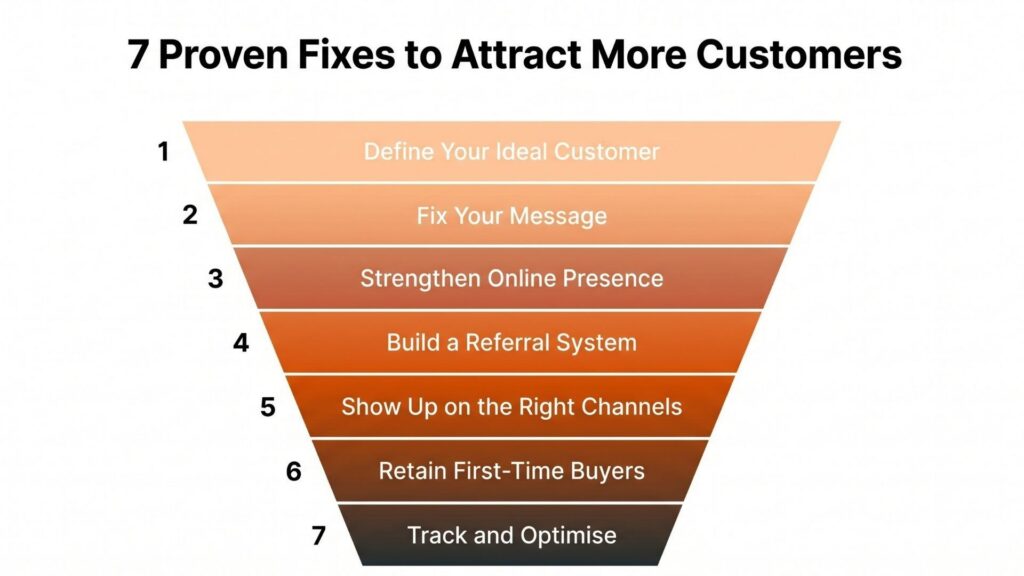
Fix 1: Validate Market Demand and Get Clear on Who Your Ideal Customer Is
Before any marketing can work, you need to confirm two things: that customers actually want your solution, and that you know exactly who those customers are.
Start with demand. Even the best marketing cannot save a product nobody needs. Four honest questions to ask before investing further in your marketing:
- Are people already paying competitors for something similar?
- Have your own customers purchased from you more than once?
- Can you generate pre-orders or commitments before fully launching?
- Are customers actively searching online for the problem you solve?
If the answers are mostly no, the issue is not your marketing; it is market fit, and that requires a different conversation entirely. If the answers are mostly yes, the next step is getting precise about who you are serving.
Most small businesses try to appeal to everyone. The result is a message that resonates with no one. You need a specific customer profile, not a vague demographic like “women aged 25-45,” but a real picture: what problem are they trying to solve, what language do they use to describe it, what have they already tried, and why did it not work?
Start by interviewing your three best existing customers. Ask them why they chose you. The words they use are the words your marketing should be using.
Fix 2: Fix Your Message Before You Fix Your Marketing
A common mistake is investing in marketing channels, social media, ads, and SEO before having a clear message. If you cannot explain in one sentence what you do, who it is for, and why it matters, no marketing channel will fix that.
A strong message answers three questions instantly: What real problem do you solve? Who is it for? What changes for them after working with you? What is the transformation or outcome?
One framework that works well here, used by many SaaS companies and popularized by Alex Hormozi’s Grand Slam Offer concept, is this sentence structure:
“We help [customer] achieve [desired outcome] without [major frustration].”
Fill in those three blanks clearly and specifically, and you have the core of a message that converts.
Test your current message on someone unfamiliar with your business. If they cannot summarize it back to you correctly within 30 seconds, it needs simplifying. Clarity always outperforms cleverness.
Fix 3: Make Your Online Presence Work While You Sleep
According to Clutch’s 2024 small business statistics, 89% of customers read online reviews before making a purchase decision. If your online presence is thin, outdated, or hard to find, you are losing customers before they ever contact you.
Three things to fix immediately: make sure your Google Business Profile is complete and active, ensure your website loads quickly on mobile, and make sure you have at least ten recent, genuine reviews visible to potential customers. These three alone can significantly increase the number of people who choose you over a competitor.
Fix 4: Build a Referral System That Runs on Its Own
Referrals are the highest-converting source of new customers for most small businesses, yet most businesses leave them entirely to chance. A happy customer who would gladly recommend you simply forgets to unless you make it easy and give them a reason.
The most reliable way to build this system is through email. Set up a simple email follow-up sequence that goes out automatically after a positive outcome: a thank-you message first, followed by a request for a review or referral, and finally an exclusive offer for returning customers. Most referrals are lost not because customers are unwilling, but because the business never asks.
Make the ask specific, not generic. Offer a small incentive if appropriate. According to ReferralCandy’s 2024 benchmarks, referred customers convert 3 to 5 times faster than paid leads and deliver 16 to 25% higher lifetime value. A referral system does not need to be complex; it just needs to exist.
Fix 5: Show Up Where Your Customers Are Already Looking
One of the most common visibility mistakes is being active on the wrong channels. A B2B consultant spending hours on Instagram while their ideal clients are on LinkedIn is wasting effort. A local café investing in paid search while their customers discover new places on Google Maps is missing the obvious.
Before choosing a marketing channel, ask: where does my ideal customer go when they are looking for what I offer? Then go there first. Own one channel well before spreading thin across many. Consistency in the right place beats activity in the wrong place every time.

Fix 6: Turn First-Time Buyers Into Repeat Customers
Attracting a new customer costs five to seven times more than retaining an existing one. Yet most small businesses invest almost everything in acquisition and almost nothing in retention. The result is a leaking bucket, with new customers coming in while existing ones quietly walk out.
After a first purchase or project, have a deliberate follow-up sequence: a check-in message, a relevant piece of value, and an exclusive offer for returning customers. The goal is to make coming back feel natural and rewarding. A customer who buys twice is significantly more likely to buy a third time, and to refer others.
To know whether retention is actually improving, track these three metrics consistently:
- Repeat Purchase Rate: What percentage of customers come back for a second purchase?
- Customer Lifetime Value (CLV): How much total revenue does a customer generate over the full relationship?
- Average Order Value (AOV): Are returning customers spending more per transaction over time?
Retention is your cheapest customer acquisition strategy, but only if you are measuring it.
Fix 7: Track What Is Working and Cut What Is Not
According to PostcardMania’s 2025 report, 73% of small businesses are not sure their marketing is working. The reason is almost always the same: they are not tracking results in any systematic way.
You do not need a complex analytics setup. Start simple. For every marketing activity, ask: how many leads did this generate, and how many of those became customers? After 30 days, double down on the one or two activities with the best results and pause everything else. Data removes guesswork and focuses your limited time and budget where it actually matters.
7 Fixes at a Glance: Effort, Cost, and Speed of Results
| Fix | Effort | Cost | Speed of Results |
| Validate demand and define your customer | Low | Free | Immediate clarity on direction and messaging |
| Fix your message (consider A/B testing) | Low | Free | Fast, within days |
| Strengthen online presence | Medium | Medium | Medium, weeks to months |
| Build a referral system via email | Low | Low | Fast, within weeks |
| Show up on the right channels | Medium | Low to medium | Medium, weeks |
| Retain first-time buyers | Low | Low | Fast, compounds over time |
| Track and cut what does not work | Low | Free | Immediate clarity |
Most of these fixes require a shift in focus rather than a bigger budget. The ones that do require investment pay back quickly when pointed in the right direction.
Quote:
“The aim of marketing is to know and understand the customer so well that the product or service fits him and sells itself.”
— Philip Kotler, Author of Marketing Management
Final Thoughts: You Do Not Need More Customers. You Need Better Ones.
There is an important distinction worth making before you apply any of these fixes. This article is about attracting more customers. But what most businesses actually need is better customers, the ones who buy repeatedly, refer others, and value what you do enough to pay a fair price for it.
The businesses that consistently grow are not necessarily the ones spending the most on marketing. They are the ones who are clearest about who they serve, most consistent in how they show up, and most deliberate about turning every customer interaction into a long-term relationship.
Get specific about who your ideal customer is before changing anything else. Everything else, your message, your channels, your referral system, becomes sharper once that foundation is solid.
Your next step:
Before spending more on advertising, make sure you understand exactly who your ideal customer is. The Customer Persona Template from excellentbusinessplans.com helps you identify customer needs, buying triggers, and pain points, so you attract better customers, not just more of them.
Once your persona is clear, the Marketing Plan Template helps you turn those insights into a focused customer acquisition strategy with measurable goals and actions. For businesses looking for a complete planning system, EBP also offers marketing and startup planning bundles that combine multiple tools into one practical framework.
Frequently Asked Questions (FAQ)
1. Why is my small business not attracting customers? The most common reasons are an unclear message, weak online visibility, no referral system, and marketing on the wrong channels. However, it is also worth asking a more fundamental question first: is there genuine market demand for what you offer? If competitors are thriving in the same space, the issue is likely visibility or messaging. If the whole category is struggling, the issue may be market fit. Diagnose the right problem before applying any fix.
2. What is the fastest way to get more customers for a small business? Activate your existing network first. Reach out personally to past customers, ask for referrals, and make sure your Google Business Profile is complete and up to date. These three actions cost nothing and can generate new customer inquiries within days.
3. How do I find my ideal customer? Start by interviewing your three best existing customers. Ask them why they chose you, what problem you solved for them, and what they would say to a friend about your business. Their answers reveal the exact language and pain points your marketing should be speaking to. A second powerful method: analyze your existing CRM or sales data using the Pareto principle. In most businesses, roughly 20% of customers generate 80% of revenue. Identify that segment clearly, their profile is your ideal customer.
4. How much should a small business spend on marketing to attract customers? According to Intuit’s 2025 research, the average estimated marketing budget for a small business is $78,000 per year. However, budget matters far less than focus. Before setting a budget, calculate your Customer Acquisition Cost (CAC), the total marketing and sales spend divided by the number of new customers acquired. This tells you exactly what each new customer costs and helps you identify which channels deliver the best return. Owning one channel well almost always outperforms being average on five.
5. How do referrals help attract more customers? Referred customers convert 3 to 5 times faster than leads from paid advertising and tend to have significantly higher lifetime value. They also come with built-in trust, which shortens the sales process dramatically. A simple, consistent referral ask process, ideally delivered through an automated email sequence, is one of the highest-ROI customer acquisition strategies available to any small business.
6. How do I know which marketing channel is right for my business? Go where your ideal customer already goes when they are looking for what you offer. If they search on Google, invest in SEO or Google Ads. If they ask peers for recommendations, invest in referral systems and community presence. If they research on LinkedIn, show up there consistently. Channel choice should follow customer behavior, not personal preference.
7. How do I know if my business has a marketing problem or a market demand problem? If customers understand your offer but still choose not to buy, the issue may be market demand; there is simply not enough need or urgency for what you are selling. If customers rarely discover your business or do not understand your value proposition, the issue is usually visibility, trust, or messaging. The clearest way to find out: talk directly to people who did not buy from you. Their reasons will tell you exactly which problem you are actually dealing with.
References
- Fortunately. (2025). Percentage of Small Businesses That Fail: 2026 Data. https://fortunly.com/articles/what-percentage-of-small-businesses-fail/
- Constant Contact & Ascend2. (2024). Top Marketing Challenges of Small Businesses. Reported by MarketingProfs. https://www.marketingprofs.com/charts/2024/51206/top-marketing-challenges-of-small-businesses
- LocaliQ. (2025). The Big Small Business Marketing Trends Report for 2025. https://localiq.com/blog/small-business-marketing-trends-report/
- PostcardMania. (2025). 143 Small Business Marketing Statistics: The Definitive Guide. https://www.postcardmania.com/blog/small-business-marketing-statistics-definitive-guide/
- Clutch. (2024). 7 Small Business Stats to Know in 2025. https://clutch.co/resources/small-business-stats
- ReferralCandy. (2024). Customer Acquisition Strategy Benchmarks. Cited in Saras Analytics. https://www.sarasanalytics.com/blog/customer-acquisition-strategy
- Kotler, P. (2000). Marketing Management. Prentice Hall. https://www.amazon.com/Marketing-Management-Philip-Kotler/dp/0136009980


