
Know when cash will arrive, when payments are due, and what to do before a shortfall becomes a crisis.
Introduction: Sales are coming in. Can you pay next Friday?
Imagine opening your banking app on Monday morning. The balance looks comfortable. Customers owe you money, new orders are arriving, and the business feels busy.
Then you check the calendar. Payroll is due on Friday. A supplier payment clears the following Monday. An equipment deposit falls in the same week, while a major customer is unlikely to pay until the week after.
The question is no longer “Are we making sales?” It is “Will the money arrive before we need to spend it?”
A 13-week cash flow forecast helps answer that question. It lays out expected receipts and payments week by week, showing when your cash balance could fall below a level you are comfortable with. BDC recommends this rolling weekly approach for closer visibility than a monthly budget alone provides.
This guide explains how to build the forecast, identify your most vulnerable week, and turn the numbers into specific actions.
Business facts: Why planning ahead matters
In the Federal Reserve Banks’ 2026 Report on Employer Firms, based on the 2025 Small Business Credit Survey, 56% of financing applicants cited meeting operating expenses as a reason for seeking funding. Only 42% of applicants received the full amount they sought. These findings concern surveyed U.S. employer firms, not every small business worldwide.
Applying for funding does not make that money available for Friday’s payroll. Build your forecast around realistic dates and explicit funding assumptions—not the hope that cash will appear when needed.
What a 13-week cash flow forecast actually shows
A cash flow forecast follows money entering and leaving your business. It is not the same as a sales forecast: a sale belongs in the cash forecast when the payment is expected to reach your bank account.
Thirteen weeks provides roughly a quarter of visibility. Each column represents a week, and each row represents a category of cash movement. The basic calculation is:
Opening cash + cash received − cash paid = closing cash.
That closing balance becomes the next week’s opening balance.
Use the forecast as a rolling window. Once a week is complete, record what actually happened and add another future week, keeping thirteen weeks ahead in view.
This article uses Northstar Supply, a fictional office-supplies distributor in the 13 Week Cash Control Dashboard. All figures are in U.S. dollars. The 2027 dates belong to a teaching simulation, not real company accounts.
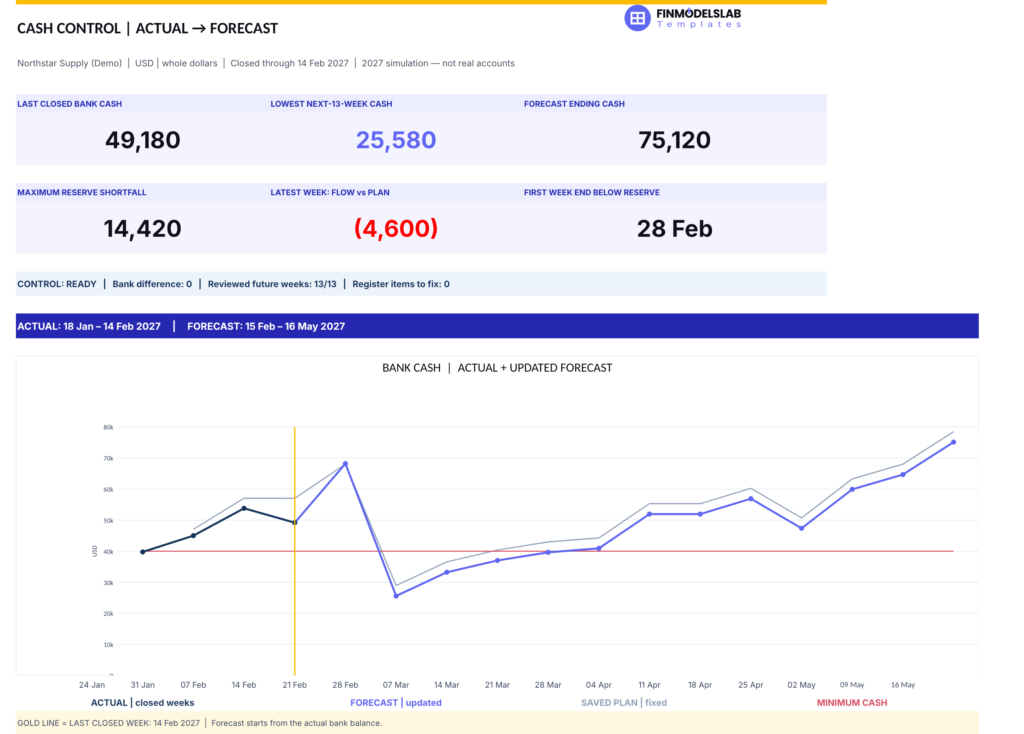
Figure 1. The workbook’s Dashboard separates actual cash, the forecast low point, the final balance, and the reserve shortfall. The chart also distinguishes actuals, the updated forecast, and the saved plan.
Step 1: Start with a bank balance you can trust
Choose a clear starting point, such as the Monday after your most recently completed week. Use the reconciled closing bank balance from that completed week as the starting cash for the forecast.
Gather your bank records, outstanding customer invoices, unpaid supplier bills, payroll dates, recurring commitments, tax payment dates, and financing schedules. Keep the supporting information beside the forecast so each important number can be explained.
Use a consistent scope. For example, decide which business bank accounts are included. Transfers between those included accounts should not create new business receipts or expenses. Show restricted funds separately rather than treating them as available for routine payments.
In the fictional workbook used below, Northstar Supply has $49,180 of reconciled bank cash on February 14, 2027. That is the opening balance for the forecast beginning February 15—not an estimate and not the amount customers owe.
Step 2: Build a weekly calendar and set a minimum reserve
Create thirteen dated columns. Label each with its start and end date rather than relying only on “Week 1” and “Week 2.”
Organize the rows into three sections:
| Section | What to include |
|---|---|
| Operating cash | Customer collections, cash sales, supplier payments, payroll, rent, taxes, and other operating payments |
| Investing cash | Equipment purchases and proceeds from selling business assets |
| Financing cash | Loan proceeds, repayments, owner contributions or withdrawals, and credit-line movements |
The accompanying workbook also groups interest and finance fees within financing for its management view. The essential control is that every cash movement appears once and feeds the closing bank balance.
Next, set a minimum cash reserve: the balance you want to protect while meeting your commitments. In the teaching case, it is $40,000. This is a management assumption, not a universal recommendation or a legal minimum. To choose a reserve for your own business, list the essential payments you could not comfortably postpone and test the effect of your largest uncertain receipts arriving late. Revisit the reserve when those exposures change.
Keep unused credit separate from bank cash. In this model, a credit facility increases the cash balance only when a drawing is explicitly scheduled. Available borrowing capacity remains a separate measure.
The screenshots in this guide come from the 13-week cash flow forecasting template. You can follow the same process in a spreadsheet you build yourself.
Step 3: Forecast when customers will actually pay
For incoming cash, the important date is the expected payment date—not merely the invoice date or the contractual due date. British Business Bank specifically recommends entering receipts when payments are expected to reach the account.
Start with invoices already issued. Record the customer, unpaid amount, due date, expected collection date, and person responsible for following up. Use customer confirmations and observed payment behavior to support the timing.
The workbook makes the distinction visible. Cedar Office Group’s invoice was originally $9,880, but only $5,000 remains open. Its due date is February 2; the revised expected collection date is February 17. Harbor Workspace has another $2,000 outstanding, expected on February 18 after missing its February 9 due date. These are fictional entries, but the control is specific: forecast the unpaid amount on a supported collection date, not the original invoice total on an outdated due date.
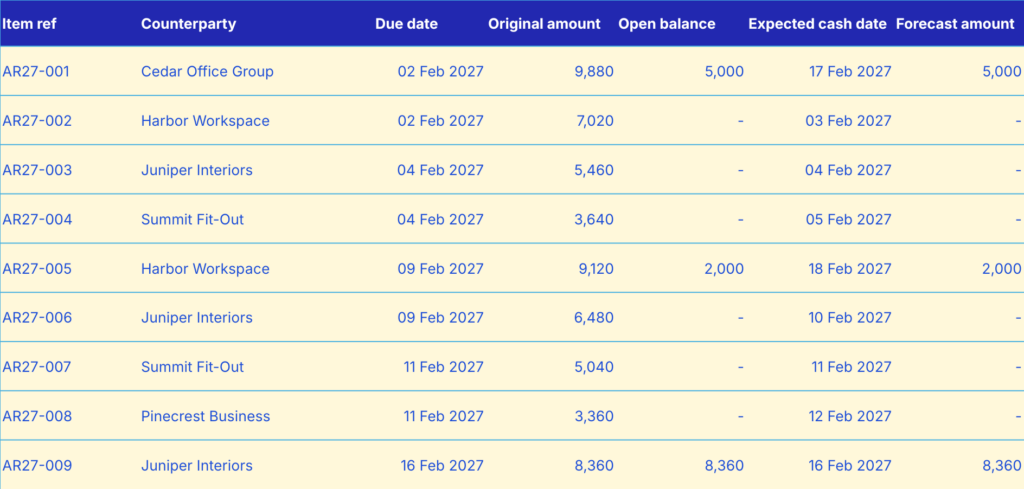
Figure 2. A crop from the Receivables sheet. Cedar’s $5,000 and Harbor’s $2,000 remain visible after their original due dates. Settled balances are not counted again as future receipts.
For a large or overdue invoice, record what supports the revised date: a customer confirmation, an agreed installment, or an established payment pattern. Repeatedly moving the same overdue amount into next week without new evidence simply moves the risk out of sight. Keep it visible and test a later collection separately.
Forecast cash from future sales separately. A cash sale and a sale made on thirty-day terms do not produce the same collection schedule. Label uncertain assumptions so they can be challenged during the weekly review.
Avoid double counting. When a forecast sale becomes an invoice in your receivables schedule, move it between the supporting schedules rather than adding a second collection. In the supplied workbook, the receivables register and manual weekly totals are alternative input methods for the same collection line.
Step 4: Put every payment in the correct week
Schedule outgoing cash according to when you expect to pay it. Include more than routine overheads: equipment purchases, loan repayments, and owner payments can also affect cash. Business Victoria’s forecasting guidance specifically highlights these non-routine outflows.
Put payroll in the actual pay week, not an equal allocation across every week. Enter rent when it is due. Include annual subscriptions, insurance payments, planned purchases, and tax payments at their expected settlement dates.
Check purchases already included in the supplier register before adding them to a separate purchases forecast. The same supplier payment should not appear in both places.
Do not add depreciation as a cash payment. Schedule the equipment payment itself. For taxes such as VAT or sales tax, use a consistent approach that captures actual customer receipts, supplier payments, and remittances without omitting or duplicating the tax component.
Finally, make borrowing visible. A planned loan should have a receipt date and associated repayments and costs. Do not insert an unexplained financing amount just to remove a shortfall.
Step 5: Find the cash low point—and decide what to do
Read the entire forecast, not just Week 13. Focus on three questions: What is the lowest projected balance? When does it occur? How far below your reserve does it fall?
Northstar Supply’s forecast finishes with $75,120, but its lowest weekly closing balance is only $25,580. Against the chosen $40,000 reserve, that creates a $14,420 reserve shortfall.
The forecast does not show a negative closing bank balance. It shows a breach of the business’s chosen safety buffer. The owner needs to decide whether that exposure is acceptable and what action could reduce it.
Possible actions to test include collecting a specific invoice earlier, negotiating a different payment schedule, deferring a nonessential purchase, or arranging financing. BDC identifies collection management, financing discussions, and negotiated payment terms as possible cash-management measures.
Give each proposed action an amount, date, owner, and confirmation status. “Improve collections” is not enough. “Confirm whether Customer A can pay $8,000 by Thursday” is something the team can follow up.
A revised spreadsheet is not an agreement. Keep an unconfirmed payment extension or funding request visible as a scenario until the relevant party agrees.
Step 6: Update the forecast and explain the differences
The forecast becomes more useful when you compare estimates with actual cash movements and investigate the differences. Business Victoria identifies this review as a central part of the forecasting process.
Use a consistent weekly routine: record actual receipts and payments, reconcile the closing balance to the bank, compare the result with the saved forecast, then update the remaining weeks and add the new thirteenth week.
Keep the previous forecast. Without a saved version, you lose the ability to distinguish what you expected from what actually happened.
Classify important differences as either timing or amount changes. A customer payment arriving a week late is a timing change. An invoice settled for less than expected is an amount change. A supplier payment postponed to next week has not become a saving. Measure collections and payments separately; matching errors can cancel out in the net total while still exposing weak assumptions.
Keep overdue invoices visible. A missed collection date should trigger follow-up and a revised assumption, not cause the unpaid balance to disappear from the forecast.
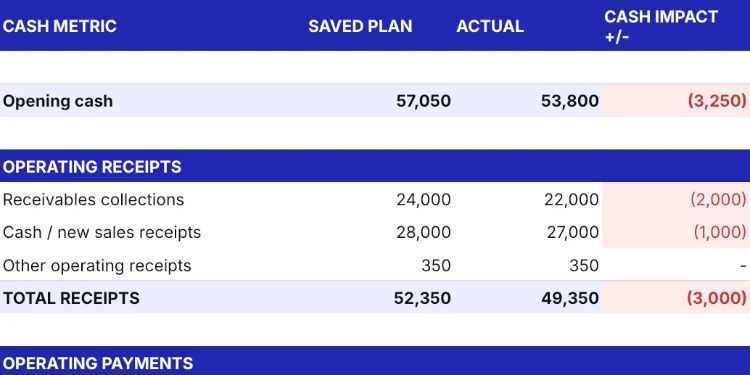
Also distinguish the week’s cash-flow variance from the difference in closing cash. In the workbook’s week ending February 14, 2027, actual cash movement was $4,600 worse than plan. The closing balance was $7,850 below plan because the week had already started $3,250 behind. Blaming the entire $7,850 on that week would misdiagnose the problem.
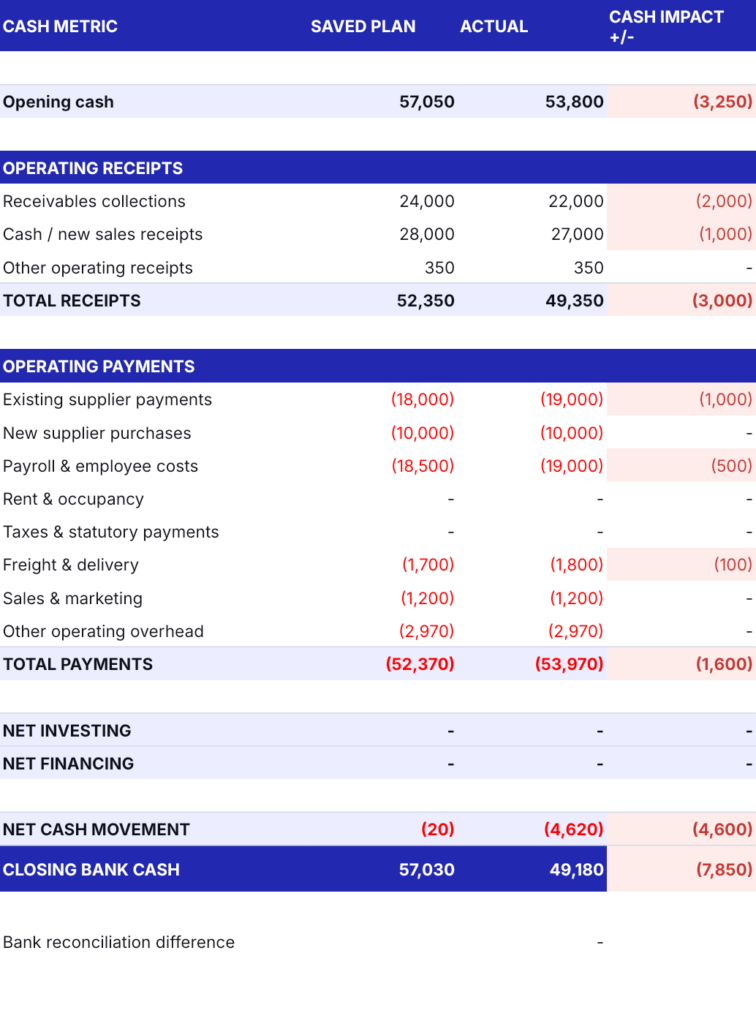
Figure 3. The Plan vs Actual sheet for the week ending February 14, 2027. The opening-cash difference plus the week’s cash-flow variance explains the closing-cash difference. Parentheses indicate negative amounts.
A practical example: Fix the timing, not just the final balance
Return to Northstar Supply’s original forecast. All figures below are from the same fictional workbook introduced above.
The forecast covers February 15–May 16, 2027. Week 1 closes with $68,190. In Week 2, ending February 28, an equipment payment coincides with payroll and supplier payments.
| Week 2 cash movement | Amount |
|---|---|
| Opening bank cash | $68,190 |
| Operating receipts | +$46,000 |
| Operating payments | −$53,710 |
| Equipment payment | −$48,000 |
| Net financing cash | +$13,100 |
| Closing bank cash | $25,580 |
| Minimum cash reserve | $40,000 |
| Shortfall against the reserve | $14,420 |
Net financing consists of $15,000 in loan proceeds, less $1,500 of principal repayments and $400 of interest and fees. Operating cash flow alone is −$7,710; the total cash movement, including investing and financing, is −$42,610.
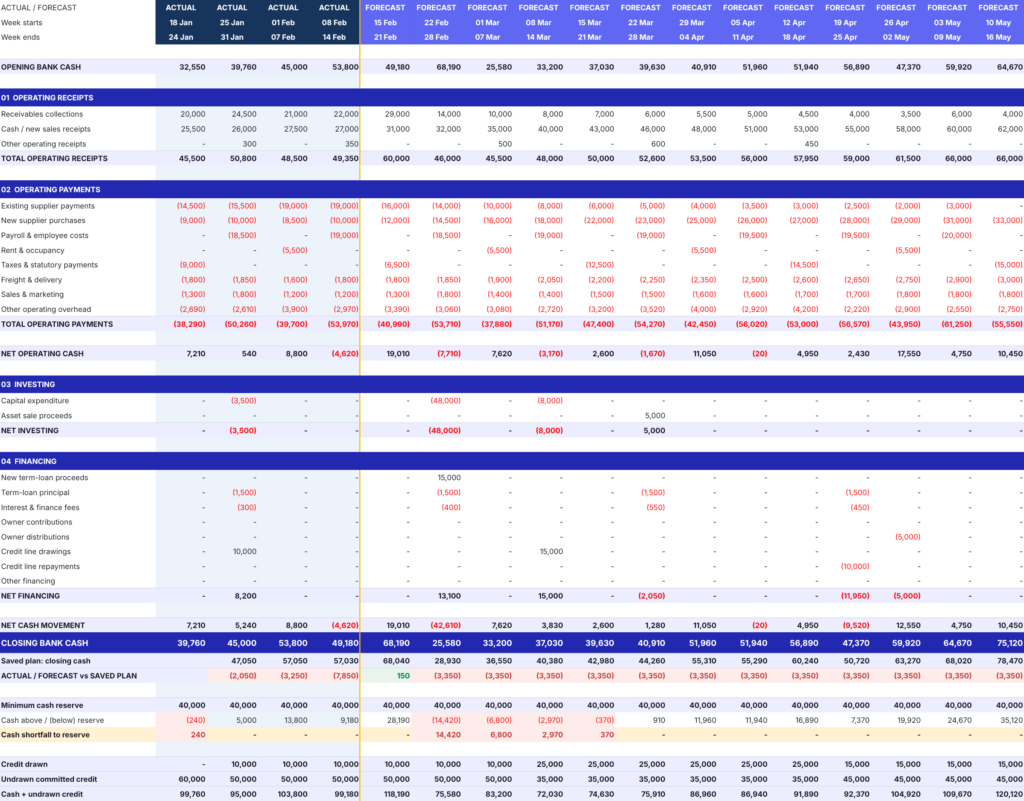
Figure 4. The original Cash Flow sheet. The first four dated columns are actuals; the next thirteen are forecasts. The column ending February 28 shows the equipment payment and reserve shortfall. This screenshot shows the original forecast, not the revised scenario below.
Test a specific payment-timing change
Suppose the equipment supplier agrees to move $15,000 of the Week 2 payment to Week 8, ending April 11. The payment does not disappear. Week 2’s equipment payment falls from $48,000 to $33,000, and a $15,000 payment is added to Week 8.
This is an additional scenario for the article, not an agreement already recorded in the original workbook. It assumes no extra fees, no effect on delivery, no change to loan terms, and no other changes to the original forecast—including its existing borrowing assumptions.
The lowest weekly closing balance rises from $25,580 to $40,580. The revised forecast stays above the $40,000 threshold at each week-end. Once the postponed payment is made in Week 8, the two cash paths rejoin. Both still finish Week 13 at $75,120.
| Measure | Original forecast | Payment-rescheduling scenario |
|---|---|---|
| Lowest weekly closing cash | $25,580 | $40,580 |
| Difference from the $40,000 reserve at the low point | −$14,420 | +$580 |
| Week 13 closing cash | $75,120 | $75,120 |
The remaining cushion at the low point is only $580. A relatively small collection delay could remove it. Treat the result as a reason to examine the risk—not proof that the cash position is secure.
For instance, test a $5,000 receipt delayed beyond Week 2. With everything else unchanged, the revised Week 2 balance would fall to $35,580, below the reserve again.
Checking your bank balance vs. using a cash flow forecast
| Question | Bank balance alone | A dated weekly forecast |
|---|---|---|
| How much cash do we have now? | Shows the current position | Starts from the reconciled position |
| What happens when several payments fall together? | Does not show future commitments | Places those payments in their expected weeks |
| How would a late customer payment affect us? | Shows the result after it happens | Lets you test the timing change beforehand |
| Can we afford a planned purchase? | Shows the cash available today | Shows the projected effect across the forecast |
| What action should we prioritize? | Does not identify the future pressure point | Helps identify its timing, amount, and main drivers |
The forecast does not replace bank records. In this workflow, actual bank information anchors the forward-looking calculation.
Key takeaways and a first-forecast checklist
Start with reconciled cash. Forecast receipts when customers are expected to pay, and payments when money is expected to leave. Then look for the lowest balance—not just the final one.
Before using your first forecast, check that all thirteen weeks are dated, financing is explicit, invoice collections and supplier payments are not duplicated, and the reserve threshold is visible. Keep a saved forecast for comparison and assign responsibility for the next update.
At the next weekly review, ask which customer payment is least certain, which outgoing payment could change the low point, and who will confirm each assumption. Those answers determine whether the forecast is ready to support a spending decision.
Frequently asked questions
Is a 13-week forecast the same as a monthly financial forecast?
No. Use the weekly forecast to examine near-term payment timing. A broader financial forecast can also include revenue, profit, investment, and balance-sheet projections. BDC presents the weekly rolling view as a way to obtain closer cash visibility alongside broader financial planning.
What should I do when a customer’s payment date is uncertain?
Record your best-supported expected date, document the uncertainty, and test a later date separately. For a large invoice, contact the customer rather than treating the contractual due date as confirmation. In this article’s example, even a $5,000 timing change can alter the reserve result materially.
Does a positive weekly closing balance mean every payment is covered?
Not necessarily. Imagine starting a week with $5,000, paying $10,000 on Tuesday, and collecting $12,000 on Friday. The weekly closing balance is $7,000, but Tuesday still presents a $5,000 gap before any financing or rescheduling. Add daily detail around tight weeks.
Should I include an overdraft or credit line as opening cash?
Keep bank cash and undrawn capacity separate, as the teaching workbook does. Enter a proposed drawing in the week it is expected to reach the account, together with its costs and repayment assumptions. Confirm that the facility is usable; a limit alone is not a scheduled cash receipt.
How often should I update the forecast?
Update it every week to maintain the thirteen-week view, and revisit significant assumptions when something material changes. BDC recommends refreshing the rolling forecast at the beginning of each week.
About the author
Henry Sheykin creates financial planning tools through Financial Models Lab. The 13 Week Cash Control Dashboard used in this article is his workbook. Its cash reconciliation, collection schedules, explicit financing inputs, and saved-plan comparisons provide the framework for this guide.
Sources
[1] BDC. “4 key steps to plan your cash flow in the coming year.”
[3] British Business Bank. “How to create a cash flow forecast in 4 steps.”
[4] Australian Government, business.gov.au. “Set up a cash flow statement.”
[5] Business Victoria. “Cash flow forecasting.”
Workbook and image source: Henry Sheykin, “13 Week Cash Control Dashboard.xlsx.” The four images are rendered crops of its original worksheets, with original figures, formatting, and charts. The payment-rescheduling and delayed-collection scenarios are additional calculations for this article; they do not appear in the screenshots and are not real transactions or agreed outcomes.