



Poor customer service is silently draining your revenue. Here is exactly what to fix, and how to fix it.
Discover 10 proven Ways to improve customer service for your small business, with real stats, practical steps, and tools you can apply today.
Introduction: The customer who left without saying a word
Most unhappy customers do not complain. They simply leave.
They stop replying to emails. They do not renew. They find a competitor who made them feel heard. And the worst part? You never find out why.
This is the silent cost of poor customer service. It does not show up in a single dramatic moment. It shows up in a slowly shrinking retention rate, in referrals that never come, and in reviews that sting when you finally read them.
The good news is that improving customer service is not about hiring more staff or installing expensive software. It is about getting a handful of fundamentals consistently right. This article gives you 10 ways that work, practical, tested, and applicable to any business at any size.
The numbers that should make every business owner pay attention
Before the Ways, the context. Because the cost of getting customer service wrong is not abstract.
- According to Bain & Company research cited by Harvard Business Review, a 5% increase in customer retention can boost profits by 25 to 95%, making retention one of the highest-ROI investments a business can make.
- According to Salesforce research, 93% of customers say they are more likely to make repeat purchases from companies that provide excellent customer service.
- According to Dimension Data, 84% of companies that actively improved their customer experience saw a direct increase in revenue as a result.
The pattern is clear: customer service is not a support function. It is a growth strategy.
Why most customer service stays mediocre and what it actually costs you
Here is the uncomfortable truth. Most businesses believe their customer service is fine. Their customers disagree.
Research consistently shows a massive gap between how companies rate their own service and what customers actually experience. This gap even has an academic name: the SERVQUAL model, developed by Parasuraman, Zeithaml, and Berry in the 1980s, identifies five specific dimensions where businesses consistently fall short: reliability, responsiveness, assurance, empathy, and tangibles. Most businesses are losing customers in one or more of these five areas without ever realizing it.
The reasons this gap persists are broader than most owners assume. Slow response times and inconsistent communication are the obvious ones. But the full picture also includes:
- Staff who cannot make decisions independently.
- No system for following up after a resolved issue.
- Failure to anticipate customer needs before they arise.
- Poor consistency across channels.
- No active feedback collection.
- Managers who are too removed from the frontline to understand what customers actually experience day to day.
None of these is a complicated problem. But they compound quietly, and by the time the impact shows up in your numbers, the trust is already gone.
The 10 ways below target exactly these gaps, in order of where most businesses go wrong first.
10 Proven ways to improve your customer service
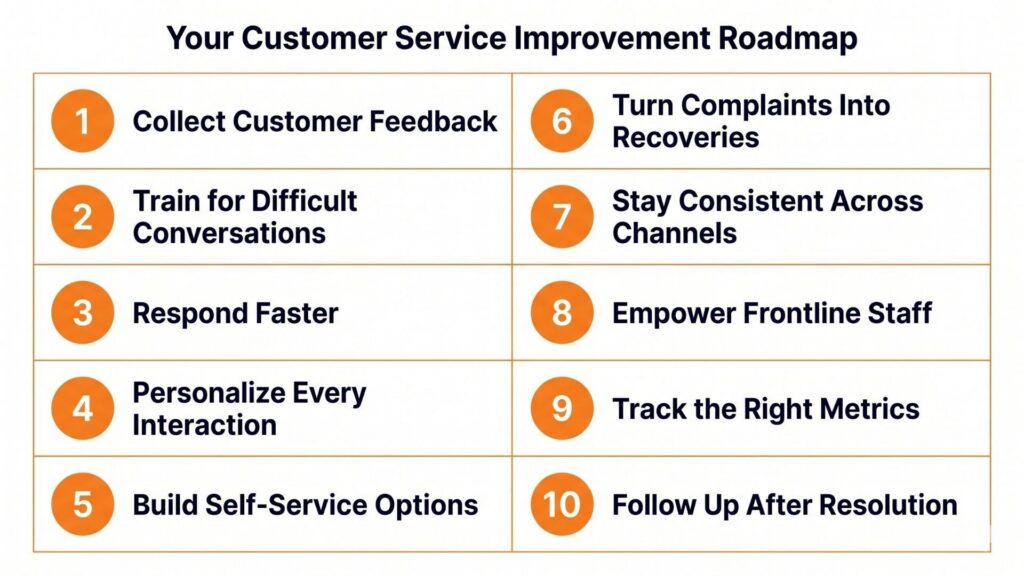
1. Listen before you react, collect real customer feedback
You cannot fix what you do not measure. Most businesses wait for complaints to arrive rather than actively seeking feedback. Start with a simple post-interaction survey, one or two questions maximum. Ask what went well and what could be better. Review the responses weekly. The patterns will tell you exactly where to focus.
Two metrics worth adding to your feedback toolkit immediately: the Net Promoter Score (NPS), which asks customers how likely they are to recommend you on a scale of 0 to 10 and is one of the most reliable predictors of long-term business growth, and the Customer Effort Score (CES), which measures how easy it was for a customer to get their issue resolved. The easier the experience, the more likely they are to return. If NPS tells you whether customers love you, CES tells you whether you are making their lives easier, and both matter. To go deeper on how to use NPS effectively in your business, read our full guide: Master Marketing Research: NPS Surveys and Customer Satisfaction for Business Growth.
2. Train your team to handle difficult conversations
Scripts do not build trust; judgment does. Train your team on the principles behind good service: acknowledge the problem first, never deflect blame to another department, and always give the customer a clear next step. Role-play difficult scenarios regularly. A team that practices hard conversations handles real ones with far more confidence.
3. Respond faster than your competitors do
Speed is a form of respect. According to Fullview’s CX statistics report, top-performing companies resolve customer issues within 17 hours, while the industry average sits at over 3 days. You do not need to be perfect; you just need to be faster than the alternative your customer is already considering. Set a response time target and make it visible to your team.
4. Personalize every interaction, not just the first one
Using a customer’s name is the floor, not the ceiling. Personalization means referencing their history, anticipating their needs, and communicating in a way that feels individual rather than templated. Even a small business can do this, keep notes in a simple CRM or spreadsheet on what each client cares about, what they have purchased, and what issues they have had. The next time you interact, use that information.
The highest level of personalization is anticipating needs before the customer even expresses them. Five-star hotels are the benchmark here: before a guest arrives, the room is already set up based on their previous preferences. The waiter checks the table before you sit down. Nothing is left to chance. You do not need a hotel budget to apply this principle; you just need a habit of reviewing what you know about a customer before every interaction and asking yourself what they will likely need next.
5. Build a self-service option your customers actually use
According to Fullview, 81% of customers attempt to resolve issues themselves before contacting support. A well-built FAQ page, a knowledge base, or a simple how-to video series reduces your team’s workload and gives customers the fast answers they actually want. Make it easy to find and easy to use; a self-service option buried three clicks deep helps no one.
6. Turn complaints into a second chance to impress
A complaint is not a failure. It is an opportunity. According to Oxford Global Resources, 78% of customers will forgive a bad experience if the brand recovers excellently. The keyword is “excellently”, not adequately. Respond fast, take full ownership, offer a meaningful resolution, and follow up to confirm the customer is satisfied. Done right, a complaint recovery can create a more loyal customer than one who never had a problem at all.
7. Be consistent across every channel you use
A customer who gets excellent service by email but is ignored on Instagram does not experience you as a good service business. They experience you as an inconsistent one. According to Aberdeen Group research, companies with strong omnichannel customer service Ways retain 89% of their customers compared to just 33% for those with weak cross-channel consistency. Pick the channels you can serve well and serve them consistently.
8. Empower your frontline staff to make decisions
Nothing frustrates a customer more than hearing “I’ll have to check with my manager” for a straightforward problem. Empower your team with clear guidelines on what they can resolve independently, refunds up to a certain amount, complimentary offers, and timeline extensions. When staff can act decisively, problems get solved faster, and customers feel respected. Set the boundaries once, and trust your team to work within them.

9. Track the right metrics, not just satisfaction scores
Customer Satisfaction Score (CSAT) tells you how people felt after one interaction. It does not tell you whether they will come back. Build a more complete picture by tracking four metrics together: Net Promoter Score (NPS), which measures whether customers would recommend you; First Contact Resolution (FCR), which measures whether problems get solved without the customer needing to follow up; and Customer Effort Score (CES), which measures how easy it was for a customer to get help. Low effort equals high loyalty. Together, CSAT, NPS, FCR, and CES give you a dashboard that goes far beyond a simple thumbs up or down.
One more underrated practice: if you are a manager responsible for customer service, spend at least one day per quarter sitting at the frontline desk and personally handling customer calls or complaints. Nothing replaces the clarity of experiencing your own service from the inside. The tension it creates is exactly the kind of insight that should be driving your next management meeting.
10. Follow up after the problem is solved
This is the step almost every business skips, and it is the one customers remember most. A brief follow-up message 24 to 48 hours after a resolved issue, asking whether everything is still on track, costs nothing and signals genuine care. It is the difference between a transaction and a relationship. Make it a standard part of your service process, not an optional extra.
How these 10 ways stack up: Effort vs. Impact
| Strategy | Effort to Implement | Cost | Business Impact |
| Collect customer feedback | Low | Free to low | High, drives targeted improvement |
| Train team on difficult conversations | Medium | Low | High reduces churn from bad interactions |
| Improve response time | Low | Free | High directly affects satisfaction scores |
| Personalize interactions | Low | Free | Medium-High, builds long-term loyalty |
| Build self-service options | Medium | Low to medium | Medium reduces friction and supports load |
| Turn complaints into recoveries | Low | Free | Very High, retention and reputation |
| Omnichannel consistency | Medium | Low to medium | High, protects brand reputation across channels |
| Empower frontline staff | Low | Free | High, faster resolution, higher satisfaction |
| Track NPS, FCR, and CES metrics | Low | Free | Medium provides clarity for improvement |
| Follow up after resolution | Low | Free | Very High, loyalty and referral generation |
Most of these improvements require a change in habit rather than a change in budget. Business impact is measured through retention, loyalty, and referral rates, not always directly in revenue, but consistently in the metrics that lead to it.
“There is only one boss. The customer.”
— Sam Walton, Founder of Walmart
Final Thoughts: Great customer service Is a decision, not a department
Customer service is not something that happens in a single team or on a single channel. It is the sum of every interaction a customer has with your business, from the first email to the follow-up after a resolved complaint.
The businesses that get this right do not have unlimited budgets or large support teams. They have clear standards, consistent habits, and a genuine commitment to making customers feel valued at every touchpoint.
Start with one strategy from this list. Apply it consistently for 30 days. Then add another. Small, compounding improvements in customer service have a way of showing up in your revenue faster than almost any other investment.
Your next step:
Map out your customer’s full journey before you start making changes. The Customer Journey Checklist from excellentbusinessplans.com helps you identify every touchpoint where service can be improved, so you fix the right things in the right order. And if you are ready to build a business where customer service is baked into your strategy from day one, the Business Plan Template gives you the structure to make it happen.
Frequently Asked Questions (FAQ)
1. What is the most important factor in good customer service? Consistency. A single excellent interaction means little if the next one is poor. Customers build trust through repeated positive experiences across every channel and every touchpoint. Consistency of response time, tone, and resolution quality is what turns a satisfied customer into a loyal one.
2. How do small businesses compete with larger companies on customer service? Small businesses have a natural advantage: they can be more personal, more responsive, and more flexible than large corporations. A small business owner who knows their customers by name and follows up personally after a problem is resolved will outperform a large company’s automated support system in the ways that actually drive loyalty.
3. How do I measure whether my customer service is improving? Track three metrics: Customer Satisfaction Score (CSAT) after interactions, Net Promoter Score (NPS) to measure loyalty and likelihood to recommend, and First Contact Resolution (FCR) to measure whether problems are solved without customers needing to follow up. Together, these give a much fuller picture than any single score.
4. What is the fastest way to improve customer service? Improve your response time and introduce a follow-up process after resolving issues. Both can be implemented immediately, cost nothing, and have a measurable impact on customer satisfaction within weeks. A third action that costs nothing but delivers immediate insight: go sit at the frontline desk for a day and personally listen to, or handle, real customer complaints. As a manager or owner, experiencing your own service firsthand reveals problems that no report will ever surface.
5. How does customer service affect revenue? The relationship between customer service and revenue is real but rarely direct. The more accurate way to think about it: excellent customer service improves the metrics that drive revenue. The key ones to track are Customer Lifetime Value (LTV), which measures how much a customer is worth over the full relationship; churn rate, which tracks the percentage of customers who stop buying; and retention rate, which measures how many customers return. According to Bain & Company, a 5% improvement in retention can boost profits by 25 to 95%, because retained customers spend more, cost less to serve, and refer others. This is especially critical for SaaS businesses, where churn directly determines growth trajectory. In subscription models, a high churn rate will cancel out even strong acquisition numbers, making customer service a core business metric, not just an operational one.
6. Should small businesses use AI for customer service? AI tools like chatbots can handle straightforward, repetitive queries efficiently, freeing up your team for complex or sensitive interactions. However, according to Qualtrics, 81% of customers still prefer human support for complex issues. The best approach is to use AI for speed and volume, while reserving human interaction for situations that require judgment and empathy.
References
- Qualtrics XM Institute. (2024). The Cost of Poor Customer Service. Reported by NJBIA. https://njbia.org/study-quantifies-the-growing-cost-of-bad-customer-service/
- Bain & Company / Harvard Business Review. (2024). Customer Retention and Profit Impact. Cited in Ringly.io. https://www.ringly.io/blog/customer-retention-statistics-2026
- Salesforce Research. (2024). Customer Service and Repeat Purchase Likelihood. Cited in Qualaroo. https://qualaroo.com/blog/customer-satisfaction-retention-loyalty-statistics/
- Dimension Data. (2024). Customer Experience and Revenue Growth. Cited in Electroiq. https://electroiq.com/stats/customer-retention-statistics/
- Fullview. (2024). 110+ Customer Experience Statistics and Trends. https://www.fullview.io/blog/cx-trends-in-2023
- Oxford Global Resources. (2024). The Cost of Poor Service: Looking at the Numbers. https://www.oxfordcorp.com/insights/blog/the-cost-of-poor-service-looking-at-the-numbers/
- Aberdeen Group Research. (2024). Omnichannel Customer Retention Statistics. Cited in Envive. https://www.envive.ai/post/customer-retention-in-ecommerce-statistics


