
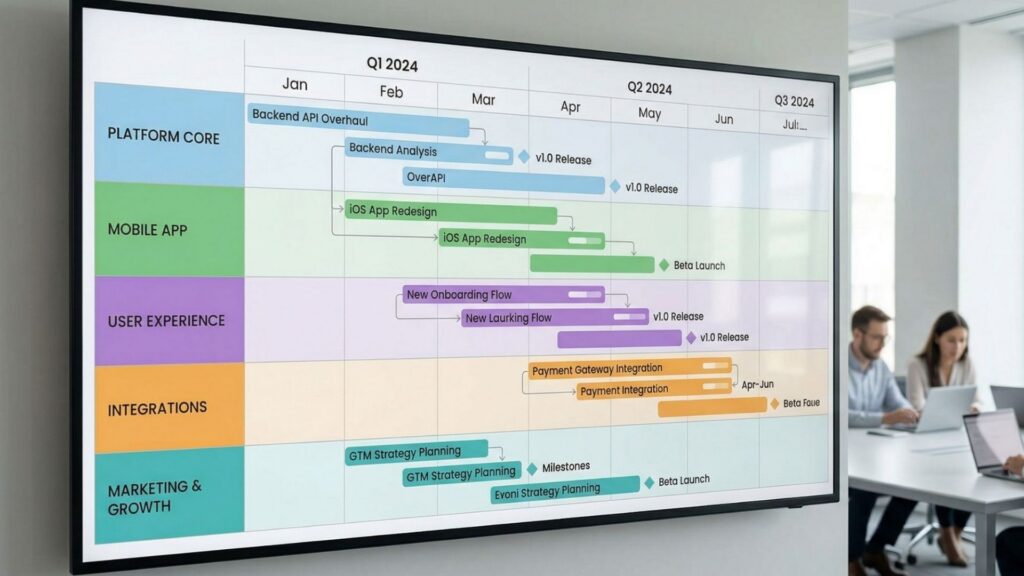
That Actually Gets Your Product Built, Launched, and Loved
Most products do not fail because of a bad idea. They fail because no one had a clear plan to build them right.
Learn how to create a product roadmap step by step. A practical guide for founders, managers, and teams who want to build, launch, and grow successful products.
Introduction
You have a product idea that excites you. Maybe you have even started building it. But somewhere between the first sketch and the actual launch, things get messy. Priorities shift, the team loses focus, deadlines slip, and suddenly no one is sure what they are building or why.
This is not a talent problem. It is a planning problem. And a product roadmap is exactly what fixes it.
A product roadmap is a shared, visual plan that shows where your product is going, what needs to happen to get there, and in what order. It connects your big vision to the daily work your team actually does. Without one, even the best ideas get lost in execution.
This guide walks you through how to build a product roadmap from scratch, step by step, so your product gets built on time, launched with confidence, and loved by the people it was made for.
Business Facts
- New products fail at a rate of 40% to 46% according to multiple PDMA Best Practices Studies. However, the best-performing companies achieve failure rates as low as 24% by using structured development processes. Source: https://newproductsuccess.org/
- According to ProductPlan’s 2024 State of Product Management Report, based on responses from over 1,400 product professionals worldwide, 76% said product strategy was essential for product management tools, and 58% identified roadmapping as a core investment priority. Source: https://assets.productplan.com/content/The-2024-State-of-Product-Management-Report.pdf ; https://www.productplan.com/2024-state-of-product-management-annual-report/
- A Protolabs survey of more than 700 engineers, designers, and product developers found that over 60% say tight deadlines and pressure to accelerate time-to-market will play a major role in their prototyping goals over the next five years. Source: https://www.protolabs.com/resources/guides-and-trend-reports/product-development-trends
Why It Matters: The Real Cost of Having No Roadmap
Building a product without a roadmap is like driving to a new city with no GPS and no map. You might eventually get there. But you will waste fuel, take wrong turns, and arrive exhausted.
For most founders and small business owners, the cost of no roadmap shows up in three painful ways. First, the team works hard but in different directions. A developer builds one thing while the designer assumes something else entirely. Second, features get added without a clear reason, ballooning the scope and blowing the budget. Third, the launch gets delayed again and again because no one has defined what “done” actually looks like.
A good product roadmap eliminates all three problems before they start.
What Is a Product Roadmap?
A product roadmap is a high-level visual plan that outlines the goals, features, and timeline for developing and launching a product. It is not a detailed task list. It is a strategic document that answers three questions: What are we building? Why are we building it? And when will it be ready?
One important distinction worth understanding early: a roadmap is a plan, not a promise. As ProductPlan explains, sharing your roadmap with stakeholders is an invitation into your current strategic thinking, not a binding commitment to deliver specific features by exact dates. Markets shift, priorities change, and a good roadmap adapts with them.
It serves two audiences at once. Internally, it keeps your development team aligned and focused. Externally, it gives stakeholders, investors, and partners a clear picture of where the product is headed.

How to Make a Product Roadmap in 6 Steps
Step 1: Start With Your Product Vision
Before you map anything, write down one clear sentence that describes what your product does and who it helps. This is your north star. Every decision you make on the roadmap should connect back to it.
Example: “We help freelance designers manage client projects without the chaos of email chains and spreadsheets.”
If your team cannot agree on that one sentence, stop here and align first. A roadmap built on a blurry vision will fall apart in execution.
Step 2: Define Your Goals, Not Just Your Features
Most roadmap mistakes start here. The Founders list features they want to build instead of outcomes they want to achieve. Features are outputs. Goals are outcomes. Always start with the goal.
Instead of writing “Build a dashboard,” write “Help users see their project status at a glance so they spend less time in meetings.” The feature follows the goal, not the other way around.
Once your goals are clear, translate them into user stories. A user story is a simple, one-sentence description of a feature written from the perspective of the person using it. The format is straightforward:
“As a [type of user], I want to [do something], so that [I get this outcome].”
For example: “As a freelance designer, I want to see all my active projects in one view, so that I never miss a deadline.”
These stories, often written on scrum cards in agile teams, make your features human and testable. They keep the entire team focused on the user’s real need rather than the technical solution. Before any feature goes on your roadmap, write its user story first. If you cannot write it clearly, the feature is not ready to be built.
Step 3: Gather and Prioritize Your Ideas
Collect input from your team, your early users, and your own research. You will have more ideas than time. That is normal and healthy. The roadmap is not a wish list. It is a prioritized plan.
When it comes to ranking your ideas, the most effective approach is to score them by customer value first. Ask yourself which features or improvements deliver the highest value to the user and start there.
A simple scoring method works well for most teams. Score each idea on three questions:
- How much value does this deliver to the customer?
- Does it move us toward our core vision?
- Can we build it with what we have right now?
Give each question a score of one to five, add them up, and rank your ideas from highest to lowest. The items at the top of your list go into the Now phase. Everything else moves to Next or Later based on its score and your available resources.
Step 4: Organize Into Phases: Now, Next, and Later
This is the most practical roadmap structure for small teams and startups. Divide your roadmap into three time horizons. “Now” covers what your team is actively working on. “Next” covers what comes in the following one to three months. “Later” covers everything planned beyond that.
This structure keeps the team focused on today without losing sight of the bigger picture. It also makes it easy to adjust when priorities change, which they will.
To make this concrete, here is a simple example using a fictional SaaS tool for freelance designers:
Now (Month 1-2): Client onboarding flow, project dashboard, basic invoicing
Next (Month 3-4): File sharing, client feedback tools, email notifications
Later (Month 5-6): Team collaboration features, third-party integrations, mobile app
Notice how each phase builds on the previous one. Nothing in “Next” can exist without “Now” being solid first. That sequencing is the whole point of the Now/Next/Later structure.
Step 5: Assign Ownership and Set Clear Milestones
Every item on your roadmap needs a name next to it. Not a team name. A person’s name. Ownership creates accountability and removes the ambiguity of “I thought someone else was handling that.”
Set milestones for each phase with a realistic completion date. A milestone is not a task. It is a meaningful checkpoint that shows real progress, such as “Beta version ready for user testing” or “Payment integration complete and tested.”
Step 6: Share It, Review It, and Update It Regularly
A roadmap that lives in one person’s laptop is not a roadmap. It is a private document. Share it with your full team, your key stakeholders, and anyone whose work depends on it.
Review your roadmap at least once a month. Markets shift. User feedback changes priorities. New information changes what “right” looks like. A good roadmap is a living document, not a contract written in stone.

Types of Product Roadmaps
Not every product needs the same type of roadmap. Here are the three most common formats and when to use each one.
- A goal-oriented roadmap focuses on outcomes rather than features. It is ideal for early-stage startups that need flexibility as they learn from users.
- A feature-based roadmap lists specific features with timelines and is best for teams with a stable product and a clear development cycle.
- A release roadmap organizes work by launch dates and is most useful when coordinating across multiple teams or preparing for a major product launch.
Comparison Table
| Roadmap Type | Best For | Focus | Flexibility |
| Goal-Oriented | Early-stage startups | Outcomes and learning | Very High |
| Feature-Based | Established products | Specific features and timelines | Medium |
| Release Roadmap | Multi-team launches | Launch dates and coordination | Lower |
| Now / Next / Later | Small teams and founders | Priorities and phases | High |
Quote
“A goal without a plan is just a wish.” –
Antoine de Saint-Exupery, author of The Little Prince
Final Thoughts
A product roadmap is not a luxury for big companies with large teams. It is a practical tool for anyone who wants to turn a product idea into something real, useful, and successful.
You do not need expensive software or a formal process to get started. You need a clear vision, honest priorities, and the discipline to write it all down in one shared place.
The founders who build products people love are not the ones with the most features. They are the ones who knew exactly what they were building, kept their team aligned, and stayed focused on what mattered most at every stage.
Next Steps: Build Your First Roadmap Today
You do not need to plan everything at once. Start small and build the habit.
- Write your one-sentence product vision today
- List 10 ideas or features you want to build
- Score each one: does it serve the vision, solve a real pain, and fit your current resources?
- Pick your top three and place them into a Now/Next/Later structure
- Share it with at least one team member or a trusted advisor this week
- Schedule a monthly roadmap review to check progress, adjust priorities, and reflect any market changes that affect your plan
Markets shift. Customer needs evolve. A roadmap that is never reviewed quickly becomes a document that no longer reflects reality. Treat your monthly review as a non-negotiable habit, not an optional task.
That is your first roadmap. It does not have to be perfect. It has to exist.
Ready to take the next step? Download the Business Plan Template from Excellent Business Plans and build the strategic foundation your product deserves. Download the Product Roadmap Template.
FAQs
1. What is the difference between a product roadmap and a project plan? A product roadmap shows the strategic direction of your product over time, including goals, priorities, and phases. A project plan is a detailed operational document that lists specific tasks, deadlines, and team assignments. You need both, but the roadmap comes first.
2. How long should a product roadmap be? For most startups and small businesses, a roadmap covering three to six months is practical and realistic. Anything longer risks becoming outdated before you reach it. Review and update regularly rather than planning too far ahead.
3. What tools can I use to build a product roadmap? You do not need specialized software to start. A simple spreadsheet or whiteboard works perfectly for early-stage teams. As your team grows, these popular tools make roadmap planning easier and more collaborative: Jira, Trello, Asana, Monday.com, and Notion. Start with whatever fits your team size and budget.
4. How often should I update my product roadmap? At a minimum, review your roadmap once a month. If your product is in active development or your market is moving quickly, a weekly review of the “Now” phase keeps your team sharp and aligned.
5. Who should be involved in building the product roadmap? The product owner or founder typically leads the process, but the best roadmaps are built with input from the development team, designers, customer-facing staff, and key stakeholders. More perspectives at the planning stage means fewer surprises during execution.
6. Can a solo founder use a product roadmap? Absolutely. A roadmap is just as valuable for a solo founder as it is for a large team. It forces clarity, helps you prioritize, and gives you a reference point when new ideas or distractions pull you away from what matters most.
References
- PDMA Best Practices Study on New Product Failure Rates: https://www.newproductsuccess.org/
- ProductPlan 2024 State of Product Management Report: https://www.productplan.com/2024-state-of-product-management-annual-report/
- Protolabs Product Development Trends Survey: https://www.protolabs.com/
- ProductPlan: Your Product Roadmap Is a Plan, Not a Promise https://www.productplan.com/learn/product-roadmap-plan/