


Thousands of entrepreneurs swear by it. Others call it an expensive waste of time. Here is how to figure out which camp you belong to, before you spend a cent.
Thinking about hiring a business coach? We break down the real pros, cons, and costs of business coaching, plus a quick self-test to help you decide if it is right for you.
Introduction: The question no one answers honestly
Type “business coaching” into Google, and you will find two types of content. Coaches are selling you on why coaching will change your life. And skeptics telling you it is all hype.
Neither is particularly useful.
The truth is more nuanced. Business coaching can be genuinely transformative for some entrepreneurs and a complete waste of money for others. The difference has nothing to do with the quality of the coach. It has everything to do with where you are in your business journey and whether you are actually ready to be coached.
This article gives you the honest picture, the real benefits, the real drawbacks, the real costs — and a simple self-test to help you decide if business coaching makes sense for you right now.
The numbers behind the business coaching boom
Business coaching is not a fringe idea anymore. It is a serious and fast-growing industry.
- According to the ICF and PwC Global Coaching Study, the global coaching market reached $6.25 billion in 2024 and is projected to grow to $7.3 billion by 2025, reflecting a 17% annual growth rate since 2019.
- According to Luisa Zhou’s Coaching Industry Market Size report, 86% of companies that measured the ROI of coaching made back their initial investment, and the average return on executive coaching is 5 to 7 times the cost.
- According to the International Coaching Federation, the average business coaching session costs around $244 per hour globally, making it a significant financial commitment that demands careful consideration.
The data is compelling. But data about averages does not tell you whether coaching is right for your specific situation. That requires a harder look.
The Real Problem: Most entrepreneurs wait too long, or jump in too early
Here is a pattern that repeats itself constantly in the entrepreneurship world.
Some business owners hire a coach when they are already overwhelmed, hoping someone else will fix their broken systems, unclear strategy, and cash flow problems overnight. They burn through the investment without getting much back, then blame coaching.
Others wait until they are already successful, then wonder how much further they could have gone if they had started earlier.
The sweet spot for coaching is neither of these. It is the moment when you have enough momentum to act on advice, but enough pain to actually change.
Before we break down the pros and cons, take two minutes to run this quick self-test.
Quick Self-Test: Are you ready for a business coach?
Answer each question honestly. Mark, yes or no.
Direction & Strategy
- ☐ My business has been stuck at roughly the same revenue level for 6+ months
- ☐ I know I need to change something, but I am not sure what
Accountability & Execution
- ☐ I regularly set goals but struggle to follow through on them
- ☐ I have no one in my circle who will push back on my decisions, honestly
Skills & Blind Spots
- ☐ There are areas of my business I know are weak, but I keep avoiding them
- ☐ I often feel like I am the bottleneck in my own business
Readiness
- ☐ I have the budget to invest in coaching for at least 3 months
- ☐ I am genuinely open to being challenged and changing how I work
Your Result:
- 6 to 8 yes answers: You are a strong candidate. Coaching could accelerate your growth significantly right now.
- 3 to 5 yes answers: Coaching could help, but identify your top 1 or 2 pain points first so you can find the right type of coach.
- 0 to 2 yes answers: You may not be ready yet. Focus on building momentum first, then revisit coaching in 6 months.
The Real Pros of Business Coaching
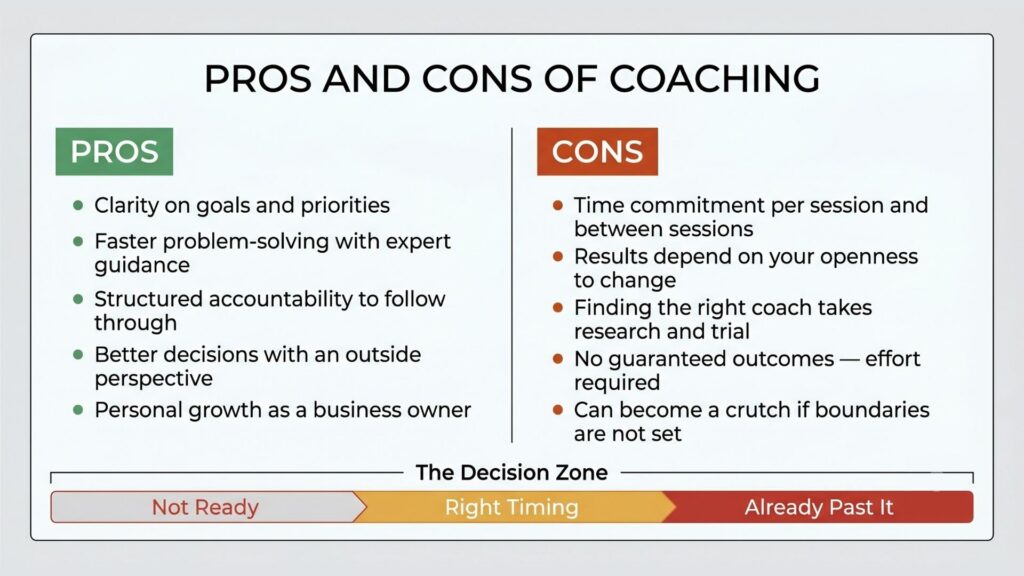
1. An Outside Perspective That Cuts Through the Noise. When you are deep inside your business, you cannot always see what is obvious to someone on the outside. A good coach spots patterns, blind spots, and missed opportunities that you have stopped noticing. As the founder of Foundr, Nathan Chan, put it: when you have a strong business coach, you set yourself up for success because they help you focus your time on the right things.
2. Accountability That Actually Works Most entrepreneurs are great at making plans and poor at following through on them, not because of laziness, but because there is no one to answer to. A coach creates structured accountability. You agreed to do something. Now you have to report back. This alone is worth the investment for many business owners.
3. Faster Problem-Solving A coach who has worked with dozens of businesses has likely seen your exact problem before. Instead of spending six months figuring out why your sales pipeline keeps stalling, a good coach can diagnose it in a session and give you a tested solution. You are paying for pattern recognition, not just conversation.
4. Confidence in High-Stakes Decisions: Hiring your first employee. Raising prices. Walking away from a client. These decisions feel enormous when you are making them alone. A coach gives you a thinking partner who has no emotional stake in the outcome, just honest analysis.
5. A Clearer Path Through the Chaos. Many business owners know what they want to achieve, but cannot break it down into actionable steps. A coach does not build that structure for you; that part is still your work. What a coach does is ask the right questions, point you toward the right frameworks, and help you think clearly enough to build it yourself. The result is still a sharper vision and a more focused plan, but the ownership stays entirely with you.
The real cons of business coaching
1. The Cost Is Not Small. At $244 per hour on average, and most engagements running 3 to 6 months, business coaching is a moderate financial commitment. For an early-stage entrepreneur with limited cash flow, this money might be better spent on product development, marketing, or hiring.
2. Quality Varies Enormously. The coaching industry is largely unregulated. Anyone can call themselves a business coach. The gap between an experienced coach with a proven track record and someone who completed a weekend certification course is massive, and from the outside, they can look identical.
3. Results Depend on Your Readiness. Coaching is not consulting. A consultant delivers answers. A coach helps you find them. If you are not in a mindset to be challenged, to do the work between sessions, and to act on feedback, you will not get much out of it, regardless of how good the coach is.
4. It Can Become a Crutch Some entrepreneurs get so comfortable with the coaching relationship that they stop developing their own decision-making ability. The goal of good coaching is to make itself unnecessary over time. If that is not happening, something is wrong.
5. Wrong Coach, Wrong Stage A coach who specializes in scaling a 50-person company has limited value for a solopreneur just starting. Matching the right coach to your specific stage and challenge is critical, and it is something many first-time coaching clients get wrong.

Business Coach vs. Mentor vs. Consultant: What is the difference?
Many entrepreneurs use these terms interchangeably. They are not the same.
| Business Coach | Mentor | Consultant | |
| What they do | Help you find your own answers | Share their own experience and wisdom | Deliver specific solutions and recommendations |
| Relationship style | Structured, ongoing, accountability-focused | Informal, relationship-based | Project-based, task-focused |
| Best for | Clarity, accountability, and personal growth | Inspiration, industry insight, network | Specific problems needing expert execution |
| Typical cost | $150 to $500/hour | Often free or informal | $100 to $300+/hour |
| Time horizon | 3 to 12 months | Long-term, open-ended | Weeks to months |
Understanding which type of support you actually need is often more valuable than debating whether coaching is worth it.
Three Signs Coaching Is Working And Two Signs It Is Not
Coaching is working when:
- You are making decisions faster and with more confidence than before
- You are completing commitments between sessions consistently
- Your metrics, revenue, team performance, and client retention are moving in the right direction
Coaching is not working when:
- Sessions feel like venting with no actionable output
- You leave each session feeling motivated, but nothing changes in the weeks after, not because coaching failed, but because the owner has not done the work. A coach points the way; the owner has to walk the path.
- You dread the accountability check-in rather than looking forward to it
If coaching is not working, it usually comes down to one of three things: the wrong coach, the wrong timing, or an ownership mentality that is not yet ready to act on feedback. All three are fixable, but the third one starts with an honest look in the mirror.
“We hire smart people so they can tell us what to do.” — Steve Jobs
Final Thoughts: It Is not about whether coaching works. It Is about whether it works for you right now.
Business coaching works. The data supports it, and thousands of entrepreneurs have proven it. But it is not magic, and it is not for everyone at every stage.
If you scored high on the self-test above, if you have the budget, the openness, and the specific pain points that a coach can address, then the investment has a strong chance of paying off multiple times over.
If you are not ready yet, that is fine too. The best move is to get your foundations right first. A solid business plan, a clear strategy, and tracked KPIs will put you in a much stronger position to extract real value from coaching when the time comes.
Your next step:
Many entrepreneurs assume they need coaching when they actually need clarity. Before investing thousands in coaching, it is worth creating a structured business plan, a financial forecast, or a marketing roadmap. Often, the exercise alone reveals the bottlenecks holding the business back.
Start with the Business Plan Template from us and you might be surprised how many answers are already inside your own business, just waiting to be written down.
Frequently Asked Questions (FAQ)
1. What does a business coach actually do? A business coach works with you one-on-one to help you gain clarity on your goals, identify what is blocking your growth, and build accountability around taking action. Unlike a consultant, they do not give you a ready-made solution; they help you develop your own thinking and decision-making ability.
2. How much does business coaching cost? The average business coaching session costs around $244 per hour globally, according to the International Coaching Federation. Most coaching engagements run 3 to 6 months, making the total investment anywhere from $2,000 to $15,000+, depending on the coach’s experience and your goals.
3. How is a business coach different from a mentor? A mentor shares their own experience and wisdom informally, often for free. A business coach provides a structured, accountability-driven process designed to help you achieve specific business outcomes. Both are valuable, but they serve different purposes.
4. When is the right time to hire a business coach? The best time is when you have enough momentum to act on advice, but enough pain to actually change. Common triggers include plateauing revenue, feeling like a bottleneck in your own business, or facing a major decision you cannot see clearly from the inside.
5. How do I find a good business coach? Look for coaches with a verifiable track record, client testimonials, and experience working with businesses at your specific stage and in your industry. Always start with an introductory session before committing to a longer engagement. Certifications from recognized bodies like the ICF are a positive signal, though not a guarantee of quality.
6. Can a solopreneur or freelancer benefit from business coaching? Absolutely. Solopreneurs and freelancers often benefit most from coaching because they have no team to bounce ideas off, no manager to set direction, and no colleague to create accountability. A good coach fills all three of those gaps.
References
- International Coaching Federation & PwC. (2024). ICF Global Coaching Study. https://coachingfederation.org/research/global-coaching-study
- Luisa Zhou. (2025). Coaching Industry Market Size: Latest Data. https://luisazhou.com/blog/coaching-industry-market-size/
- Entrepreneur HQ. (2026). 81 Coaching Statistics 2026: Demand, Results, Future, Niches, and Revenue. https://entrepreneurshq.com/coaching-statistics/
- U.S. Chamber of Commerce. (2025). How to Know When to Hire a Business Coach. https://www.uschamber.com/co/grow/thrive/when-to-hire-business-coach
- Foundr. (2023). 5 Reasons Why You Need a Business Coach. https://foundr.com/articles/leadership/personal-growth/business-coach
- Heights Platform. (2024). Should You Hire a Business Coach? The Pros and Cons. https://www.heightsplatform.com/blog/should-you-hire-a-business-coach-the-pros-cons-of-coaching-for-small-business-owners


