If you’re working harder for the same results, your sales funnel isn’t broken; your business model is. Here’s how to fix it and do value creation.
Learn how to grow your small business with business model innovation or value creation. This guide uses the ‘Business Model Wheel’ and 12 growth models to help you find new revenue.
Introduction: The traditional growth trap
As a small business owner, you live by a simple rule: growth is life. But what happens when the old rules stop working?
You’ve spent years optimizing your sales, running social media ads, and pushing for “more customers.” Yet, you feel like you’re running on a treadmill. You’re working harder, but your revenue stays flat. Your market is saturated, and your customers are being pulled in a dozen new directions.
This is the traditional growth trap. The hard truth is that for most businesses, the next phase of growth won’t come from just “doing more.” It will come from business model innovation, rethinking how your business creates, delivers, and captures value.
You don’t need a revolutionary new product. You need to reconfigure the parts you already have. This guide, inspired by the frameworks in Groeimodellen (Growth Models), will show you how to use a simple “Business Model Wheel” to find new, sustainable growth.
Why your old business model is failing: The data on growth
Relying on “business as usual” is no longer a safe strategy. The market is evolving too quickly, and leaders are actively changing their business models to keep up.
- According to McKinsey, roughly 70% of large-scale transformations fail to achieve their goals, not because of a bad strategy, but due to factors like a lack of conviction, not addressing skill gaps, or failing to build the right change-management infrastructure.
- The 2023 “Most Innovative Companies” report from Boston Consulting Group (BCG) found that the top 50 most innovative firms outperformed their peers on the MSCI World Index for shareholder return by 3.3 percentage points per year.
- The shift to new revenue models is undeniable. The subscription economy alone has grown over 435% in the last 9 years, proving that customers are willing to pay in new ways for value (Source: Zuora). (All Statistics Verified)
The 5 parts you can reconfigure (The Business Model Wheel)
The book Groeimodellen introduces a powerful framework called the “Business Model Wheel.” It shows that your business isn’t one fixed thing; it’s a system of 5 interconnected parts. To find growth, you don’t need to reinvent the whole wheel. You just need to innovate on one part.
This is exactly what we meant by “reconfiguring your business parts.” Let’s break down the 5 parts you can change.
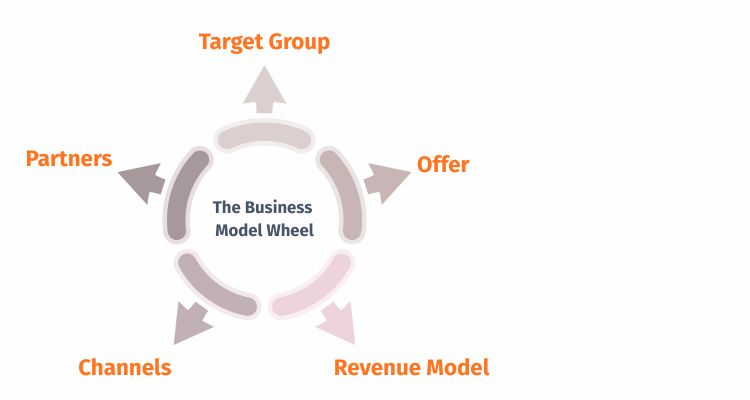
Innovate Your Target Group & Relationship
Instead of selling the same single product to everyone, you can create new value by focusing on a specific niche. This is what Huub calls “approaching customers for new packages.” For example, instead of selling “web design” to everyone, you could create an all-in-one “Launch Package” just for local restaurants. This focuses your value and makes your marketing infinitely more effective.
Innovate Your Offer (Value Proposition)
This means “changing your business offer” from a simple product to a service, or from a service to a community. A gym that only sells “access to treadmills” is competing on price. A gym that sells “community and accountability” (the Offer) through a monthly membership (the Revenue Model) is creating a much stickier, more valuable proposition.
Innovate Your Revenue Model
How you get paid is one of the most powerful changes a small business can make. The old way is a one-time, transactional sale. The new way is predictable, recurring revenue. A local IT consultant who charges $150/hour is always chasing the next invoice. If they change their revenue model to a $500/month “Managed IT” subscription, they get stable income, and the client gets peace of mind.
Innovate Your Channels
This involves using new “digital and social channels” not just for marketing, but for delivery. A local chef, once limited to their restaurant (a single channel), can now create a digital “Cooking Club” on Patreon or sell “Meal Kits” direct-to-consumer (DTC) via their website, completely bypassing traditional distribution.
Innovate Your Resources & Partners
Instead of trying to do everything yourself, you can use strategic “partnerships” to grow faster. A freelance graphic designer, a copywriter, and a web developer could partner up. Together, they can bid on large, high-value projects as a “full-service agency,” something none of them could do alone.
The 12 Growth Models to innovate your business
Here are the 12 growth models from the Groeimodellen framework. You don’t need to use all of them. Just pick one that solves your biggest problem.
Category 1: Innovate Your Customer & Offer
1. Respond to Customer Needs: Stop selling what you think customers want and start solving what they actually need. For example, instead of just selling coffee, a café might notice remote workers need quiet, so it creates a $10 “work pass” that includes coffee and a guaranteed table.
2. Reassemble the Offering: Combine existing products or services in a new way to form a unique value. A bookstore, a café, and a local artisan shop could combine into one “community hub” space, creating a new experience that none could offer alone.
3. Charge Differently: This is the core of the subscription economy. Change how you charge for value, moving away from a single transaction. A modern example is Adobe, which stopped selling $2,000 software and moved to a $50/month Creative Cloud subscription, guaranteeing recurring revenue.
Category 2: Innovate Your Value Chain
4. Replace Inefficiencies: Find a slow, expensive, or frustrating process in your industry and build a model that fixes it. A perfect example is Calendly, which built an entire business by replacing the 10-email chain of “What time works for you?” with one simple link.
5. Re-calibrate the Chain: This means you “negotiate your position” by changing your role. A coffee farmer who stops selling raw beans to a distributor for $2/lb can start roasting and selling their own beans online directly to customers for $20/lb, capturing far more of the value.
6. Re-position in the Chain: Move to a completely different spot in the value chain. A restaurant doesn’t have to just serve food; it can “re-position” by teaching its recipes through a new online cooking school, adding a completely new revenue stream.
7. Re-distribute Value: Change how profit or benefits are shared with your partners. A software company can create a “Partner Program” that gives 30% of the revenue to marketing agencies that refer them new clients, creating a powerful sales force that doesn’t have to pay a salary.
8. Re-connect the Chain: Collaborate deeply with partners to offer one integrated solution. For instance, a wedding photographer and a florist could create combined “all-inclusive” packages, making the customer’s life easier and selling more for both businesses.
Category 3: Innovate Your Network
9. Co-create: Build with your customers, not just for them. This removes market risk. LEGO Ideas is a brilliant example: fans design and vote on new sets. LEGO simply manufactures the winners, which are guaranteed to be bestsellers.
10. Offer Need-Driven Value: Deliver your product or service at the exact moment your customer has the problem. A travel insurance company that stops selling annual plans and instead offers “pay-as-you-go” insurance you can turn on with an app the second you get to the airport is a great example.
11. Replace Reciprocity: Build an open ecosystem where value is shared, not just transacted. Seats2meet.com offers free co-working spaces in exchange for users sharing their skills and knowledge with other members, creating a “social capital” marketplace.
12. Open Innovation: Accept that not all the smart people work for you and use external knowledge to innovate. When Procter & Gamble (P&G) needed a new cleaning solution, instead of spending 5 years in their own lab, they posted the problem online and had a solution from an outside chemist in 2 weeks.
How to start: Your 8-week growth sprint
Based on the book’s “40-day” plan, here is a practical sprint to put this into action.
| Weeks | Focus | Actionable Questions |
| 1-2 | Analyze Your Model | Use the “Business Model Wheel” to map your 5 parts. Where is the most friction? Where are you a bottleneck? |
| 3-4 | Choose a Growth Model | Pick ONE of the 12 models. Are you “Charging Differently” (Model 3) or “Replacing Inefficiencies” (Model 4)? |
| 5-6 | Develop & Validate | Create a “minimum viable offer” for your new model. Don’t rebuild your business; offer it to 3-5 existing customers. |
| 7-8 | Create Your Plan | The new model worked. Now, what’s the plan to roll it out? This is where you formally update your business plan. |
“The greatest danger in times of turbulence is not the turbulence itself, but to act with yesterday’s logic.” – Peter Drucker
Final Thoughts
Your next level of growth is not buried in “more” of the same. It’s hidden in “different.” You don’t need to work harder; you need to change the rules. By looking at your business as a system of 5 reconfigurable parts, you can stop being a bottleneck and start being an innovator.
As your next step, take 30 minutes to map your own 5-part “Business Model Wheel.” Identify your single biggest point of friction. Is it your revenue model? Your channels? That single insight is the starting point for your new growth.
Ready to build a more resilient business? A smart business model is the foundation of a strong business plan. Download our complete Business Plan Template to formally outline and test your new growth model today.
Frequently Asked Questions (FAQ)
- What is business model innovation?
It’s the process of changing how your business creates, delivers, or captures value. Instead of just inventing a new product, you might change your pricing (from one-time to subscription), your channels (from retail to direct-to-consumer), or your key partners. - What is the ‘Business Model Wheel’?
It’s a simple framework for analyzing the 5 key parts of your business: your Target Group, your Offer (value proposition), your Revenue Model (how you get paid), your Channels (how you sell), and your Partners/Resources (what you need to operate). - How is this different from the ‘Business Model Canvas’?
They are very similar. The “Business Model Wheel” is a simplified version of the “Business Model Canvas” (an Osterwalder framework). Both are tools to help you map, discuss, and innovate your business model on a single page. - Can a service business use these models?
Absolutely. Service businesses are often the best at using these models. A consultant who “replaces inefficiency” by turning their brain into a $50/mo software tool is a perfect example. A marketing agency that “charges differently” by moving from hourly rates to a flat “growth package” is another. - Where do I start? This feels overwhelming.
Start with your biggest pain. Is it an unpredictable cash flow? If yes, start by innovating your Revenue Model (Model 3). Are you wasting too much time on admin? If yes, start with Replacing Inefficiencies (Model 4). Don’t try to change all 5 parts at once. Just pick one.
References
- Groeimodellen Creeër Nieuwe Business https://www.bol.com/nl/nl/f/groeimodellen/9200000000890474/
- McKinsey & Company. (2019). Why do most transformations fail? A conversation with Harry Robinson. https://www.mckinsey.com/capabilities/transformation/our-insights/why-do-most-transformations-fail-a-conversation-with-harry-robinson
- Boston Consulting Group (BCG). (2024). Most Innovative Companies: The Collection. https://www.bcg.com/publications/most-innovative-companies-the-collection
- Zuora. (2024). Subscription Economy Index. https://www.zuora.com/resource/subscription-economy-index/