
A proven path to consistent business success
How small business operators can bridge the gap between abstract strategy and tactical execution to build a resilient market presence.
Learn how to build a flexible content roadmap that aligns with 2026 search trends and AI visibility. This guide provides a practical framework for solopreneurs and small teams to achieve consistent delivery and long-term authority.
Introduction
A content roadmap is the tactical bridge between your business goals and your daily operations. For many small business owners, the struggle is not a lack of ideas but a lack of a documented timeline to execute them. Without this structure, marketing efforts often become reactive rather than proactive. A roadmap provides the necessary clarity to ensure that every piece of content published serves a specific purpose in the customer journey, turning your digital presence into a long-term business asset.
The Data Behind the Roadmap
- 24% of B2B organizations report they do not have a dedicated content marketing person or team on staff (this number rises significantly for smaller companies with under 100 employees).
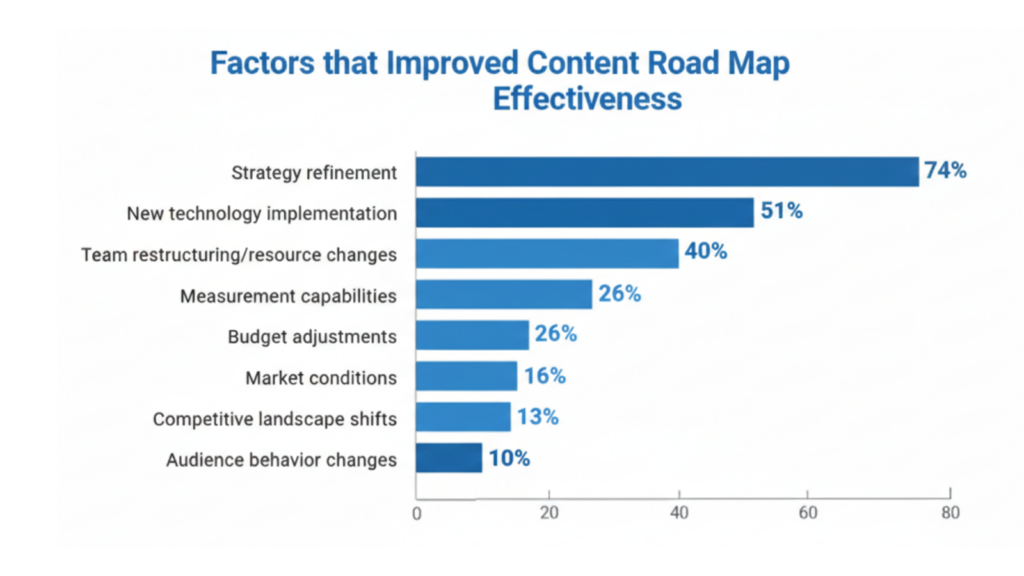
- 74 percent of marketing leaders identified “Strategy Refinement”, the core process of building a roadmap, as the single biggest driver of their brand’s performance improvement this year.
- Small businesses are 23 percent more likely than the industry average to see a positive return on investment (ROI) from consistent blog content.
Assessing Your Current Content Health
Before drafting a timeline, a business operator must assess the health of their current assets. Content health refers to how well your existing pages meet modern technical standards and user needs. In 2026, regularly updated content, often reviewed on a quarterly basis as a best practice, is more likely to maintain visibility than static pages. A healthy roadmap begins with a content audit to identify which topics need refreshing and where new information is required to support the customer’s decision-making process.
By focusing on content health, you ensure that your brand remains a reliable source of wisdom. This matches the Sage persona by providing factual, up-to-date information that helps your audience solve real-world problems. This foundational work prevents you from wasting resources on new content while your older, high-value pages lose their impact due to neglect.
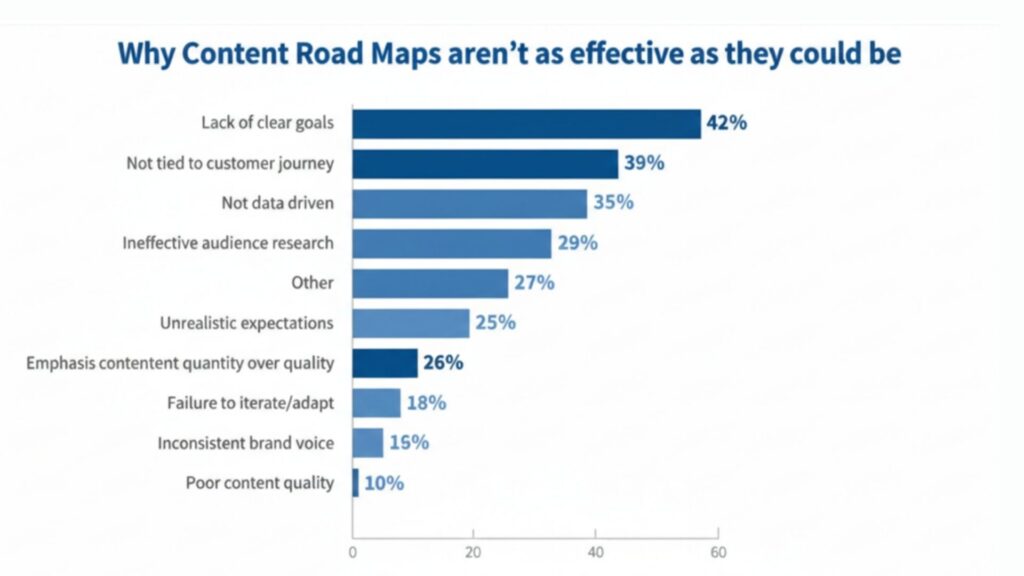
Why Content Road Maps aren’t as effective as they could be
A content roadmap fails the moment it is treated as a simple checklist rather than a strategic asset. Data from recent B2B surveys reveals that a lack of clear goals undermines many strategies, while others are disconnected from the actual customer journey. When your plan is not data-driven, it becomes a series of high-effort tasks that produce low-impact results. Securing market authority requires you to prioritize rigorous audience research over sheer content quantity.
To align your strategy with the buyer journey, you must map your topics to the specific mindset of your customer. Start by creating awareness content that addresses the immediate problems your audience is trying to solve. Follow this with consideration content, such as case studies or comparisons, that proves your expertise. Finally, provide decision stage content that answers the direct objections a buyer has before they commit. Without the discipline to iterate based on these journey results, even the most detailed roadmap will collapse under the unrealistic expectations that often derail early-stage business growth.
Source: https://contentmarketinginstitute.com/b2b-research/b2b-content-marketing-trends-research
Factors that Improved Content Road Map Effectiveness
Strategic success in 2026 is driven by human intelligence and proactive planning rather than just the adoption of new software. The solution to common pitfalls lies in creating a documented framework that balances rigid timelines with strategic agility. For the 61 percent of marketers who reported improved results this year, the most significant contributing factor was strategy refinement. While implementing new technology remains a priority for many organizations, the focus has shifted toward fundamental resource management and established measurement capabilities. By restructuring teams to align with the customer’s actual decision-making process, businesses transform a simple calendar into a diagnostic tool that measures real growth. This ensures that your team remains focused on high-value activities that build long-term trust, rather than simply filling a schedule with empty posts.
Source: https://contentmarketinginstitute.com/b2b-research/b2b-content-marketing-trends-research
Building Authority Through Topic Clusters
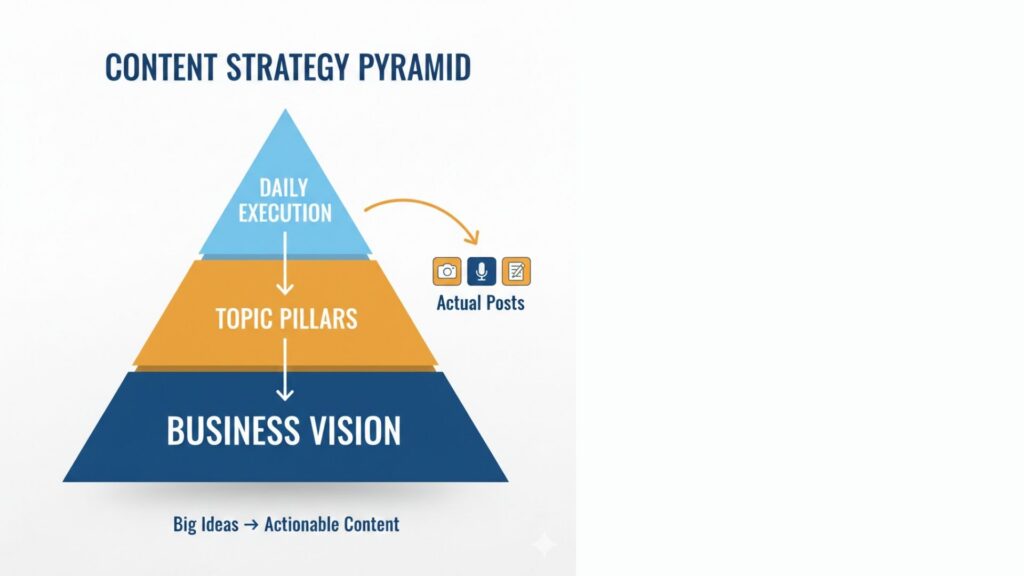
Modern search engines and AI assistants have moved beyond simple keywords to a more sophisticated understanding of topical authority. To win in this environment, your roadmap should center on topic clusters. A cluster consists of a pillar page that covers a broad subject, and several spoke articles that address specific questions related to that subject. This interconnected structure signals to both users and algorithms that you possess deep expertise in your field.
When you plan your roadmap, identify three core pillars that align with your business goals. For a business planning firm, these might include financial forecasting, market research, and operational scaling. By scheduling articles that branch off these pillars, you create a comprehensive knowledge base that guides a reader from their initial curiosity to a state of full trust in your expertise.
Implementing a Flexible Tactical Timeline
For small teams of 2 to 10 employees, a roadmap typically looks three to twelve months ahead, depending on team size and market volatility. This timeframe allows for enough consistency to see results while remaining flexible enough to adapt to changes. Your roadmap should define who is responsible for each task, what the specific milestones are, and when the final delivery is expected. This level of detail moves the business away from the stress of last-minute content creation.
Execution consistency and delivery reliability are the primary metrics of success for a content roadmap. Unlike vanity metrics such as content velocity, consistency focuses on the reliability of your brand’s voice in the market. A successful operator knows that a predictable schedule of high-quality posts is more valuable than a high volume of uncoordinated updates. This approach ensures that your marketing remains an engine for growth rather than a source of operational friction.

Photo by Thirdman: https://www.pexels.com/photo/people-working-in-the-office-7653978/
Navigating the Age of AI and AEO
In 2026, your content must be optimized for both traditional search and AI answer engines. This process, known as Answer Engine Optimization or AEO, focuses on making your content easily citable for AI models. While AI systems do not all cite sources in the same way, they consistently prioritize structured, authoritative, and well-referenced content when generating responses.
To increase your visibility, your roadmap should include content designed to answer direct industry questions. By providing clear, data-backed answers and citing reputable sources like the Bureau of Labor Statistics, you improve your chances of being selected as a primary source of information. This is not about marketing fluff; it is about being the most technically accurate and helpful resource in your niche.
The Roadmap in Action: A Practical Example
Consider a boutique consulting firm specializing in supply chain logistics for small retailers. Initially, the owner published articles whenever a new challenge arose, leading to a disjointed website with low engagement. By implementing an adaptive content roadmap, the firm identified “Sustainable Logistics” as a core pillar. They scheduled one deep-dive pillar page and several supporting articles regarding eco-friendly packaging and last-mile delivery. Within two quarters, the firm reported noticeably higher-quality inbound inquiries because the roadmap ensured they were consistently answering the exact questions their ideal clients were searching for during the research phase.
Strategy vs. Roadmapping: The Operator’s View
Leadership needs to distinguish between the high-level strategy and the tactical roadmap. While one sets the direction, the other ensures you arrive at the destination on time.
| Feature | Content Strategy | Content Roadmap |
| Primary Focus | Brand Identity and “The Why” | Project Timelines and “The When” |
| Main Goal | Defining the Target Audience | Scheduling Specific Deliverables |
| Duration | Long-term (1 to 3 years) | Adaptive (3 to 12 months) |
| Success Metric | Market Fit and Brand Trust | Execution Consistency and Reliability |
| Key Output | Brand Guidelines and Personas | Editorial Calendars and Task Lists |
“Management is doing things right; leadership is doing the right things.” — Peter Drucker
Finalizing Your Growth Trajectory
A content roadmap is not a static document but a living guide that evolves with your business. It is the tool that allows a small firm to compete with much larger organizations by being more targeted and more consistent. By committing to this structure, you are laying the groundwork for sustainable growth and long-term market authority. By using a roadmap, you move from merely doing things to leading your industry with intention. You ensure that your team is focused on the right things, the topics that build your authority, and the schedule that builds your brand.
Ready to turn your content roadmap into action?
Use our Content Strategy Template to define your content direction and our Digital Marketing Plan Template to align it with measurable business goals — so you can clearly see where your content will drive the greatest impact.
Frequently Asked Questions
- Why is a 3 to 12-month roadmap better for small teams?
A shorter, adaptive timeframe allows small teams to pivot quickly if the market shifts while still maintaining a baseline of consistency for their audience. - How do I measure the ROI of my content roadmap?
ROI is measured by tracking lead quality, customer acquisition costs, and the conversion rates of your pillar pages over six months. - What is the difference between SEO and AEO?
SEO focuses on ranking pages in a search results list, while AEO focuses on providing structured data and direct answers that AI models can use to generate responses. - How often should I audit my content health?
For the best results in 2026, you should perform a technical and factual audit of your top-performing content at least once every quarter. - Can I use AI to help build my roadmap?
Yes, AI is an excellent tool for brainstorming pillars and spokes, but the final tactical timeline should be reviewed by an operator to ensure it is realistic for the team.
References
- U.S. Small Business Administration (SBA). (2026). Strategic Plan Fiscal Years 2022-2026. https://www.sba.gov/about-sba/organization
- HubSpot. (2026). 2026 Marketing Industry Trends & Data. https://blog.hubspot.com/marketing/hubspot-blog-marketing-industry-trends-repot
- Content Marketing Institute Research. (2026). B2C and B2B Content Marketing Statistics. https://searchendurance.com/content-marketing-statistics/
- Bureau of Labor Statistics. (2026). Business Employment Dynamics. https://www.bls.gov/news.release/cewbd.toc.htm
- Amsive. (2026). Answer Engine Optimization (AEO) and AI Visibility. https://www.amsive.com/insights/seo/answer-engine-optimization-aeo-evolving-your-seo-strategy-in-the-age-of-ai-search/
- 9 Takeaways and Insights From the 2026 B2B Content and Marketing Trends Report.https://contentmarketinginstitute.com/b2b-research/b2b-content-marketing-trends-research