Stop throwing money at ads that don’t work. This guide explains the crucial difference between marketing and advertising, with expert lessons from Philip Kotler and David Ogilvy.
Introduction: The cost of confusion
Many founders use the words “marketing” and “advertising” interchangeably. This isn’t just a simple mistake; it’s an incredibly expensive one. When you don’t understand the difference, you risk wasting thousands of dollars on ads that don’t connect with a larger strategy.
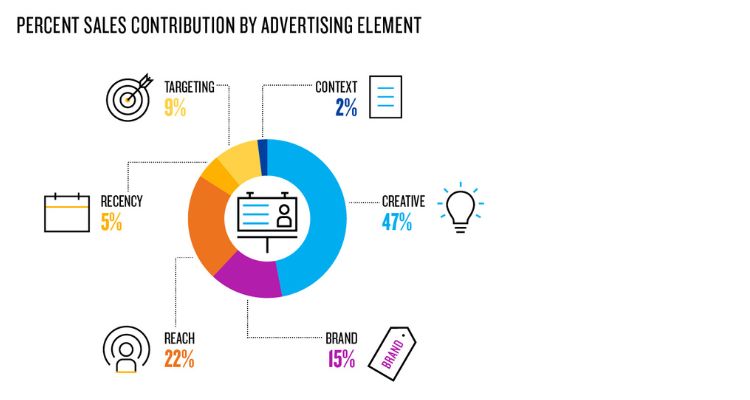
The data shows why a strategic approach is critical:
- A study by Nielsen found that the quality of the creative is the single biggest contributor to advertising profitability, with a brilliant ad being up to 10 times more effective than a poor one.
- According to research from CoSchedule, businesses that prioritize a documented marketing strategy are 313% more likely to report success in their campaigns.
- David Ogilvy, the “Father of Advertising,” famously stated that half the money spent on advertising is wasted; the trouble is, you don’t know which half. A clear marketing strategy is the best tool for reducing that waste.
Marketing is the overall strategy; advertising is just one tactic. Understanding this is the first step toward building a brand that lasts.
1. The bigger picture: What is marketing?
Marketing is the entire strategic process of bringing a product to market. As legendary professor Philip Kotler defined it, it’s a complete system for creating and exchanging value with your customers. The easiest way to understand this is with the classic 4 Ps of Marketing:
- Product: Creating a product or service that people actually want.
- Price: Setting a price that is both profitable and valuable to the customer.
- Place: Making your product available where your customers shop.
- Promotion: Communicating the value of your product to your target market.
Advertising is just one small part of the fourth “P”—Promotion.

2. The art of advertising: Lessons from the Ad Masters
Advertising is the paid act of spreading a message about your product. According to masters like David Ogilvy, Robert Bly, and John Caples, the goal is simple: to sell.
- Start with a “Big Idea” (Ogilvy): Your ad must be built around a single, compelling promise to the customer.
- The Headline is 80% of the Ad (Caples): John Caples was a pioneer of testing. His data proved that if your headline doesn’t grab attention and promise a benefit, the rest of the ad is useless.
- Write Persuasive Copy (Bly): In “The Copywriter’s Handbook,” Robert Bly teaches that good copy is clear, concise, and focuses on the customer’s self-interest. It answers the question, “What’s in it for me?”
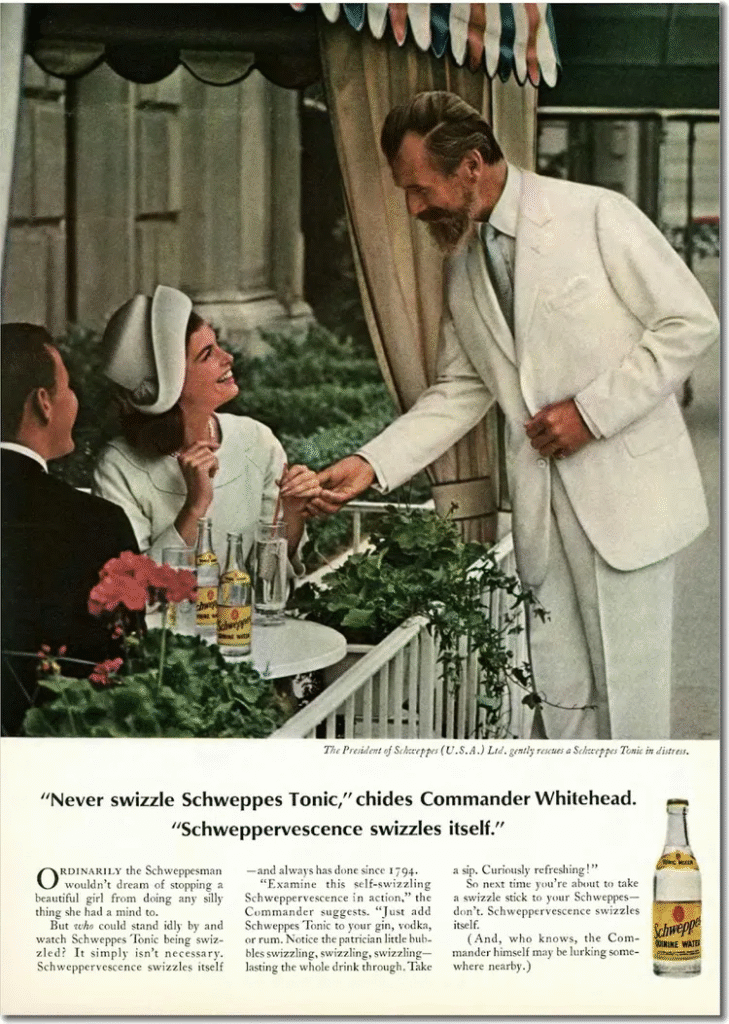
1950s Schweppes Tonic Print Ad
3. Crafting your message: The “Laddering” technique
“Laddering” is a powerful technique for creating an emotionally resonant message. It connects a simple product feature to a higher-level emotional benefit for the customer.
| Ladder Rung | Example: A New Laptop |
| Feature | “It has an M3 processor.” |
| Functional Benefit | “It’s faster, so you can edit videos without lag.” |
| Emotional Benefit | “You’ll feel more creative and professional, and less frustrated.” |
4. Choosing your channels
In the digital age, there are countless channels to advertise on. The key is to test different channels and then focus your budget on the ones that work best for your business.
| Advertising Channel | Pros | Cons |
| Social Media Ads (e.g., Instagram) | Highly targeted, great for visual products. | It can be expensive and requires constant management. |
| Search Engine Ads (Google Ads) | Captures high-intent customers actively searching. | Highly competitive, can be complex to manage. |
| Content Marketing (Blogs, YouTube) | Builds long-term trust and authority. | Takes a long time to see results. |
| Newspapers / Magazines | Reaches specific, local, or niche audiences. | Hard to measure direct ROI, can be expensive. |
| Out-of-Home (e.g., Billboards) | Great for building local brand awareness. | Very hard to measure effectiveness, high cost. |
“The consumer isn’t a moron; she is your wife. You insult her intelligence if you assume that a mere slogan and a few vapid adjectives will persuade her to buy anything.” – David Ogilvy
Final Thoughts
Confusing advertising with marketing is like confusing a single brushstroke with the entire painting. Advertising is a powerful tool, but without a strong marketing strategy behind it, a great product, the right price, and a clear audience, it’s just noise.
Start with your strategy first. Understand your customer, define your 4 Ps, and then consider creating ads. By following the timeless principles of masters like Kotler, Ogilvy, and Caples, you can stop wasting money and start building a brand that truly connects with customers.
Ready to build a marketing strategy that works? Start by documenting your vision and plan in our professional Business Plan Template.
Frequently asked questions (FAQs)
- What’s the difference between Advertising and PR?
Advertising is paid media (you pay for an ad to run). Public Relations (PR) is earned media (a newspaper or blog writes about you because you are newsworthy). - What is Copywriting?
Copywriting is the art and science of writing words (copy) that persuade people to take an action. As Robert Bly teaches, it’s a critical skill for creating effective ads. - What is a “Big Idea” in Advertising?
Coined by David Ogilvy, the “Big Idea” is the single, overarching creative concept that grabs attention, sticks in the memory, and makes the sale. - How much should I budget for marketing?
While it varies, a common benchmark for small businesses (under $5 million in revenue) is to allocate 7-8% of total revenue to marketing. This has been a consistent finding in studies like the CMO Survey. - What does “Laddering” do?
Laddering is a technique that connects a product’s technical feature to a practical functional benefit, and then to a higher-level emotional benefit, making the message much more persuasive.
References
- Ogilvy on Advertising. (1983). David Ogilvy. https://www.amazon.com/Ogilvy-Advertising-David/dp/039472903X
- The Copywriter’s Handbook: A Step-By-Step Guide to Writing Copy That Sells. (2005). Robert W. Bly. https://www.amazon.com/Copywriters-Handbook-Step-Step-Writing/dp/0805078045
- Tested Advertising Methods. (5th Edition). John Caples & Fred Hahn. https://www.amazon.com/-/es/Advertising-Methods-Prentice-Business-Classics/dp/0130957011
- Marketing Management. (15th Edition). Philip Kotler & Kevin Lane Keller. https://www.amazon.com/Marketing-Management-15th-Philip-Kotler/dp/0133856461
- The CMO Survey. (n.d.). Deloitte. https://cmosurvey.org/
- When it comes to advertising effectiveness, what is key? (2017). Nielsen. https://www.nielsen.com/insights/2017/when-it-comes-to-advertising-effectiveness-what-is-key/