Don’t wait until you’re ready to sell. Learn how to calculate the value of your business today to make smarter decisions, secure funding, and build long-term wealth.
Introduction: Why is your valuation a strategic asset?
As a business owner, you track daily sales and monthly profits. But do you know the single most important number for your long-term success: the actual value of your company? This number is more than just a score; it’s a strategic lever.
Understanding your valuation is critical for strategic decision-making, especially when it comes to fundraising and planning your exit.
- For Fundraising: As A.J. Sherman explains in “Raising Capital,” your valuation is the centerpiece of your pitch to investors. It’s the number that determines how much of your company you give away in exchange for funding.
- For Deal Making: According to Brad Feld in “Venture Deals,” the valuation is a critical component of the “term sheet,” directly impacting the structure of any potential investment deal.
- For Strategic Growth: The authors of McKinsey’s “Valuation” argue that companies that consistently measure and manage their value are the ones best equipped to make smart, profitable growth decisions.
Knowing your number allows you to think like an investor. This guide breaks down the three most common methods in simple terms.
Which business valuation method is right for you?
The right valuation method for your small business isn’t one-size-fits-all; it depends on your industry and stage. Use the decision flowchart below to quickly match your business type to the right valuation approach.
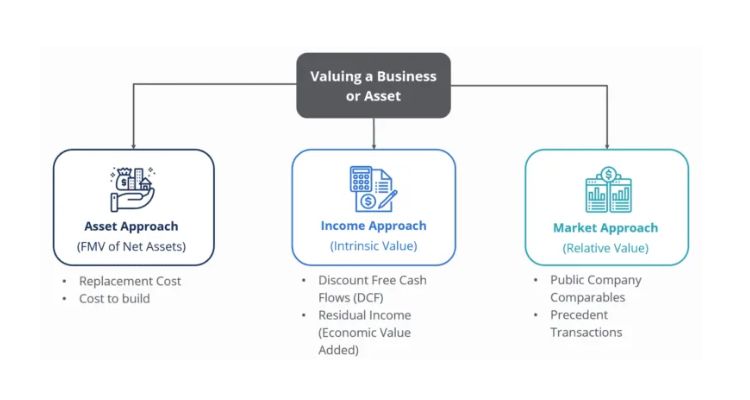
Image source: https://corporatefinanceinstitute.com/resources/valuation/valuation/
The 3 main approaches to valuing your business
Most valuation methods fall into one of three simple categories. For a complete picture, professionals often use a combination of all three.
| Valuation Approach | Best For | Pros | Cons |
| Asset Approach | Businesses with significant tangible assets (e.g., manufacturing). | Straightforward and based on concrete balance sheet numbers. | Ignores future earnings potential and intangible assets like brand value. |
| Market Approach | Businesses in established industries with public competitors (e.g., SaaS). | Grounded in real-world market data of what similar companies are worth. | It can be misleading if “comparable” companies aren’t a good match. |
| Income Approach | Profitable, service-based businesses with a strong track record. | Focuses on actual profitability and future cash flow. | Highly sensitive to assumptions about future growth. |
1. The asset approach
This method calculates value by taking your company’s total assets and subtracting its total liabilities. It’s a snapshot of the company’s “book value.”
Simple Formula: Total Assets – Total Liabilities = Business Value
Sample Calculation: A small logistics company owns trucks and a warehouse worth $500,000 (assets) and has outstanding loans of $150,000 (liabilities). Its asset-based value is $350,000.
2. The market approach
This method values your business by comparing it to similar companies. It often uses a “multiple” of revenue or EBITDA. To apply this, you need to find the current average multiple for your specific industry from a financial data platform like Eqvista.
These multiples can vary widely by industry and market conditions. Here is a sample list to give you a general idea:
| Industry | Average Revenue Multiple |
| SaaS (Software as a Service) | 5x – 8x |
| E-commerce | 0.8x – 1.5x |
| Professional Services | 0.9x – 1.3x |
| Manufacturing | 0.7x – 1.2x |
| Restaurants & Food Service | 0.4x – 0.9x |
(Note: These are illustrative examples and can change based on the market.)
A Practical Example: A SaaS company generates $1 million in Annual Recurring Revenue (ARR). Using a 5x Multiple from the sample list, its market-based value is $5 Million.
3. The income approach
This is often the most important method for investors because it focuses on a business’s ability to generate future cash. A common technique for small businesses is the Seller’s Discretionary Earnings (SDE) method.
Sample Calculation: The owner of a local service business has a net profit of $100,000. They add back their own $80,000 salary and $20,000 in personal benefits. This gives them an SDE of $200,000. If the industry multiple is 2.5x, the business value is $500,000.

Putting it all together: A comparative example
To see how these methods can result in different numbers, let’s value a single hypothetical small business, a local printing company, using all three approaches.
| Approach | Calculation | Valuation |
| Asset Approach | $200,000 (Assets) – $50,000 (Liabilities) | $150,000 |
| Market Approach | $300,000 (Revenue) x 0.8 (Industry Multiple) | $240,000 |
| Income Approach | $75,000 (SDE) x 2.5 (Industry Multiple) | $187,500 |
This comparison shows why using a combination of methods is crucial for arriving at a realistic and defensible number.
Final thoughts
As a founder, understanding your business’s value is one of the most strategic actions you can take as a founder. This isn’t just an exercise for a sale; it’s a critical part of your strategic toolkit that should inform your strategy and guide your investments. To see how it connects to your day-to-day finances, read our guide: Cash Flow: A simple guide to your business’s most important number.
To start turning these valuation insights into an actionable growth strategy, download our Business Plan Template and build a clear roadmap for the future.
Frequently asked questions (FAQs)
- Which valuation method is best?
There is no single “best” method. Most professionals use a combination of all three to get a comprehensive view. - How can I increase the value of my business?
Focus on the drivers of the Income Approach. Grow your revenue, improve your profit margins, and create recurring income streams. - How often should I update my valuation?
It’s a good practice to value your business at least once a year, or before any major event like seeking investment, a loan, or planning for a sale. - Can I use AI tools for business valuation?
Yes, AI tools are becoming more common for providing quick, data-driven estimates. However, for formal purposes like a sale or legal matter, you will still need a certified human appraiser.
References
- Valuation: Measuring and Managing the Value of Companies. (7th Edition). McKinsey & Company. https://www.amazon.com/Valuation-Measuring-Managing-Companies-Finance/dp/1119610885
- Raising Capital: Get the Money You Need to Grow Your Business. (2019). A.J. Sherman. https://www.amazon.com/Raising-Capital-Money-Need-Business/dp/0814417035
- Venture Deals: Be Smarter Than Your Lawyer and Venture Capitalist. (2011). Brad Feld & Jason Mendelson. https://www.amazon.com/Venture-Deals-Smarter-Lawyer-Capitalist/dp/1119594820
- How to Calculate Startup Valuation. (n.d.). Equidam. https://www.equidam.com/how-to-calculate-startup-valuation/
- PwC Pulse Survey: Business insights. (2024). PwC. https://www.pwc.com/us/en/library/pulse-survey.html