
A great roadmap aligns your team, clarifies your strategy, and helps you win your market. This guide shows you how to build one.
Learn how to build a product roadmap that drives results. This guide covers open innovation, the development cycle, and how to prioritize features for maximum impact.
Introduction: The difference between a to-do list and a strategy
What’s the number one cause of product failure? It’s not a lack of features or a shortage of funding. According to a CB Insights report, the top reason startups fail is building something nobody wants. They create a feature list, not a strategy.
A product roadmap is the bridge between your high-level vision and the work your team does every day.
- A study by ProductPlan found that companies with a formal product roadmap report 34% higher growth in profits.
- As Marty Cagan, author of “Inspired,” argues, the purpose of a roadmap is to solve business problems, not just to build a feature list.
- The principles of “The Lean Startup” by Eric Ries are built on using a roadmap to test hypotheses and learn from customers, not just to execute a rigid plan.
A great roadmap aligns your team and ensures you are always building what matters most.
1. What is a product roadmap? (Open innovation)
A product roadmap is a high-level, strategic document that shows the direction and priorities of your product over time. As Henry Chesbrough explains in his book “Open Innovation,” the most successful companies understand that the best ideas often come from outside the company. This means actively seeking out customer feedback, listening to your support teams, and watching the market to find new problems to solve. Your roadmap should be a living document that is constantly informed by these external insights.

2. The core components of a modern product roadmap
Instead of a long list of features, a modern product roadmap is organized by themes and desired outcomes.
| Component | Description | Example |
| Themes | High-level customer problems or goals. | “Improve the New User Onboarding Experience” |
| Objectives/Outcomes | What do you want to achieve with the theme? | “Reduce new user churn by 20% in Q3.” |
| Time Horizons | Broad timeframes, not specific dates. | “Now,” “Next,” and “Later” |
3. A 5-step guide to creating your first roadmap
- Define your “Why” (The Product Vision): What is the ultimate purpose of your product? Who is it for, and what problem does it solve?
- Gather insights (Open Innovation): Actively collect feedback from customers, sales teams, and market research.
- Prioritize with a framework: You can’t do everything at once. Use a simple framework like RICE (Reach, Impact, Confidence, Effort) to score your potential initiatives.
- Organize into themes: Group your prioritized ideas into high-level themes to focus on solving problems, not just building features.
- Share and get feedback: Share your roadmap with your team and stakeholders to ensure everyone is aligned.
4. A practical roadmap example
To make this concrete, here is a sample roadmap for a fictional project management software company. Notice how it focuses on customer outcomes (“Improve Collaboration”) rather than just features (“Add a chat function”).
| Now (Q3) | Next (Q4) | Later (Next Year) |
| Theme: Improve collaboration | Theme: Enhance mobile experience | Theme: International expansion |
| – Objective: Increase daily active users by 15%. | – Objective: Achieve a 4.5-star app store rating. | – Objective: Launch in 3 new European markets. |
| – Key Initiatives: Launch in-app notifications, integrate with Slack. | – Key Initiatives: Redesign the mobile dashboard, launch an Android widget. | – Key Initiatives: Add multi-language support, integrate with local payment systems. |
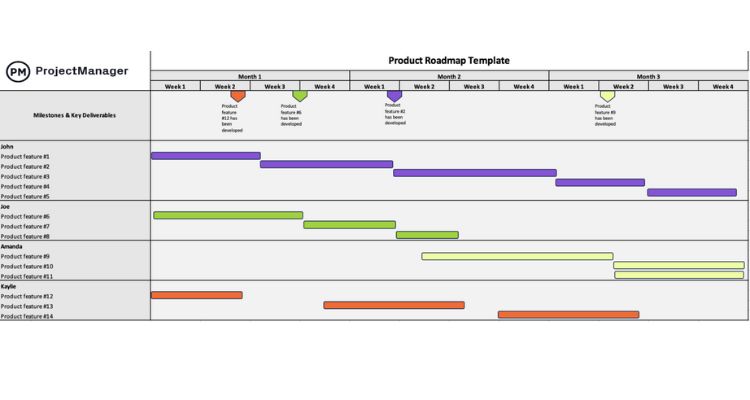

Project Manager’s Gantt charts to make detailed product roadmaps.
5. From roadmap to reality: Execution with Scrum & Kanban
A roadmap is your strategic “why,” but you need a system for the “how.” This is where execution frameworks come in.
- Scrum Sprints: The strategic themes on your roadmap are broken down into smaller pieces of work for your team to complete in short, focused cycles called Scrum Sprints.
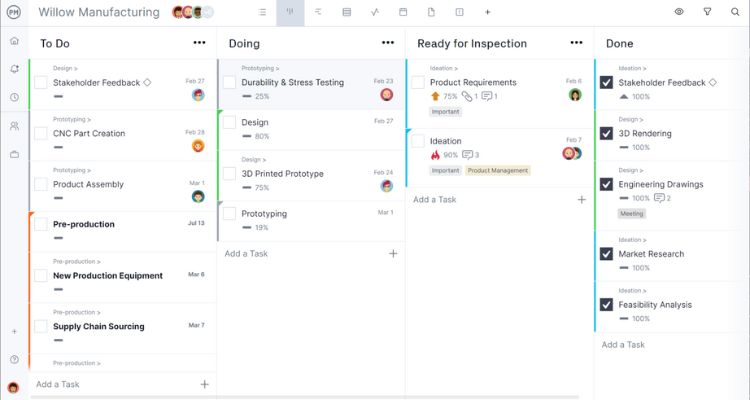
- Kanban Boards: A Kanban board (like Trello) is a visual tool used to manage the day-to-day workflow of the tasks within a Sprint. It shows what is “To Do,” “In Progress,” and “Done.”
The roadmap sets the destination; Scrum and Kanban are the engine that gets you there.
6. Managing risk with a stage-gate process
As detailed in books like “The Pursuit of New Product Development,” a Stage-Gate process is a formal system for managing risk. It breaks a project into distinct stages (e.g., Ideation, Feasibility, Development). At the end of each stage is a “gate” where decision-makers review the project and decide if it should move forward. This prevents companies from wasting money on a bad idea.
“The purpose of a roadmap is to articulate the strategy… to ensure that we are all pulling in the same direction.” – Marty Cagan, Inspired
Final thoughts
A product roadmap is one of the most powerful strategic tools a founder has. It’s the single source of truth that aligns your team, guides your development, and keeps you focused on solving real problems for your customers.
By embracing open innovation and connecting your strategy to a clear execution framework, you stop being a “feature factory” and start becoming a value-creation engine.
Ready to build a strategic plan for your product? Start by using our professional Business Plan Templates to define your vision and market strategy.
Frequently asked questions (FAQs)
- What’s the difference between a product roadmap and a Kanban board?
A roadmap is a high-level strategic document showing what you plan to do over the long term. A Kanban board is a detailed, tactical tool showing the status of the work you are doing right now. - How detailed should a roadmap be?
It should be high-level. Avoid specific dates for items in the “Next” or “Later” columns, as these are likely to change. The goal is to show direction, not to make promises you can’t keep. - Who owns the product roadmap?
The Product Manager or the founder typically owns and manages the product roadmap. - What is “Open Innovation”?
It’s a concept developed by Henry Chesbrough. It argues that companies should use external ideas and collaboration (from customers, partners, etc.) in addition to internal ideas to drive innovation. - How does the Yoast SEO plugin use this?
Yoast is a great example of a company that uses a continuous release cycle. Their roadmap is less about big, distant features and more about a steady stream of small, valuable improvements and updates based on user feedback.
References
- Inspired: How to Create Tech Products Customers Love. (2018). Marty Cagan. https://www.svpg.com/inspired-how-to-create-tech-products-customers-love/
- The Lean Startup: How Today’s Entrepreneurs Use Continuous Innovation to Create Radically Successful Businesses. (2011). Eric Ries. https://theleanstartup.com/book
- Scaling Up: How a Few Companies Make It…and Why the Rest Don’t. (2014). Verne Harnish. https://scalingup.com/book/
- The 2023 State of Product Management Report. (2023). ProductPlan. https://www.productplan.com/2023-state-of-product-management-annual-report/
- APM Resources. (n.d.). Association for Project Management (APM). https://www.apm.org.uk/resources/
- Open Innovation: Researching a New Paradigm. (2006). Henry Chesbrough. https://www.amazon.com/Open-Innovation-Researching-New-Paradigm/dp/0199290725
- The Pursuit of New Product Development. (2005). Marc Annacchino. https://www.amazon.com/Pursuit-New-Product-Development-Successful/dp/0750678227