



A Simple Step-by-Step Guide That Actually Works
Most small business owners are creating content. Very few have a strategy behind it. Here is how to change that in one afternoon.
Learn how to build a simple content strategy for your small business. A practical step-by-step guide to help you create the right content, reach the right people, and grow consistently.
Introduction
You are posting. You are writing. You are showing up on social media, sending emails, and maybe even publishing the occasional blog. But something is not adding up.
The likes are there. The comments are occasional. But the leads are not coming. The customers are not finding you. And every Monday morning, you sit down and ask yourself the same question: What should I post this week?
That question is the problem. Not the content itself.
A content strategy is what turns random posting into a system that consistently brings the right people to your business. It does not have to be complicated. It does not require a marketing team or an agency. It requires clarity, a simple plan, and the discipline to follow it.
This guide gives you exactly that.
Business Facts
Small businesses are 23% more likely than the industry average to see a positive return on investment from consistent blog content, according to HubSpot’s State of Marketing Report 2026. Consistency backed by strategy is what makes the difference.
- According to Semrush’s State of Content Marketing Report, 80% of very successful companies have a documented content marketing strategy. Only 52% of unsuccessful companies do. The gap between winning and losing at content is almost always a strategy gap.
- Businesses that blog consistently get 55% more website visitors on average than those that do not. More visitors mean more opportunities to turn readers into customers.
What Happens Without a Content Strategy?
Without a content strategy, three things happen almost every time.
First, your content has no direction. You post what feels right that week. Some posts are about your product. Some are motivational quotes. Some are behind-the-scenes photos. None of it connects to a clear goal, and none of it consistently brings in new customers.
Second, you waste time. Creating content takes real effort. Writing a blog post, filming a short video, designing a graphic, all of that takes hours. Without a strategy, a significant portion of that effort goes toward content that does not move your business forward.
Third, you get inconsistent. Life gets busy. Without a plan, content is the first thing that stops when things get hectic. And when you disappear from your audience’s view, they find someone else who shows up consistently.
A content strategy fixes all three problems before they start.
What Is a Content Strategy?
A content strategy is a documented plan that defines what content you will create, who it is for, why you are creating it, where you will publish it, and how you will know if it is working.
It is not a content calendar. A calendar tells you when to post. A strategy tells you what to post and why. The calendar comes after the strategy.
It is not a complicated document. For a small business owner, a content strategy can fit on a single page. What matters is that it exists, it is written down, and you follow it consistently.
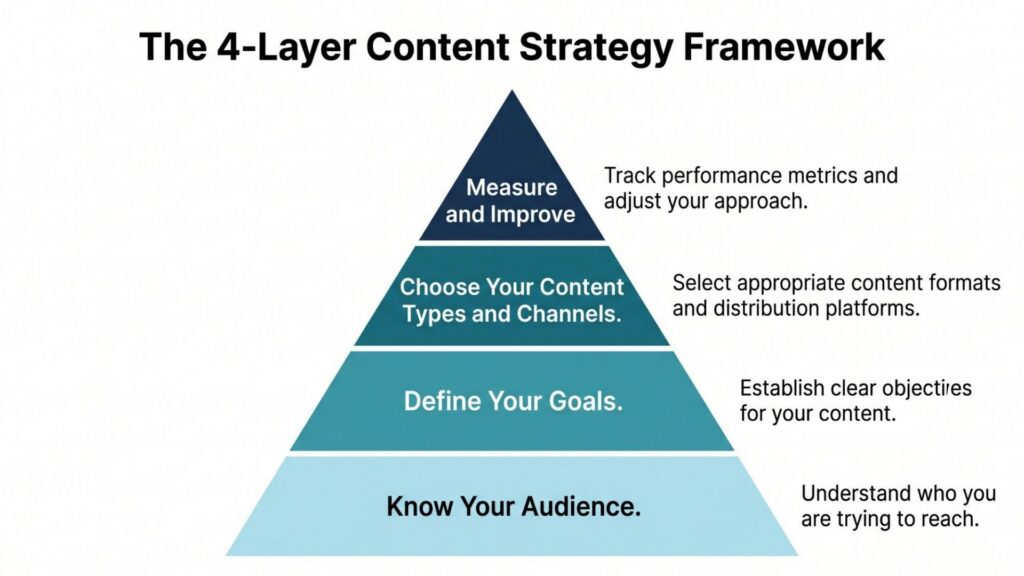
How to Build a Content Strategy for Your Small Business in 6 Steps
Step 1: Define Your One Clear Goal
Before you create a single piece of content, you need to know what you want it to do for your business. Not every business has the same goal, and your content strategy should reflect that.
Are you trying to attract new customers who have never heard of you? Then your goal is awareness, and your content should focus on answering the questions your ideal customer is already asking online.
Are you trying to convert people who already know you but have not bought yet? Then your goal is conversion, and your content should focus on trust-building, social proof, and showing people exactly what working with you looks like.
Are you trying to keep existing customers coming back? Then your goal is retention, and your content should focus on value, education, and making customers feel like they made the right choice.
Pick one primary goal. Start there.
Step 2: Know Exactly Who You Are Talking To
Content that tries to speak to everyone ends up connecting with no one. The most effective content is written for one specific type of person with one specific problem.
Write down the answers to these questions about your ideal customer. What does their typical day look like? What problem keeps them up at night that your business solves? Where do they spend time online? What language do they use when describing their problem? What have they already tried that has not worked?
The more specifically you can answer these questions, the more powerful your content becomes. A bakery owner writing for first-time wedding planners will always outperform a bakery owner writing for everyone who likes cake.
If you have not already built a customer persona, this is the most important step you can take before creating any content. It shapes everything else.
Your Content Must Match Where Your Customer Is Right Now
Knowing your audience is only half the picture. The other half is understanding where they are in their journey toward buying from you.
A person who has never heard of your business needs completely different content from someone ready to buy. Sending the wrong message at the wrong moment is one of the most common reasons content fails to convert.
The customer journey for most small businesses follows five clear phases:
Awareness: The customer has a problem but does not know your business exists yet. Content at this phase should answer the questions they are already typing into Google. Blog posts, short videos, and social media posts that address common pain points work best here. Example: “5 Signs Your Business Needs a Marketing Plan.”
Interest: The customer has found you and wants to know more. Content at this phase should educate and build credibility. Guides, how-to articles, and email newsletters that go deeper into your topic work best here. Example: “How to Build a Marketing Plan in One Afternoon.”
Desire: The customer likes what they see and is comparing options. Content at this phase should show why you are the right choice. Case studies, testimonials, product comparisons, and detailed explainers work best here. Example: “How Our Marketing Plan Template Helped 500 Founders Launch Faster.”
Action: The customer is ready to buy. Content at this phase should make the decision easy and remove any last hesitation. Clear CTAs, FAQs, pricing pages, and guarantee statements work best here. Example: “Download Your Marketing Plan Template Today, Risk Free.”
Retention: The customer has bought, and you want them to stay, return, and refer others. Content at this phase should deliver ongoing value and deepen the relationship. Email newsletters, tips, updates, and exclusive content work best here. Example: “Your Monthly Business Planning Checklist, Straight to Your Inbox.”
When you plan your content calendar, always ask: which phase of the journey is this piece serving? A strong content strategy covers all five phases, not just the first one.
Why Content Strategy Becomes Essential as Your Business Grows
Here is something most small business owners do not realize until it is too late. Content volume grows much faster than expected the moment you start doing it properly.
Consider this simple example. Imagine your business serves four different types of customers:
- The first-time founder is just starting out
- The freelancer building their independent career
- The marketing manager in a growing company
- The business consultant serving multiple clients
Now map those four personas across the five journey phases above. That is 20 unique content moments, each requiring a different message, a different angle, and a different tone.
Now choose five content formats: blog post, short video, email, social media post, and case study.
Suddenly, you are looking at up to 100 potential pieces of content, each serving a specific person at a specific moment in their journey toward your business.
That is not a reason to panic. It is a reason to plan.
This is exactly why a documented content strategy is not optional for a growing business. Without one, content creation becomes chaotic, inconsistent, and impossible to manage. With one, every piece of content has a clear purpose, a defined audience, and a measurable goal.
For a solo founder or small team, this means prioritizing ruthlessly. You cannot create 100 pieces of content every month. But you can choose the two or three highest-impact combinations of persona, journey phase, and format and do those brilliantly.
For a growing business with a marketing team, this volume calculation is exactly what justifies dedicated content ownership. When your marketing manager can show leadership that consistent content across four personas and five journey phases requires a structured system and clear brand alignment, the case for proper resourcing becomes impossible to argue against.
A content strategy is not just a planning tool. It is the foundation that makes scaling your marketing possible without losing your brand voice or your consistency.
Step 3: Choose Your Content Types
Not all content is created equal, and not all content suits every business. The right content type depends on your audience, your goal, and what you are comfortable creating.
Blog posts work well for businesses that want to rank on Google and build authority over time. They attract people who are actively searching for answers to specific questions.
Short-form videos work well for businesses that want to build a personal connection quickly. They work especially well on social media and for audiences that prefer watching over reading.
Email newsletters work well for businesses with an existing audience that wants to deepen the relationship and drive repeat purchases or referrals.
Social media posts work well for visibility, community building, and keeping your brand top of mind between bigger content pieces.
Start with one. Do it well. Add more only when it is working.
Step 4: Pick Your Channels
Where you publish matters as much as what you publish. The best content in the wrong place reaches nobody.
The simple rule is: go where your customers already are. If your ideal customer is a 45-year-old business owner, LinkedIn and email will outperform TikTok every time. If your ideal customer is a 25-year-old consumer, Instagram and short-form video will outperform a long blog post every time.
Pick two channels maximum. Focus always beats scattered presence.
Step 5: Build a Simple Content Calendar
A content calendar is not a complicated spreadsheet. For a small business owner, it can be as simple as a monthly plan that answers three questions for each piece of content: What is the topic? What is the format? When does it go live?
Aim for a realistic publishing frequency you can actually maintain. One well-researched, genuinely useful blog post per week will outperform three rushed posts every time. One honest, engaging email newsletter per fortnight will build more trust than daily emails that say nothing new.
Consistency over volume. Always.
To make this concrete, here is a simple example for a small accounting firm targeting self-employed freelancers:
Week 1: Blog post: “5 Tax Mistakes Freelancers Make Without Realising It.”
Week 2: Email newsletter: Three quick bookkeeping tips for the month ahead.
Week 3: Social media post series: Client question of the week answered in three slides.
Week 4: Blog post: “How to Set Aside the Right Amount for Tax as a Freelancer.”
Notice how every piece of content serves the same audience, answers a real question, and connects back to the firm’s core expertise. That is what a strategy looks like in practice.
Step 6: Measure What Matters and Adjust
Content strategy is not set and forget. It is set, measure, and improve.
Every month, look at three simple numbers. How many people saw your content? How many engaged with it by clicking, commenting, or sharing? And most importantly, how many took a business action as a result, such as signing up, booking a call, or making a purchase?
If people are seeing your content but not engaging, your topic or format needs work. If people are engaging but not taking action, your call to action or offer needs work. If nobody is seeing your content, your channel, or frequency needs work.
Do not change everything at once. Identify the single weakest point and improve that first. Give each change at least four weeks before measuring again. Content marketing is a long game, and consistency always wins over time.

Types of Content That Work for Small Businesses
Every content type serves a different purpose. Use this table to choose the right format for your goal, your audience, and the effort you can realistically commit to.
Comparison Table
| Content Type | Best Goal | Effort Level | Time to See Results |
| Blog Post | Awareness and SEO | Medium | 3 to 6 months |
| Short Form Video | Reach and connection | Low to Medium | 1 to 4 weeks |
| Email Newsletter | Retention and conversion | Medium | Immediate |
| Case Study | Trust and conversion | High | Immediate |
| Social Media Post | Visibility and community | Low | 1 to 2 weeks |
“Content is the reason search began in the first place.”
– Lee Odden, CEO of TopRank Marketing
Final Thoughts
A content strategy does not have to be a 40-page document written by a marketing agency. For a small business owner, it can be one page with clear answers to five questions: who am I talking to, what problem am I solving, what content will I create, where will I publish it, and how will I know it is working?
Start today. Write your goal, define your audience, pick one content type, choose one channel, and create your first month of content. That is your content strategy. It does not have to be perfect. It has to exist.
Ready to take it further? Download the Content Strategy Template from Excellent Business Plans and give your content the structure it needs to actually grow your business.
Next Steps: Build Your Content Strategy This Week
You do not need to plan everything at once. Start with these six steps:
- Write your primary content goal in one sentence today
- Describe your ideal customer in as much detail as you can on one page
- Choose one content type and one channel to start with
- Plan four pieces of content for your first month
- Set a reminder to review your numbers at the end of the month
- Commit to your publishing schedule for at least 90 days before judging the results
Content strategy is not a one-time task. It is a habit. Build the habit first, and the results will follow.
FAQs
1. Do I need a content strategy if I am a very small business or solo founder? Yes, especially if you are small. A solo founder or micro business has limited time and budget. A content strategy makes sure every piece of content you create has a purpose and moves your business forward. Without one, you are spending your most valuable resource, your time, on content that may not be helping you at all.
2. How long does it take to see results from a content strategy? It depends on the content type and channel. Social media and email can show results within weeks. Blog content and SEO typically take three to six months to build momentum. The key is consistency. Most small business owners give up too early. Commit to at least 90 days before evaluating whether your strategy is working.
3. How much time should I spend on content as a small business owner? You do not need to spend hours every day. Even four to six hours per week, spread across planning, creating, and publishing, is enough to build a consistent and effective content presence. The key is having a strategy so those hours are always spent on the right things.
4. What is the single most important piece of content a small business can create? A well-written, genuinely useful blog post that answers the most common question your ideal customer types into Google. It works 24 hours a day, builds your authority over time, and brings in people who are already looking for exactly what you offer.
5. Should I be on every social media platform? No. Focus on the one or two platforms where your ideal customers actually spend time. Being consistent and valuable on one platform will always outperform being scattered and sporadic across five. Master one channel before adding another.
6. What is the difference between a content strategy and a content calendar? A content strategy defines what you create, who it is for, why you are creating it, and how you will measure success. A content calendar tells you when each piece goes live. The strategy comes first. The calendar is simply the execution tool that puts your strategy into practice week by week.
References
- HubSpot State of Marketing Report 2026: https://www.hubspot.com/marketing-statistics
- Semrush State of Content Marketing Report via Blogging Wizard: https://bloggingwizard.com/content-marketing-statistics-trends/
- Digital Silk: 40 Must-Know Content Marketing Statistics for 2025: https://www.digitalsilk.com/digital-trends/content-marketing-statistics/
- Content Marketing Institute B2B Content Marketing Benchmarks 2025: https://contentmarketinginstitute.com/b2b-research/b2b-content-marketing-trends-research-2025
- Semrush Content Marketing Statistics 2025: https://www.semrush.com/blog/content-marketing-statistics/
- HubSpot Marketing Statistics 2026: https://www.hubspot.com/marketing-statistics


