
Most small businesses set goals in January and forget them by March. A 12-month business growth roadmap fixes that, and it is simpler to build than you think.
Learn how to create a practical 12-month business growth roadmap, broken into quarterly priorities and monthly projects, so your business grows with intention and not guesswork.
Introduction: The ambitious January, a forgotten February problem
Every year, most small business owners start with the same energy. Revenue targets get written down. New markets get circled on a whiteboard. Hiring plans get sketched out on a napkin. By the end of January, most of it has been buried under the daily demands of running the business.
This isn’t a motivation problem. It’s a structure problem. A goal without a roadmap beneath it is just a wish. Knowing where you want to be in twelve months tells you nothing about what you should actually be doing this month, this week, or today.
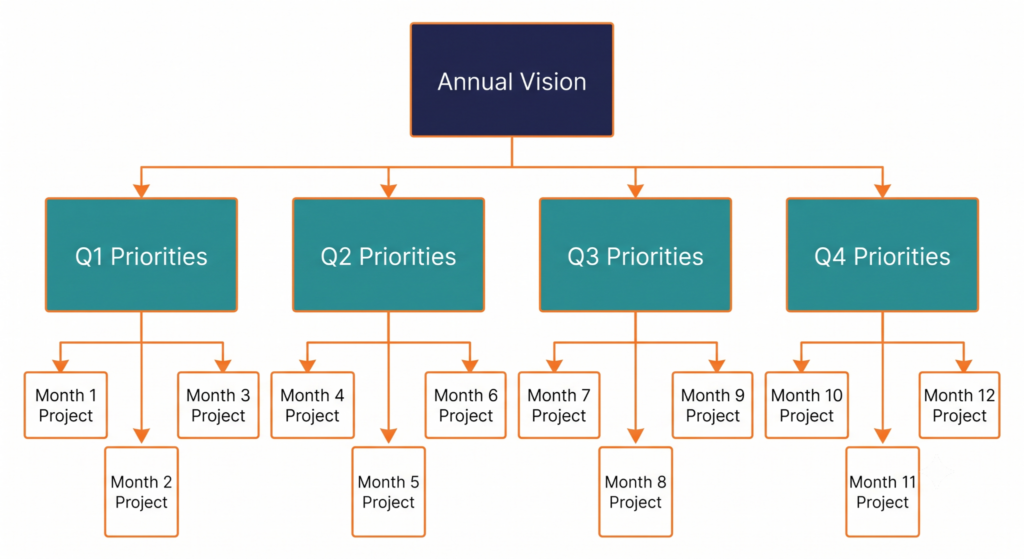
A 12-month growth roadmap solves this by working in three layers: a clear annual vision at the top, four quarterly priorities beneath it, and concrete monthly projects at the base. Each layer translates the one above it into something specific and actionable. Together, they turn a vague annual goal into a structured plan that your business can actually execute.
This article walks you through how to build that roadmap, step by step.
Business facts: What the data shows
- Businesses with a formal written plan grow 30% faster than those without one, and are 2.5 times more likely to secure funding when they need it. (Source: Business Dasher, 2024, citing SBA data)
- 71% of fast-growing companies have a written business plan they actively use and refer to, compared to only 35% of slower-growing businesses. (Source: Business Dasher, 2024)
- 78% of small business owners say they plan to grow in the coming year, yet most lack a documented roadmap to structure how that growth will actually happen. (Source: Chalifour Consulting, Small Business Growth Breakthroughs, 2025)
- Only 33% of small businesses have a formal written plan, meaning two in three are attempting to grow without any documented direction to guide their decisions. (Source: Business Dasher, 2024)
Why most annual goals fail before February
The problem with most annual goal-setting isn’t ambition. It’s architecture. Owners set a target for the year and then try to hold that target in their head while managing day-to-day operations. Without a structure to break the year into smaller, manageable pieces, the annual goal competes with every other urgent task and usually loses.
There are three specific reasons annual goals fail without a roadmap:
No connection between the goal and daily decisions. If the only plan is “grow revenue by 40% this year,” there is nothing to guide what actually gets prioritized on a Tuesday in March. The goal is too distant to shape daily behavior.
No review rhythm. Many owners review progress only once a year, or not at all, which is far too infrequent to catch problems early or adjust when circumstances change. Those who do review quarterly are far more likely to stay on track.
No shared direction. A goal that lives only in the owner’s head can’t align a team. When different team members don’t know what the business is working toward this quarter, they optimize for their own priorities rather than a shared one.
A 12-month growth roadmap addresses all three of these problems by giving the annual goal a structure, a rhythm, and a format that can be shared.
What a 12-month growth roadmap actually is
A 12-month growth roadmap is not a 30-page business plan. It is a simple, living document with three layers that connect long-term vision to short-term action:
- Layer 1: Annual vision. One clear goal for the year. Where does the business need to be by December 31?
- Layer 2: Quarterly priorities. Four sets of 2 to 3 priorities, one per quarter, that define what must happen each quarter to reach the annual goal.
- Layer 3: Monthly projects. Three concrete actions per month that deliver each quarter’s priorities.
Each layer translates the one above it into something actionable. The annual vision sets the destination. The quarterly priorities define the route. The monthly projects determine what the team actually does each week.
Step 1: Set your annual growth vision
Start with one clear, specific goal for the year. Not ten goals, one. This is what Gino Wickman calls a “one-year plan” in Traction, and what Jim Collins describes as the anchor that aligns every other decision.
The annual vision should be measurable and honest. It is not a dream and not a conservative estimate. It is an ambitious but realistic target that the business could genuinely reach with focused effort. Good examples:
- Grow monthly revenue from $25,000 to $40,000 by December
- Expand from 3 to 6 active retainer clients by Q4
- Hire and onboard two new team members and reduce owner working hours by 30%
One goal does not mean one thing changes. It means one primary outcome defines success for the year, and everything else serves that outcome.
Step 2: Break it into quarterly priorities
Once the annual goal is clear, work backward through four quarters and ask: what must happen in each quarter to stay on track?
This is the core insight of The 12 Week Year by Brian Moran: treat each quarter like a mini-year. Give it its own priorities, its own finish line, and its own review. This creates urgency without pressure, because there is always a near-term accountability point, not just one distant annual deadline.
For most small businesses, 2 to 3 priorities per quarter is enough. More than that spreads focus too thin. As John Doerr writes in Measure What Matters, “If we try to focus on everything, we focus on nothing.”
A practical example using the revenue goal above:
- Q1: Fix pricing on the two lowest-margin service lines and launch one new lead generation channel
- Q2: Convert leads into 2 new retainer clients and document the client onboarding process
- Q3: Hire a part-time team member to handle delivery, freeing owner time for sales
- Q4: Optimize the new team structure and review annual performance against the December target
Each quarter has a clear outcome, not just a task list.
Step 3: Turn each quarter into monthly projects
Each quarterly priority needs to be broken into monthly projects: specific, concrete actions that the team will actually execute that month.
The rule here is a maximum of three projects per month. Not a list of everything that could be done, three things that will actually be done. This is the level where planning meets execution, and the temptation to overload the month is the single most common reason roadmaps fall apart in practice.
Using Q1 from the example above:
- January: Audit current pricing on all service lines and calculate true margin per service
- February: Raise prices on the two lowest-margin services and communicate the change to existing clients
- March: Launch one new lead generation channel (LinkedIn outreach or email campaign) and set a target for first qualified leads
Each month now has a clear purpose that connects directly to the quarterly priority, which connects directly to the annual goal. The roadmap is coherent from top to bottom.

Step 4: Build a simple review rhythm
A roadmap without a review rhythm is just a document. The review rhythm is what makes it a management tool.
A practical cadence for small businesses:
- Monthly: A short 30-minute check-in. Did we complete this month’s three projects? What’s on track for next month? What needs to change?
- Quarterly: A longer session (1 to 2 hours) to review the full quarter’s results, close out completed priorities, and confirm or adjust the next quarter’s plan based on what you’ve learned.
- Annually: A full review of the year’s results against the original vision, followed by setting the next year’s roadmap.
This is the OKR cadence described by John Doerr in Measure What Matters, adapted for small business scale. The monthly check-in keeps the roadmap alive. The quarterly reset keeps it honest.
Step 5: Share it with your team
A roadmap that only the owner knows about can’t align a team. Once the roadmap is built, share it clearly with every team member who needs to contribute to it.
This doesn’t require a formal presentation. A shared document, a brief team meeting, or even a one-page summary pinned to a shared workspace is enough. What matters is that everyone understands:
- What the business is working toward this year
- What the priorities are this quarter
- What their specific role is in the monthly projects
When people understand how their daily work connects to the annual goal, they make better decisions, escalate the right problems, and stay focused on what actually matters rather than what feels urgent.
A practical example
Sarah runs a small HR consulting firm with a team of three. At the start of the previous year, she had written “grow the business” as her only goal, with no further structure beneath it.
After building a 12-month growth roadmap, her annual vision became specific: increase revenue from $180,000 to $260,000 by December, with at least three new long-term retainer clients.
Her quarterly priorities broke that target into concrete phases: fix her service packaging and pricing in Q1, launch a referral program and content strategy in Q2, close three new retainer clients in Q3, and systematize delivery to protect margin in Q4.
Each month had three clear projects. Each quarter had a review session. By June, Sarah had already signed two new retainer clients and was ahead of her Q2 target for the first time in three years. Not because she worked more hours, but because for the first time, every hour was pointed in the same direction.
No roadmap vs. 12-month growth roadmap
| No Roadmap | 12-Month Roadmap | |
| Annual goal | Vague or unwritten | Clear, specific, and measurable |
| Quarterly focus | Reactive: whatever feels urgent | Defined in advance, reviewed regularly |
| Monthly actions | Ad hoc and scattered | Three specific projects per month |
| Review rhythm | None or once a year | Monthly check-in, quarterly reset |
| Team alignment | Everyone optimizes independently | Everyone works toward the same outcome |
“We must realize, and act on the realization, that if we try to focus on everything, we focus on nothing.”
– John Doerr, Measure What Matters
Final thoughts
A 12-month growth roadmap doesn’t guarantee that everything goes to plan. Markets shift, clients leave, and unexpected problems appear. But a roadmap means that when things change, you have a clear reference point to return to and adjust from, rather than starting from scratch every time something goes wrong.
Build the roadmap once, at the start of the year. Review it every month. Reset it every quarter. Share it with your team. That is the difference between a business that grows on purpose and one that grows by accident, if it grows at all.
Your next steps:
- [ ] Write down one clear, measurable annual goal for the next 12 months
- [ ] Work backward through four quarters and define 2 to 3 priorities per quarter
- [ ] Turn Q1 priorities into three monthly projects for each of the first three months
- [ ] Set a monthly 30-minute review and a quarterly 2-hour planning session in your calendar now
- [ ] Share the roadmap with your team before the quarter begins
Ready to build your roadmap inside a complete business structure? Download our Business Plan Template to align your 12-month growth plan with your financial goals, marketing strategy, and operational structure, all in one place.
Frequently Asked Questions
What is a 12-month business growth roadmap? A 12-month growth roadmap is a structured plan that connects a single annual goal to four quarterly priorities and twelve monthly projects. It gives a business a clear direction for the year and a practical system for executing that direction month by month.
How is a growth roadmap different from a business plan? A business plan is a comprehensive document covering the full picture of the business: market, model, financials, and operations. A 12-month growth roadmap is a focused, operational tool that sits inside that plan and tells the team specifically what to work on this year, this quarter, and this month.
How many goals should a small business set for the year? One primary annual goal is enough. More than one splits focus and makes it harder to align the quarterly and monthly layers beneath them. Supporting objectives can exist, but one outcome should define what success looks like for the year.
What is the OKR framework and how does it relate to a growth roadmap? OKR (Objectives and Key Results) is a goal-setting framework developed at Intel and popularized by Google. It defines what you want to achieve (objective) and how you will measure progress (key results). A 12-month growth roadmap follows the same logic: the annual vision is the objective, and the quarterly priorities and monthly projects are the measurable steps toward it.
How often should a small business review its growth roadmap? Monthly for a short progress check on that month’s projects, and quarterly for a deeper review of the full quarter’s results and a reset of the next quarter’s priorities. Annual goals should remain stable unless a major external change makes them unrealistic.
What if my business doesn’t hit the quarterly targets? Missing a quarterly target is information, not failure. Use the quarterly review to understand what changed, adjust the next quarter’s priorities accordingly, and carry forward what didn’t get done if it’s still relevant. The roadmap is a living document, not a fixed contract.
References
- Doerr, J. (2018). Measure What Matters. Portfolio/Penguin. https://www.amazon.com/Measure-What-Matters-Google-Foundation/dp/0525536221
- Wickman, G. (2011). Traction: Get a Grip on Your Business. BenBella Books. https://www.amazon.com/Traction-Get-Grip-Your-Business/dp/1936661837
- Moran, B. (2012). The 12 Week Year. Wiley. https://www.amazon.com/12-Week-Year-Others-Months/dp/1118509234
- Collins, J. (2001). Good to Great. HarperCollins. https://www.amazon.com/Good-Great-Some-Companies-Others/dp/0066620996
- Business Dasher. (2024). 16+ Business Plan Statistics That You Must Know. https://www.businessdasher.com/business-plan-statistics/
- Chalifour Consulting. (2025). Small Business Growth Breakthroughs 2025. https://chalifourconsulting.com/white-papers/small-business-growth-breakthroughs-2025/
- U.S. Chamber of Commerce. (2025). Why Business Owners Need OKRs. https://www.uschamber.com/co/grow/thrive/objectives-and-key-results-model