
In a fast-moving market, speed and adaptability are your greatest weapons. Discover how the Scrum framework can help your team develop better products more efficiently.
Introduction: The problem with traditional planning
In today’s market, a rigid business plan can become obsolete the moment it’s printed; the real challenge is adapting to reality fast enough to win. This is where many projects fail and where frameworks like Scrum provide a powerful advantage.
The impact of this challenge is significant:
- The core principle of Eric Ries’s “The Lean Startup” is the “Build-Measure-Learn” feedback loop, designed to avoid the ultimate risk: building a product that customers don’t want.
- According to the Project Management Institute, a staggering 12% of project investment is wasted due to poor performance. (Source: PMI “Pulse of the Profession”)
- According to Jeff Sutherland, one of the co-creators of Scrum, teams that master Scrum can improve their productivity by 300% to 400%.
- Companies with a strong agile culture report 60% higher profit growth and significantly better employee morale. (Source: McKinsey & Company)
Scrum is a framework that turns these modern principles into a simple, repeatable process. It isn’t just for software developers; it’s a powerful system for any team trying to solve complex problems in an uncertain environment.
What is Scrum? A Framework for Agility
Scrum is a simple framework that helps teams deliver value in short, focused cycles called “Sprints” (usually 1-4 weeks). Instead of a single “big bang” launch, the team produces a small, usable piece of the final product at the end of each Sprint. This allows you to get feedback early and adapt, perfectly embodying the “fast implementation” and “MVP design iterations” of The Lean Startup.
While more traditional methods, such as Prince2, focus on a highly structured, stage-by-stage approach, Scrum is designed for flexibility and continuous improvement in environments where not everything is known upfront.

Image source: https://www.scrum.org/resources/what-scrum-module
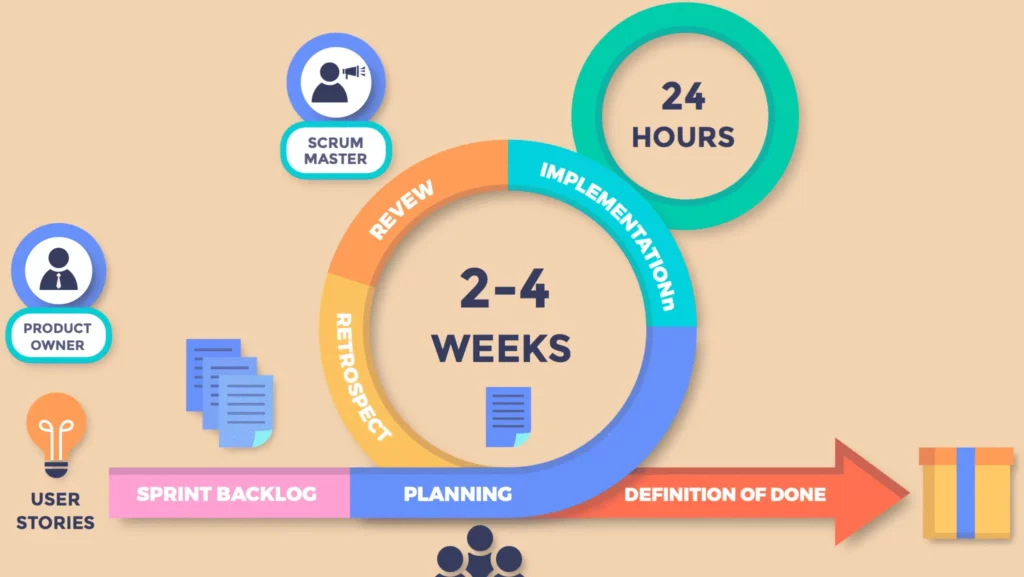
Image source: https://martech.org/what-is-scrum-the-project-management-framework-agile-teams-rely-on/
The Core Building Blocks of Scrum
Scrum is built on a simple foundation of three roles and three key tools that make work visible and keep the team aligned.3
The 3 core roles
- The product owner: Your value maximizer. This person, representing the customer, ensures the team always works on the most valuable tasks to maximize market impact and ROI.4
- The Scrum master: Your efficiency guardian. A facilitator who removes obstacles so the team’s delivery speed is protected, guarding your competitive edge.
- The developers: Your cross-functional engine. The group of experts (engineers, designers, marketers) who execute the work and turn ideas into value.
The 3 key components
- The product backlog: The master to-do list for the entire project. It forces ruthless prioritization, ensuring your team always works on what drives the most customer value.
- The sprint backlog: The to-do list for a single Sprint. It creates intense focus, allowing the team to deliver a concrete piece of value in a short, predictable timeframe.
- The increment: The usable, “done” piece of work produced at the end of a Sprint. It allows you to get real feedback from the market in weeks, not months, letting you adapt to customer needs faster than your rivals.
Real-world examples:
- A marketing agency, WikiSpeed, used one-week Sprints to test new ad campaigns. This allowed them to find the most effective messaging 8x faster than their traditional competitors.
- A retail company used Scrum to plan a new store layout. They built one section of the store per Sprint, gathered shopper feedback, and adapted the design, resulting in a 15% increase in sales per square foot compared to previous store launches.

The 4 key events: The Rhythm of Scrum
Scrum operates on a consistent rhythm of four key meetings. This structure creates predictability and a culture of continuous improvement.
| Event | Purpose | Why It Matters to Competitiveness |
| Sprint Planning | To plan the work for the upcoming Sprint. | Aligns the team on a single, focused goal, preventing wasted effort. |
| Daily Scrum | A 15-minute daily meeting for the Developers to sync. | Allows the team to adapt its plan daily, solving problems before they derail the Sprint. |
| Sprint Review | To inspect the Increment and get feedback. | Creates a rapid feedback loop with customers and stakeholders. |
| Sprint Retrospective | To reflect and plan improvements for the next Sprint. | Builds a culture of continuous improvement, making the team faster and more efficient over time. |
Final thoughts
Mastering Scrum is about embracing a mindset of transparency, inspection, and adaptation. It provides a framework for turning chaotic projects into focused, productive ventures. By breaking down big goals into small Sprints, you empower your team to learn from customer feedback and adapt to change faster than your competition.
Once your team is aligned on your product vision and market positioning using our Business Plan Template, Scrum will give you the operational engine to execute that vision faster and more effectively than your competitors.
“The only way to win is to learn faster than anyone else.” – Eric Ries
Invest in this framework, and you’ll be investing in a more resilient and successful future for your business.
Frequently asked questions (FAQs)
Is Scrum only for software development?
No. Marketing agencies use it to manage campaigns, and construction companies use it to build houses. Any project with complexity and uncertainty can benefit.
What is the biggest challenge when adopting Scrum?
The biggest challenge is often cultural. Scrum requires a shift from top-down management to a model of trust and team autonomy.
What’s the difference between Agile and Scrum?
Agile is a broad philosophy. Scrum is a specific framework that helps you put the Agile philosophy into practice.
What’s the ideal size for a Scrum team?
The Scrum Guide recommends a team of 10 or fewer people, more specifically: Developers: 3–9 members (small enough to stay nimble, large enough to have all necessary skills) plus: 1 Scrum Master and 1 Product Owner.
References
- PRINCE2: A brief summary of the method. (n.d.). Axelos. https://www.axelos.com/best-practice-solutions/prince2
- The Lean Startup (2011). Eric Ries. https://theleanstartup.com/book
- Agility in the time of COVID-19: Changing your operating model in an age of turbulence. (2020). McKinsey & Company. https://www.mckinsey.com/capabilities/people-and-organizational-performance/our-insights/agility-in-the-time-of-covid-19-changing-your-operating-model-in-an-age-of-turbulence
- The Scrum Guide (2020). Ken Schwaber & Jeff Sutherland. https://scrumguides.org/
- Scrum Definition (n.d.). Agile Alliance. https://agilealliance.org/glossary/scrum/
- Pulse of the Profession® (2020). Project Management Institute (PMI). https://www.pmi.org/learning/library/forging-future-focused-culture-11908