

How to recognize the need for financial leadership, choose the right level of support, and agree on work that improves business decisions.
Your accountant has finished the monthly reports. Sales are up, the business is profitable, and a new customer wants to place a substantial order. You are considering two more employees.
Can you afford them?
That question requires more than last month’s profit figure. You need to know when customers will pay, what the additional work will cost, and how much cash will remain after payroll, supplier payments, and other commitments.
Consider hiring a fractional CFO when decisions about growth, cash, pricing, or financing regularly exceed the financial insight and capacity available in your existing team—but do not yet justify a full-time finance executive.
My view is that the decision should start with the work, not a revenue threshold. Write down the financial decisions you cannot confidently make. That list is a better hiring brief than “we need someone strategic.”
What does a fractional CFO actually do?
A fractional chief financial officer provides senior financial leadership on a part-time or outsourced basis. Depending on the engagement, the work can include forecasting, cash management, financial analysis, financing discussions, and support for the owner’s operating decisions. BDO describes outsourced CFO support as a flexible arrangement that can address either ongoing requirements or a temporary gap. [1]
For an owner, the assignment becomes clearer through specific questions: Can we fund the next stage of growth? Which activities deserve more investment? What must change if sales miss the plan?
The role needs an agreed scope. Someone hired to review a monthly forecast is not automatically responsible for bookkeeping, tax filings, daily payment approvals, or negotiating with your bank.
First, identify the gap in your finance team
Before adding a CFO, establish whether the problem is accurate records, dependable reporting, analysis, or leadership.
| What needs to improve? | Support to consider first |
| Transactions are missing, bank accounts are unreconciled, or invoices are not recorded correctly. | Bookkeeping support and supervision. |
| Accounts, tax work, or accounting judgments require attention. | An accountant with the appropriate expertise. |
| The monthly close, reporting process, or financial controls need ownership. | A controller or finance manager. |
| Forecasts, financing choices, resource allocation, and financial priorities need recurring senior input. | A fractional or full-time CFO, depending on the workload. |
These responsibilities overlap. The U.S. Bureau of Labor Statistics describes accountants as performing analysis and advisory work as well as preparing records; financial managers and controllers also oversee reporting and planning. It would be misleading to suggest that accountants only explain the past while CFOs alone consider the future. [2][3][4]
Buy the missing capability, not the most impressive title. Your current accountant may already provide it. A capable analyst may be enough for a defined modeling project. Equally, an owner may need someone to take responsibility for the financial review process, rather than produce another spreadsheet.
Five situations that justify a closer look
1. Profit looks reasonable, but cash decisions remain uncomfortable
A profitable income statement and sufficient cash are different things. Cash-flow reporting also reflects movements in operating assets and liabilities, investment, and financing—not just earnings. [5]
My first question would be whether the business has a credible collection schedule. When a large receipt is forecast for next Friday, what supports that date: the invoice terms, the customer’s payment history, or a recent confirmation?
Next, examine the lowest projected cash balance and the payments around it. A comfortable quarter-end balance is not much help if payroll falls before a major collection.
Recurring uncertainty here is a reason to consider ongoing financial support. A practical starting assignment is a rolling 13-week cash forecast with a weekly review; BDC recommends this approach for closer cash visibility than a monthly budget alone. [7]
The cash-control dashboard below illustrates the information a financial adviser can review: current cash, the forecast low point, and a potential reserve shortfall. Its Northstar Supply figures are a separate fictional workbook demonstration, not the service-company hiring example later in this article.
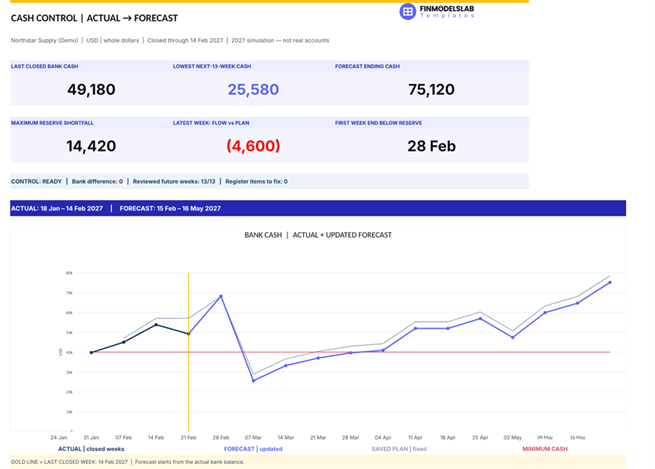
Figure 1. The cash-control dashboard makes the lowest forecast balance visible alongside the final balance. This is the original Northstar Supply teaching simulation from the supplied workbook, not client data.
2. Growth requires commitments before it produces cash
Hiring, building inventory, and opening another location involve decisions that cannot always be reversed cheaply. Working-capital requirements also matter: ACCA explains that extending customer payment terms can support sales while delaying cash and increasing funding needs. [6]
Before approving an expansion, I would want to see the cash requirement, the date it arises, and a slower-growth scenario. “We expect another $30,000 in monthly sales” is an assumption to test, not a spending authorization.
This is particularly relevant when the sales team can commit the company to delivery terms without anyone assessing the financial consequences.
3. You cannot explain which work is worth taking
Suppose two customers generate similar revenue. One places predictable orders and pays promptly. The other needs frequent revisions, small deliveries, and extended payment terms.
Compare the costs of serving each account, the capacity each consumes, and the cash each requires. Separate costs that disappear if the work stops from shared overhead that remains.
The assignment is then concrete: build a useful customer or product profitability view and establish how it will influence pricing and sales decisions.
4. A major financial decision is approaching
A loan application, acquisition, new investor, or substantial equipment purchase can justify a focused CFO engagement even when ordinary monthly operations are manageable.
Define the assignment around the decision: quantify the funding requirement, test repayment capacity, identify assumptions that could change the outcome, and prepare a model that management can explain.
A permanent retainer is not automatically necessary. Specify which work ends with the transaction and which responsibilities continue afterward.
In the same workbook demonstration, the weekly schedule separates operating cash, equipment payments, and financing. This is a cash-planning view; it is not the three-statement model discussed in the hiring example.
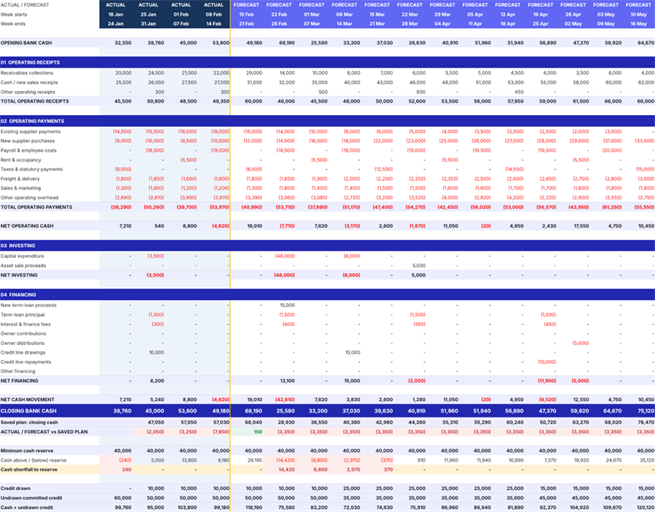
Figure 2. The original Cash Flow sheet shows when equipment payments and financing enter the bank balance. The first four dated columns are actuals; the following thirteen are forecasts. Open the image at full resolution to inspect the weekly figures.
5. Financial reviews produce reports but no follow-through
Look at the last three management meetings. Were decisions recorded? Did someone own the collection issue, pricing review, or spending change? Was the forecast updated when an assumption failed?
My test for CFO-level involvement is whether someone needs to coordinate those responsibilities across the business. Reporting alone is not the same assignment.
A worked example: Can the business afford two new employees?
Consider a fictional service company with monthly revenue of $160,000. Variable operating costs are 60% of revenue, leaving a 40% contribution margin. Existing fixed operating costs are $50,000 a month.
Two proposed hires would add $12,000 in fully loaded monthly employment costs. Management expects revenue to reach $190,000, but has not yet secured all the additional work.
The simplified scenarios below exclude interest and tax. Fixed costs include the operating overhead assumed in this example; no actual client results are represented.
| Monthly scenario | Revenue | Contribution after variable costs | Fixed operating costs | Operating result |
| Current business, before hiring | $160,000 | $64,000 | $50,000 | $14,000 |
| Hire both employees; sales unchanged | $160,000 | $64,000 | $62,000 | $2,000 |
| Hire both employees; growth achieved | $190,000 | $76,000 | $62,000 | $14,000 |
| Hire both employees; sales fall | $150,000 | $60,000 | $62,000 | −$2,000 |
After hiring, monthly break-even revenue is:
$62,000 ÷ 40% = $155,000.
This uses the standard contribution-margin break-even calculation: fixed costs divided by the contribution margin ratio. It assumes the stated cost behavior and service mix remain valid. [8]
At current sales, the business would have only $2,000 of monthly operating profit left. Growth to $190,000 would restore the previous $14,000 result, not increase it.
Now add an assumption that customers pay 45 days after invoicing while employees are paid monthly. The profit scenarios still do not tell the owner whether the first additional payroll is affordable. That requires a cash forecast with opening balances, collections, and payment dates.
I would compare hiring both employees immediately with a staged hire linked to contracted work. Test collection delays too, rather than assume that a sale and its cash receipt happen together.
A connected model helps organize that assessment. Financial Models Lab’s three-statement financial model connects operating and financing assumptions with projected income statements, balance sheets, and cash flows. It is a starting structure to adapt—not evidence that a particular hiring plan is affordable.
When a fractional CFO is not the right next step
The accounts need repairing first. A senior adviser can help scope the repair, but recurring advisory meetings should not replace reconciliations and reliable transaction records.
The problem has a clear endpoint. A one-off forecast, profitability review, or model rebuild may be better commissioned as a project. Agree on handover and training so the file remains usable afterward.
You need daily leadership. Where finance requires continuous team management, frequent executive decisions, or sustained transaction work, compare an employed finance leader or interim appointment with part-time support.
The owner is not ready to use the process. A forecast will not govern decisions if major commitments are made outside it and information arrives too late. Before hiring, agree on access to data, attendance at reviews, and responsibility for actions.
A business facing an immediate inability to meet essential payments should not wait for a standard onboarding timetable. The urgent cash position needs attention first.
What I would agree for the first 90 days
Treat the following as a proposed scope to adapt, not a promise that every engagement needs—or can complete—the same work.
| Period | Priority | Tangible output |
| First 30 days | Establish the financial starting point and immediate risks. | Reconciled opening position, cash forecast, outstanding information list, and review calendar. |
| Days 31–60 | Connect operating plans to financial consequences. | Forecast assumptions, profitability analysis, and scenarios for the decisions management is considering. |
| Days 61–90 | Make the process repeatable. | Management reporting pack, plan-versus-actual review, named action owners, and an agreed handover or ongoing scope. |
The dates should reflect the condition of the records and the urgency of decisions. A business with clean accounts may move quickly into analysis. Another may need substantial accounting work before its forecast deserves confidence.
A repeatable review also needs a saved comparison. In the workbook example, the closing-cash difference includes both the opening-balance difference and the cash-flow variance for the week.
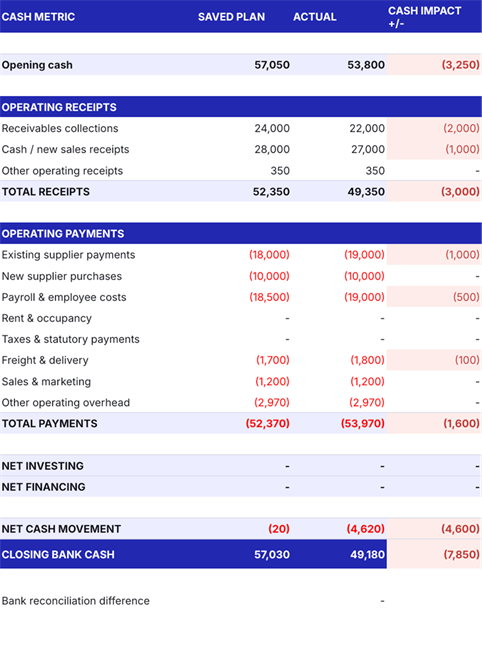
Figure 3. The Plan vs Actual sheet separates the week’s $4,600 cash-flow variance from the $7,850 closing-cash difference. Parentheses indicate negative amounts. The figures belong to the separate workbook demonstration.
Include access and ownership in the agreement: who maintains the model, who supplies operational data, who can approve payments, and what the business keeps when the engagement ends.
Connect the finance work to the company’s broader 12-month business growth roadmap. Hiring and expansion targets should have corresponding cost, capacity, and funding assumptions—not sit in a separate planning document.
How to choose a fractional CFO—and assess the fee
Ask the candidate to discuss one real decision your business faces. A useful discussion should expose missing information and explain how the work will support that decision.
Look for relevant operating experience. For your business, ask how the candidate would model its revenue, capacity, payment terms, and principal costs. A polished sample dashboard is less informative than an explanation of what would make its numbers unreliable.
Clarify who will do the work. Establish who prepares forecasts, who reviews them, and who attends management meetings. Ask about availability when an important decision falls outside the normal schedule.
Get a scoped quote. Compare onboarding, recurring analysis, meetings, transaction support, and any work excluded from the fee. Ask separately about bookkeeping cleanup, integrations, travel, and additional assignments. Do not compare two monthly fees until you understand what each includes.
I would assess progress against the agreed scope: forecast completion, explanation of significant variances, decisions supported, and actions completed. Cash balance alone is a poor scorecard because it can change through borrowing or an owner’s capital contribution.
Also distinguish a cash release from a profit improvement. Collecting an existing invoice earlier improves timing; it does not create a second sale. That distinction matters when evaluating claimed results.
The hiring decision in one question
Which important financial decisions are you currently making without enough visibility, and who should take responsibility for improving that?
The answer may be a better bookkeeping process, a focused modeling project, a controller, or recurring CFO support. Choose the smallest arrangement that can responsibly cover the work, with room to adjust as the business changes.
For owners who need help with this assessment, I provide financial modeling and fractional CFO support through Financial Models Lab, covering forecasting, cash-flow planning, profitability analysis, and management reporting. Advisory work is scoped separately from downloadable templates.
Frequently Asked Questions
At what revenue should a small business hire a fractional CFO?
I would not use revenue alone as the trigger. Assess the complexity, frequency, and consequences of decisions, alongside the capability already available. A stable business with straightforward operations may need less support than a smaller company managing inventory, financing, and uncertain collections.
Can a fractional CFO work with my existing accountant?
Yes. Scope the responsibilities together rather than assume a replacement is needed. Identify who owns the accounts, forecasting, reporting, tax work, and follow-up. Accountants can also provide management advice, so check what your existing engagement already covers. [3]
Can I start with a project instead of a monthly retainer?
That is a reasonable approach when the problem is defined. Commission the model, review, or decision analysis, specify handover requirements, and then evaluate whether recurring oversight is necessary. Outsourced CFO arrangements can cover temporary as well as ongoing needs. [1]
Will a financial model remove the need for a CFO?
A model can make a defined analysis repeatable. It does not decide whether the assumptions are credible or take responsibility for acting on the results. For a straightforward task, a trained owner or analyst may be enough; more complex decisions may require senior judgment.
About the author
Henry Sheykin is a co-founder of Financial Models Lab. His work includes financial modeling, budgeting, cash-flow planning, profitability analysis, and fractional CFO support. He helps business owners connect operating decisions with financial forecasts and management reporting.
Disclosure: The author has a commercial interest in Financial Models Lab and the products and services mentioned. The worked example is fictional and educational, not a client case study.
Sources
[1] BDO Canada. CFO & Controllership Services.
[2] U.S. Bureau of Labor Statistics. Bookkeeping, Accounting, and Auditing Clerks.
[3] U.S. Bureau of Labor Statistics. Accountants and Auditors.
[4] U.S. Bureau of Labor Statistics. Financial Managers.
[5] U.S. Securities and Exchange Commission. Beginners’ Guide to Financial Statements.
[6] ACCA. Working capital management.
[7] BDC. Plan your cash flow in the coming year.
[8] U.S. Small Business Administration. Break-even point.